
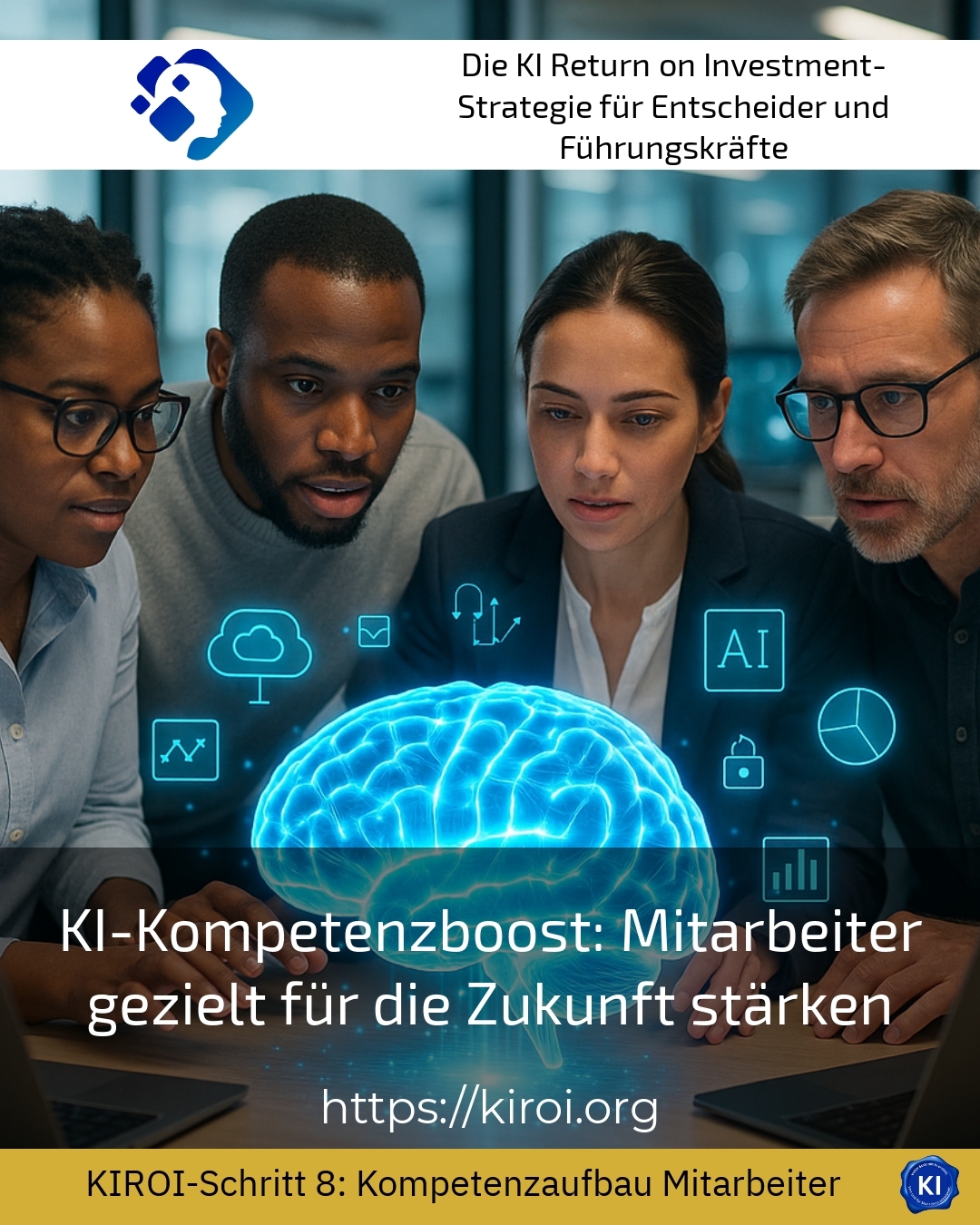
Will your company still be competitive in five years if your employees do not acquire the crucial digital skills today? This question is currently on the minds of executives in almost all sectors of the economy, because rapid technological development is changing jobs and business models at an unprecedented pace. The AI Skills Boost For employees, an optional additional benefit is no longer an option; it is a strategic necessity for forward-thinking organizations. Companies that now invest in the targeted development of their workforce secure crucial advantages in the competition for market share and qualified professionals. The challenge lies not only in imparting technical skills, but rather in a comprehensive cultural transformation that involves and empowers every individual employee.
Why the AI competence boost is essential for modern organizations
The digital transformation is advancing relentlessly and fundamentally changing the way we work, communicate, and conduct business. Studies by the World Economic Forum show that in just a few years, approximately 40 percent of all core competencies in existing professions will change [1]. This development not only affects technology-oriented industries, but is now permeating all sectors of the economy, from production to trade to services. Companies face the task of systematically preparing their employees for these changes and providing them with the necessary tools.
In manufacturing companies, for example, intelligent systems increasingly take on repetitive tasks of quality control, while employees increasingly assume monitoring and control functions. Retail companies use data-based predictive models to optimize their inventory and ordering processes, which places entirely new demands on the workforce. Even in healthcare, algorithm-based systems support diagnosis and treatment planning, allowing medical professionals to use their expertise in different ways.
The shortage of suitably qualified professionals further exacerbates the situation and forces companies to take action. Instead of relying solely on external recruitment, more and more organizations are recognizing the value of their existing workforce. These employees possess valuable industry and company knowledge that can be seamlessly integrated with new digital skills. Investing in the ongoing training of existing teams often proves more sustainable and economical than attempting to attract rare specialists to the competitive labor market.
Best practice with a AIROI customer
A medium-sized mechanical engineering company with about 800 employees faced the challenge of preparing its workforce for the increasing digitalization of production processes. The management had realized that traditional training formats were not sufficient to awaken the necessary willingness for change. In close collaboration with transruptive coaching, we developed a multi-stage program that initially involved management and then gradually included all departments. The employees not only received technical training, but were actively involved in designing new processes. Particularly noteworthy was the development of so-called „Digital Ambassadors“ from within the workforce themselves, who acted as multipliers and supported their colleagues in their daily work. After nine months, the management reported a significantly increased acceptance of new technologies and a noticeably improved collaboration between traditional manufacturing departments and the IT department. Productivity in pilot areas increased by about 15 percent, while the error rate decreased significantly.
Strategic approaches for a sustainable AI competence boost
The successful development of digital skills requires far more than isolated training measures or occasional workshops. Instead, organizations need a holistic approach that links individual learning paths, cultural changes, and strategic objectives together. An ideal starting point for such a program is an honest assessment of the existing skills and potential within the workforce. Based on this, differentiated development paths can be defined that meet the different starting situations and learning speeds of the employees.
In financial services companies, for example, the need to empower customer advisors in handling data-driven analytical tools becomes apparent. These employees must understand how algorithm-based recommendation systems work in order to provide their customers with competent advice. At the same time, they need critical thinking to recognize the limits of automated analysis and to specifically incorporate human judgment. In the logistics industry, for example, it often involves integrating route optimization systems and predictive maintenance solutions into existing workflows.
Retail is another example, where sales staff increasingly work with intelligent point-of-sale systems and personalized customer interactions. Employees must not only master the technical operation but also understand the underlying relationships. Only then can they answer customer questions competently and address privacy concerns appropriately. The combination of technical expertise and human empathy creates real value that purely automated systems cannot provide.
Individual learning paths as the key to success in AI competence enhancement
Each employee brings different qualifications, experiences, and learning preferences, which is why standardized unit-based training often fails to achieve the desired results. Modern competence development programs therefore rely on personalized learning paths that are tailored to the individual needs and the specific work context. Adaptive learning platforms can help determine the current level of knowledge and offer appropriate learning content in a meaningful sequence. However, these technological tools do not replace the human support provided by experienced coaches and mentors.
In architectural firms, for example, planning teams are increasingly using generative design tools that generate numerous design variants based on predefined parameters. Experienced architects require different learning approaches than newcomers, as they need to combine their long-term expertise with new possibilities. Similarly, in law firms, intelligent systems support document analysis and research. Here, it is necessary to combine legal expertise with a critical understanding of the possibilities and limitations of automated text analysis.
The advertising industry offers another illustrative example of the need for differentiated learning approaches. While creative directors must understand how generative systems can support idea generation, media experts require skills in using algorithmic optimization platforms. Project managers, in turn, need cross-disciplinary understanding to effectively coordinate teams with different specializations. A well-thought-out development program takes these different profile requirements into account and at the same time creates spaces for interdisciplinary exchange.
Best practice with a AIROI customer
A renowned communications agency with offices in several major German cities was looking for ways to empower its nearly 200 employees to work with data-driven creative tools. The initial skepticism within the team was considerable, as many creatives feared being replaced by automation. As part of the transruptions coaching process, we initially developed dialogue formats in which these fears could be openly addressed and constructively addressed. The employees gradually realized that the new technologies did not replace their creative work but could expand and enrich it. Particularly effective was the introduction of so-called „experimentation rooms“ where teams, without pressure to perform, could try out new tools. The agency reports today of a significantly increased sense of innovation and an improved competitive position in acquiring technology-savvy clients. Several employees have developed into internal experts and regularly share their knowledge in collegial learning formats.
The Role of Leaders in Competence Development
Leaders play a central role in the successful implementation of training initiatives, as they significantly shape the learning culture within their teams. Their attitude towards new technologies and continuous development directly impacts the willingness of their employees to embrace change. Therefore, it is advisable to understand leaders not only as drivers of training initiatives, but also as learners themselves. A leader who openly admits their own knowledge gaps and actively works on their own development sends a powerful signal to the entire team.
In the banking sector, for example, branch managers need to understand how automated systems take over routine tasks to prepare their teams for changing priorities. In hospitals, chief physicians face the challenge of integrating diagnostic support systems meaningfully into clinical workflows. This leadership task requires both professional and communication skills that can be specifically developed. Investing in the training of leadership is often a multiplier effect on the entire organization.
In the education sector as well, the importance of leadership skills in digital transformation is evident. School principals and university directors must not only understand digital tools themselves, but also create the conditions in which teachers can experiment and grow. Similarly, in cultural institutions such as museums or theaters, where artistic leadership and management must work together to develop digital strategies. The ability to integrate different perspectives and develop shared visions becomes a key competence in this context.
Create the cultural conditions for sustainable learning success
Technical training alone is not enough if the corporate culture does not promote experimentation and a tolerance for failure. Employees will only actively use new tools if they feel safe to try new things and are allowed to experience setbacks along the way. A learning-promoting culture is characterized by psychological safety, open exchange of knowledge, and recognition of developmental progress. Creating these cultural foundations often requires more time and attention than the actual delivery of technical content.
In the automotive industry, for example, traditional hierarchies and perfectionist demands have long made experimental approaches difficult. Companies that successfully build digital competencies consciously establish spaces for agile work and rapid prototyping. In the trade, on the other hand, it is important to combine appreciation for proven expertise with openness to digital additions. Here, for example, experienced masters can, together with technically-minded apprentices, try out new tools and learn from each other.
The hospitality industry offers interesting examples of cultural change in rather traditional settings. Restaurants and hotels are increasingly integrating digital booking and management systems, which is often initially viewed critically by long-standing employees. Successful establishments manage to emphasize human hospitality as a core value and position digital tools as support. This combination of tradition and innovation is best achieved when all parties are involved in the design process.
Best practice with a AIROI customer
A traditional family-run food processing company with over 100 years of history faced the challenge of training its approximately 450 employees in data-driven production control. The workforce was characterized by great loyalty and pride in artisanal traditions, but at the same time was skeptical of perceived changes as threatening. As part of the transruptive coaching process, we developed a narrative that presented tradition and innovation not as opposites but as complementary values. The introduction of new technologies was consistently communicated as a tool for securing and advancing the family business. The involvement of long-standing employees who were experts, whose expertise was indispensable for calibrating automated systems, proved particularly effective. This appreciation led to a significantly increased willingness to embrace new things and actively participate in training initiatives. Today, the company is experiencing measurably higher product quality while simultaneously reducing waste rates.
Practical implementation and proven formats
The specific design of qualification measures should be based on the principles of workplace-based learning to ensure the most direct transfer to daily practice. Traditional seminar formats, which involve employees leaving their work environment for several days, often prove less effective than continuous learning impulses in the workplace. Modern approaches therefore combine short learning units, peer mentoring, and guided experimentation into a well-thought-out overall concept. The integration of digital learning platforms enables flexibility while ensuring a clear understanding of the learning progress.
In insurance companies, for example, so-called „learning circles“ have proven to be effective; these are small groups that meet regularly to explore new tools together. Accounting firms are increasingly relying on „shadowing“ programs, in which more technically skilled colleagues accompany employees in their work and learn directly from them. Media companies are experimenting with „innovation labs“ where interdisciplinary teams develop new skills on concrete projects. All of these formats share a close connection between learning and application.
The energy sector offers interesting examples of large-scale qualification initiatives in the context of digital and ecological transformation. Technicians are trained to work with intelligent grid control systems, while customer advisors learn how to use complex tariff optimization tools. The challenge lies in reaching employees from different generations and with different initial knowledge levels alike. Successful programs create differentiated entry points and enable individual learning speeds.
My AIROI Analysis
The systematic development of digital competencies among the workforce represents one of the central leadership tasks of our time, whose importance will continue to increase in the coming years. Organizations that today invest in comprehensive digital training will be more competitive in the future. AI Skills Boost By investing, companies create the foundation for sustainable competitiveness and at the same time secure the employment prospects of their employees. This is not primarily about imparting specific technical skills that may already be outdated in a few years. Rather, it is about fostering fundamental learning capabilities, adaptability, and a critical understanding of technology that enable employees to successfully manage future changes.
The experiences from numerous mentoring projects show that successful transformations always rely on three pillars: a clear strategic direction, a learning-promoting culture, and individually tailored development measures. None of these pillars can replace the others, and the attempt to conduct competence development without cultural foundations regularly leads to disappointments. Transruptions-coaching can provide valuable guidance in this regard by helping to identify blind spots, constructively address resistance, and design sustainable change processes. The investment in the targeted development of one’s own employees is ultimately an investment in the future viability of the entire organization, which has been proven time and again to pay off.
Further links from the text above:
[1] World Economic Forum – The Future of Jobs Report
For more information and if you have any questions, please contact Contact us or read more blog posts on the topic Artificial intelligence here.






 Deutsch
 English (UK)