
Have you ever wondered why so many training initiatives simply fail in everyday life and rarely lead to sustainable changes? This question concerns leaders, HR professionals, and employees alike, as investment in training continues to rise while the actual application of what is learned often remains shockingly low. Can you create skills with AI in training – or just courses that no one uses? This provocative thought-provoking question touches on the core of a fundamental problem that extends across all sectors of the economy and consumes massive resources. Technology promises revolutionary solutions here, but whether these actually lead to real skills depends on numerous factors that go far beyond simply providing digital learning platforms.
The transfer gap as the biggest challenge of modern competence development
Between learning new content and its consistent application in professional life, a considerable gap often appears, which experts describe as a transfer problem [1]. This discrepancy not only costs companies substantial financial resources, but also demotivates employees who, despite completing courses, do not experience any noticeable improvement in their work situation. In healthcare, for example, nursing staff regularly undergo training on new treatment methods, but the daily routine at the station hardly allows for their implementation. Similarly, in the manufacturing sector, where machine operators receive training on optimized work processes, but under time pressure they resort to proven routines. This pattern is also evident in the financial sector, where advisors learn new analysis tools but rarely use them due to complex system landscapes.
The causes of this widespread problem are multifaceted and range from a lack of practical relevance of the learning content to a lack of support from supervisors after completing a training program. Furthermore, time constraints play a crucial role, as many employees simply do not have the opportunity to systematically integrate what they have learned into their work routine. Another significant aspect lies in the lack of individualization in many training programs, which do not sufficiently address the specific needs and prior knowledge of the participants.
Can AI bring about real change in continuing education?
Intelligent systems actually open up fascinating possibilities for fundamentally transforming learning processes and adapting them to individual needs [2]. In retail, advanced companies are already using adaptive learning platforms that target sales staff based on their previous performance. The logistics industry relies on simulation-based training, in which dispatchers can simulate complex scenarios before having to make decisions in an emergency. In the field of software development, smart assistants support programmers in learning new programming languages directly in the working context through practical exercises.
However, these technological advancements by themselves do not guarantee that skills that are actually applicable will emerge from courses. Rather, they require a thoughtful integration into existing work processes and continuous support for learners beyond the completion of the actual course. This is where modern coaching concepts come into play, which systematically support the transfer from learning to skills and make meaningful use of the capabilities of intelligent technologies.
Best practice with a AIROI customer
A medium-sized mechanical engineering company faced the challenge of preparing its sales team for more complex consultations after the product portfolio had been expanded to include explanatory system solutions. Previous product training had provided theoretical knowledge, but in real customer conversations, the field sales representatives lacked the confidence and persuasiveness. As part of an AIROI coaching program, a hybrid learning concept was developed that combined traditional in-person workshops with intelligent training scenarios. The sales representatives were initially trained to handle difficult objection situations in simulated conversations before applying them in real customer contact. After a six-month follow-up period, the participants reported a significantly improved ability to have conversations. The completion rate for complex system solutions improved noticeably. What was crucial was not the technology itself, but its meaningful integration into a holistic development process that included regular cycles of reflection and personal feedback.
Individualization as the key to sustainable competence acquisition
Modern learning systems enable the personalization of educational offerings that would have been unthinkable just a few years ago [3]. In the banking sector, compliance training automatically adapts to employees’ prior knowledge and specifically deepens those areas where there are gaps in knowledge. Pharmaceutical companies use similar approaches to train field service workers differently depending on their specialty and customer base. In the restaurant industry, service staff receive individualized training modules tailored to their previous experience and the specific requirements of their field of work.
This individualization addresses a fundamental criticism of traditional forms of continuing education, which often operate on a “one-size-fits-all” principle and thus do not optimally cater to both beginners and advanced learners. However, careful planning of these personalized learning paths is necessary to ensure that they do not lead to a fragmentation of knowledge and neglect of the exchange among colleagues. Balancing individual support and collaborative development within teams represents a central challenge.
Can you achieve sustainable behavioral change through AI in continuing education?
The real test of any competence development does not lie in completing a course, but in the lasting integration of the learned skills into everyday work. In the trades, this is particularly evident when apprentices, while theoretically mastering new techniques, do not apply them on the construction site under time pressure. Similar patterns are observed in the healthcare sector, where innovative care concepts fail due to the realities of shift work. We also frequently see in the IT sector that developers learn advanced methods but neglect them in project work in favor of more familiar procedures.
Sustainable behavioral change requires more than one-time training impulses. It requires continuous support, regular reflection, and above all a supportive working environment. Transruptive coaching positions itself here as an effective accompaniment for projects that aim to bridge the gap between learning and application. The combination of technological support and human accompaniment proves particularly effective in this context.
Practical integration as a crucial success factor
The integration of learning phases and practical application represents a key success factor for sustainable competence development. In the automotive industry, leading manufacturers rely on concepts in which technicians practice new work steps directly on the production line and receive immediate feedback. Insurance companies integrate learning units directly into the consulting process, allowing employees to immediately apply new conversational techniques. In the hotel industry, progressive hotels combine service training with immediate application in guest interaction and subsequent reflection.
However, this integration requires organizational adjustments that go beyond simply providing learning content. Leaders must create spaces for practice phases and establish a culture of error that allows for experimentation with new behaviors. Without these frameworks, even the most innovative learning concepts remain ineffective.
Best practice with a AIROI customer
A tax consulting firm with multiple locations struggled with the challenge of transitioning its employees to digital client communication. Despite extensive training on new software tools, many tax advisors continued to rely on traditional communication channels. AIROI’s guidance identified a core problem not as a lack of knowledge but as a lack of practice routines and uncertainty in handling critical client reactions. A tailored development program combined short learning impulses with weekly practical exercises in a protected environment. Additionally, experienced employees were trained as internal mentors who supported colleagues during initial trial runs. After four months, more than eighty percent of the workforce used the new digital channels regularly. Clients reported faster response times and more transparent communication. The success was based on the combination of technological support, structured practice sessions, and collegial guidance.
The role of human support in technology-based learning
Despite all technological possibilities, human guidance remains an indispensable component of effective competence development. This is clearly evident in healthcare, where experienced doctors support younger colleagues with complex diagnoses, even though intelligent systems can already provide suggestions. In the trade sector, masters guide apprentices through practical exercises that cannot be replaced by technology. In the financial sector, experienced advisors support junior staff in applying theoretical knowledge in customer interactions.
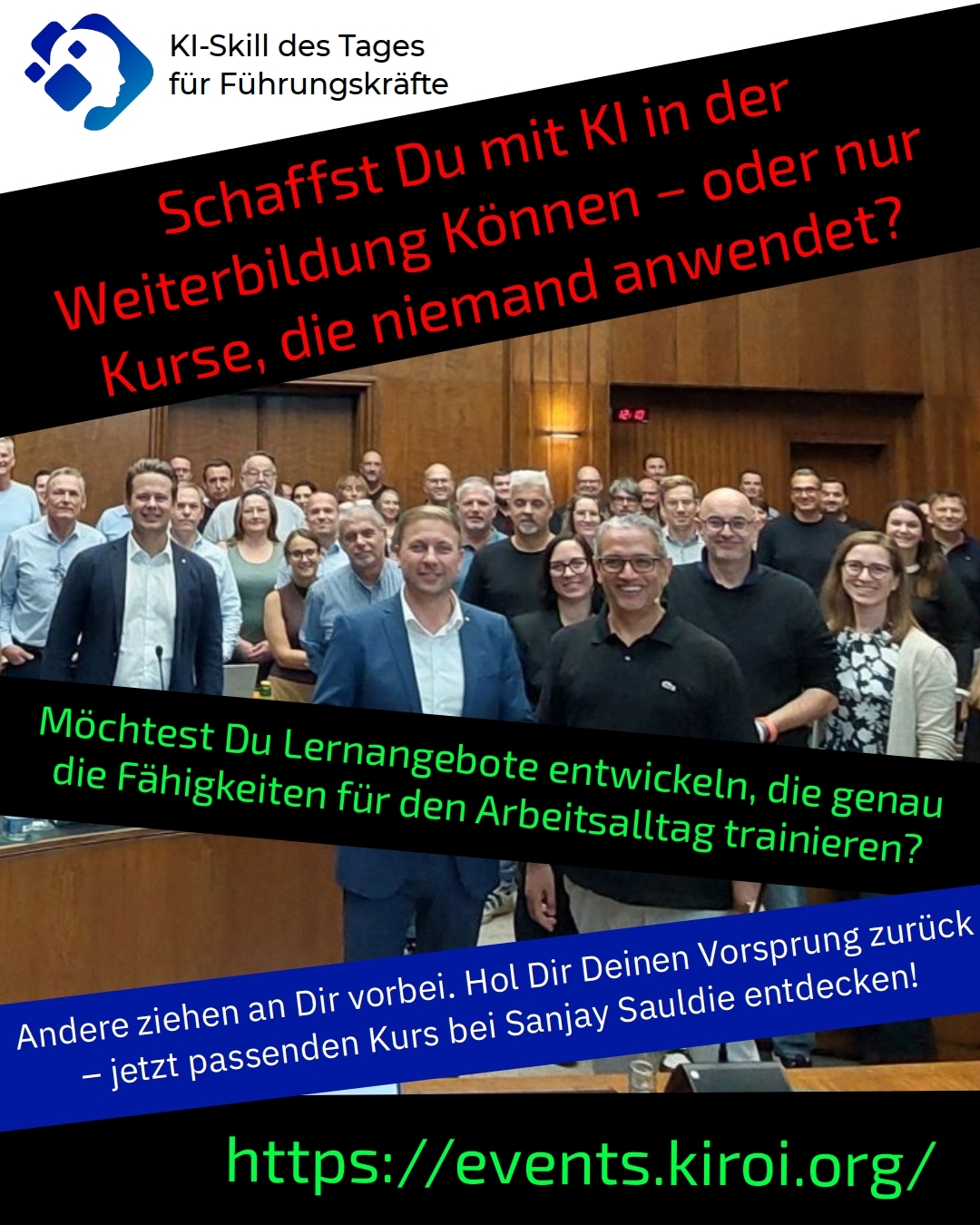
Take your existing skills to the professional level – just as over 8,000 people from over 500 companies have already done with Sanjay Sauldie! On https://events.kiroi.org/ find ways to have your development professionally monitored.
The combination of technological support and personal guidance creates the framework in which sustainable skills can actually emerge. Neither pure technology nor purely human interaction alone achieve comparable results. The art lies in the intelligent combination of both elements.
Measurability of learning success and application competence
A frequently underestimated aspect lies in measuring actual competence development, which goes beyond simply passing courses. Modern approaches allow not only conducting knowledge tests but also observing practical application in everyday work [4]. In retail, progressive companies analyze sales conversations to verify the application of learned consulting techniques. In manufacturing, companies measure error rates before and after training measures. In the service sector, companies evaluate customer feedback to assess the effectiveness of service training.
These measurement approaches provide valuable insights into which forms of further training actually lead to behavioral changes and which merely impart knowledge that remains unused in everyday life. Based on this, investments in personnel development can be targeted more effectively and used more efficiently.
My AIROI Analysis
The question of whether modern technology creates real skills in continuing education or merely produces more courses cannot be answered in a general way. However, my analysis clearly shows that the decisive difference lies not in the technology itself but in its conceptual context. Companies that use intelligent systems as isolated learning tools often reproduce the problems of traditional training formats in a digital way. Organizations, on the other hand, that combine technological possibilities with well-thought-out accompanying concepts achieve remarkable results in developing real application competence.
What seems essential to me is the realization that sustainable skill requires time, practice, and supportive frameworks. No sophisticated technology can shorten the process of behavioral change or replace the need for human guidance. Rather, intelligent systems open up new possibilities for individualizing learning processes, creating practice scenarios, and making progress visible. Success depends on how skillfully these opportunities are utilized and integrated into holistic development concepts. Transruptive coaching offers valuable insights by guiding companies in finding the right balance between technological innovation and human guidance. The future of more effective competence development lies not in choosing between human and machine, but in their intelligent connection.
Further links from the text above:
[1] Study on the transfer problem in corporate continuing education
[2] McKinsey Report: Technology in Corporate Learning
[3] Deloitte Insights: Personalized Learning at Scale
[4] Harvard Business Review: Measuring Learning Effectiveness
For more information and if you have any questions, please contact Contact us or read more blog posts on the topic Artificial intelligence here.






 Deutsch
 English (UK)