
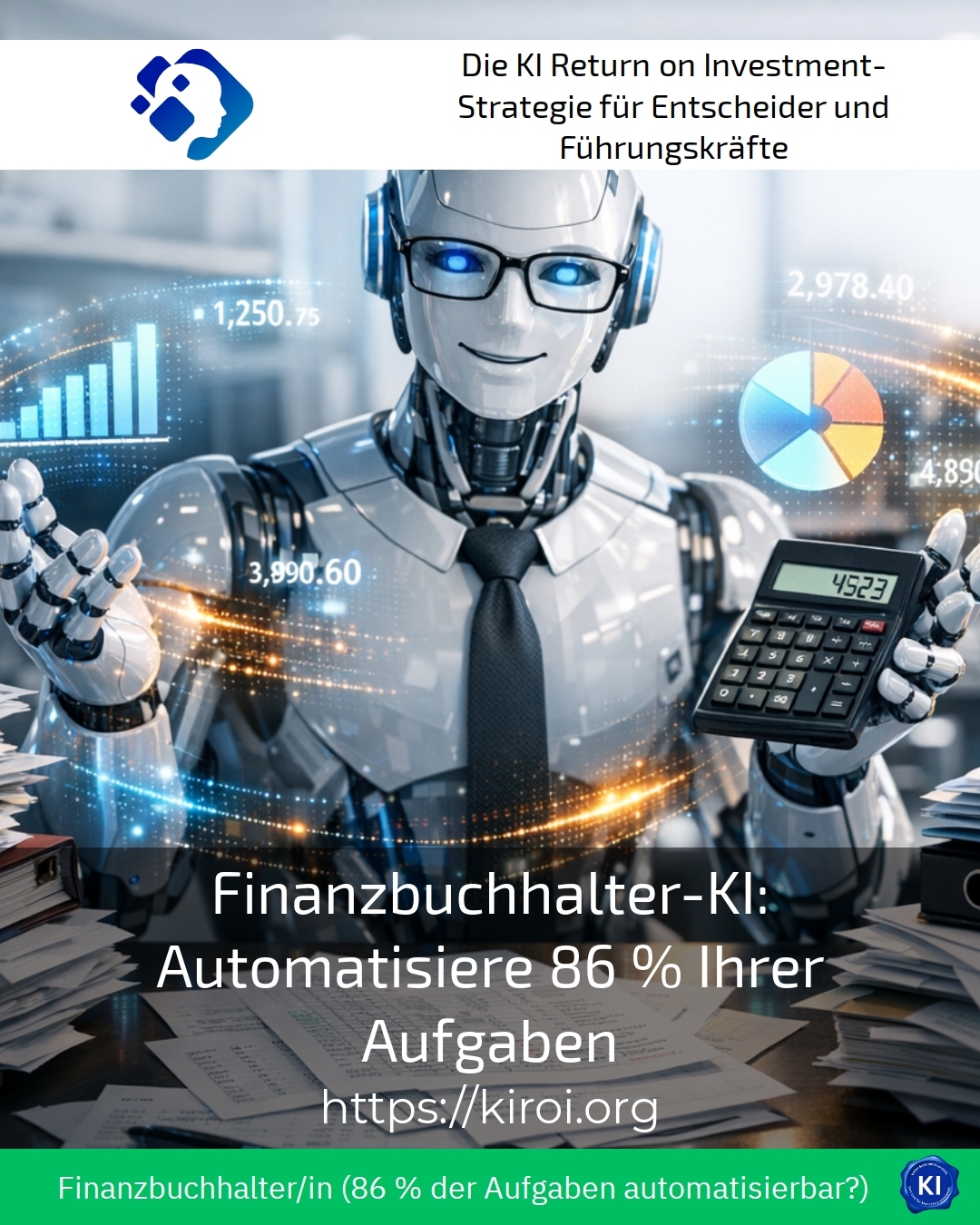
Have you ever wondered why your colleagues in accounting are still drowning in spreadsheets and data columns despite the latest software, while other companies have already radically streamlined their processes? The answer to this question lies in a technological revolution that has just begun and is fundamentally changing the way we think about data processing and accounting. According to the Job Future Report of the Institute for Employment Research, as many as 86 percent of typical tasks in this field of work can already be handled by intelligent systems [1]. Financial accounting AI It is at the heart of this transformation and offers companies enormous opportunities to use their resources more efficiently. What does this mean in concrete terms for you, your team, and the future of your organization?
Understanding the digital transformation in accounting
Accounting is currently undergoing a transformation that can only be compared in scope with the introduction of the first spreadsheet programs. Intelligent systems are increasingly taking on repetitive tasks. This includes, for example, the automatic recognition and recording of incoming invoices. The recording is based on historical booking patterns. Even the reconciliation of bank accounts with open items is now largely automated. Even the creation of monthly statements is accelerated through algorithmic support.
A medium-sized trading company receives hundreds of supplier invoices every day. Previously, clerical staff had to sort through each invoice individually and manually record them. Today, intelligent systems automatically identify the suppliers and invoice items. They assign the correct accounts to them and create booking proposals. The employees only check for exceptions and release the batch booking. In payroll accounting, algorithms calculate allowances and deductions in seconds. Compliance with wage regulations is automatically monitored. Communication with social security authorities is also increasingly taking place digitally.
Best practice with a AIROI customer
An internationally operating manufacturing company faced the challenge of modernizing its accounts payable system while freeing up personnel for strategic tasks. The company received over three thousand incoming invoices from suppliers in various countries each month. Manual entry of these invoices took up significant human resources and frequently led to delays in payment processing. As part of a transruptive coaching project, we supported the implementation of an intelligent document processing solution. Today, the system automatically recognizes invoice numbers, amounts, and tax information. It reconciles incoming invoices with orders and incoming goods. In the event of discrepancies, the system automatically generates clarification requests to the relevant departments. The turnaround time for incoming invoices decreased from an average of eight days to less than two days. The freed up staff is now focusing on supplier negotiations and cash flow optimization. Clients often report that employee satisfaction has increased significantly as a result of the relief from monotonous tasks.
Financial accounting AI and the redesign of workflows
The automation by a Financial accounting AI This by no means signifies the end of human expertise in the field of numbers. Rather, the focus shifts from performing tasks to analyzing them. The interpretation of key figures gains in importance. Consulting with management and specialist departments takes center stage. Strategic liquidity planning becomes the core business of financial specialists.
Let’s consider a concrete scenario from the services sector. An auditing firm uses intelligent analysis tools to pre-screen client documents. The system automatically identifies unusual booking patterns and account movements. It highlights potential areas of risk for manual review. This allows auditors to focus on the truly critical aspects. In tax consulting firms, algorithms create draft tax returns. They take into account current case law and tax planning options. The advisors review the proposals and discuss optimization potential with their clients.
An example from retail illustrates further areas of application. Cash register systems generate extensive transaction data daily. Intelligent systems analyze this data and generate automatic daily reports. They detect differences between target and actual inventory levels. They forecast sales trends for the coming weeks. Controlling receives meaningful reports without manual data preparation.
Practical insights for the integration of financial accounting AI
The successful integration of intelligent systems requires a thoughtful approach. First, you should carefully analyze your current processes. Which activities consume the most time? Where do errors or delays often occur? What data already exists in digital form? These questions form the foundation for a targeted automation strategy.
For example, a construction company can start digitizing its construction site invoices. Time sheets are recorded digitally and automatically reconciled with project budgets. Material and equipment costs are entered into the project calculation in real time. The construction management receives immediate information about budget deviations. In the hotel industry, automated billing processes for reservations and ancillary services are available. The accounting system processes booking data directly from the property management system. Payment entries are automatically associated and recorded. The collection process runs largely without manual intervention.
Best practice with a AIROI customer
A mid-sized corporate group with several subsidiaries was looking for ways to simplify and accelerate its group consolidation. The monthly aggregation of individual financial statements previously required significant manual effort. Intercompany reconciliations regularly took several days. As part of our support, we jointly developed a structured implementation plan for an intelligent consolidation solution. Today, the system automatically recognizes Intercompany transactions based on defined criteria. It reconciles receivables and payables between the group companies. In the event of discrepancies, it generates automatic clarification requests to the affected companies. The consolidation, which previously took a week, is now completed within two days. The finance department now uses the time gained for in-depth analyses and strategic planning. Clients in comparable projects often report a significantly improved data quality and increased transparency regarding corporate developments.
Challenges and solutions for implementation
The introduction of intelligent systems in accounting brings typical challenges. Many employees initially fear the loss of their jobs. This concern is understandable and should be taken seriously. Open communication about the goals of automation is crucial. The qualification for new job fields must begin early. This way, the transformation is perceived as an opportunity rather than a threat.
Technical hurdles can also arise. Existing accounting software must be compatible with new components. Interfaces to pre-existing systems must be defined and implemented. The data quality in historical records affects the learning capabilities of intelligent systems. For example, a pharmaceutical company faces special requirements regarding traceability and validation. Intelligent systems must meet strict regulatory requirements in this area. In the food industry, similar requirements apply to batch tracking. The integration of intelligent accounting systems must take these industry-specific requirements into account.
In the public sector, specific requirements arise from budgetary law. Chambered accounting requires specific adjustments to the automation logic. The separation of budgetary and budget responsibility must be reflected at the system level. Intelligent systems can help to ensure compliance with procurement regulations and monitor them.
The role of financial accounting AI in different company sizes
Small businesses benefit especially from cloud-based solutions with integrated intelligence. These do not require extensive IT resources for implementation and operation. A craft business can, for example, create offers and invoices digitally. The system automatically monitors payment entries and generates reminders. The VAT return is generated at the touch of a button. The owner receives up-to-date reports on business development on their smartphone.
Medium-sized companies often combine different automation components. The debtor accounting department of a wholesaler processes thousands of customer orders daily. Intelligent systems automatically check credit limits and payment histories. They propose optimal delivery conditions and discount guarantees. In the asset accounting department, algorithms calculate depreciation using various methods. They monitor useful lives and identify depreciation needs. The inventory is automated by linking it to RFID systems.
Large companies rely on comprehensive platform solutions with extensive automation. Shared service centers consolidate accounting functions for different corporate entities. Intelligent systems standardize processes across borders. They take into account local accounting regulations and tax laws. Treasury management systems optimize liquidity and currency risks in real time.
Best practice with a AIROI customer
A rapidly growing e-commerce company faced the challenge of scaling its accounting with the growth of the business without having to add proportionally more staff. The transaction volume had tripled within two years, while the finance department had grown only slightly. As part of the transruptions coaching, we first analyzed all the interfaces between the sales platform and accounting. Together, we developed an automation strategy that was implemented gradually. The intelligent system now automatically processes all orders from various sales channels. It calculates country-specific sales tax rates for international deliveries. Returns are automatically detected and corresponding credits are created. The integration with payment service providers enables the automatic assignment of payment entries. The company was able to continue its growth without significantly increasing its finance department. Employees are now focusing on controlling and business analysis instead of data collection. Clients often report that this shift in focus leads to more valuable insights for business management.
My AIROI Analysis
The analysis of current developments in the field of intelligent automation of accounting activities reveals a differentiated picture with considerable room for design for companies of all sizes. The automation level of 86 percent determined by the Institute for Employment Research illustrates the enormous potential that lies in optimizing financial processes. At the same time, this value underscores that certain core activities will continue to require human expertise and judgment.
The successful integration of an Financial accounting AI In existing organizational structures, more than just technical implementation is required. It requires comprehensive change management that involves and empowers employees. It requires a clear vision of how the acquired capabilities should be used for value-adding activities. It requires a realistic assessment of the necessary investments and implementation timelines.
Companies that now begin to systematically analyze their financial processes and prepare for automation will achieve a sustainable competitive advantage. The quality and timeliness of financial information is increasingly becoming a strategic differentiator. At the same time, the relief from routine tasks allows for a stronger focus on analysis and consulting. Transruptive coaching can accompany you in this transformation and provide valuable insights for shaping your individual path.
Further links from the text above:
[1] Job-Futuromat of the Institute for Employment Research
For more information and if you have any questions, please contact Contact us or read more blog posts on the topic Artificial intelligence here.









 Deutsch
 English (UK)