
Have you ever wondered why your company is investing millions in digitalization but the hoped-for breakthrough is not happening?
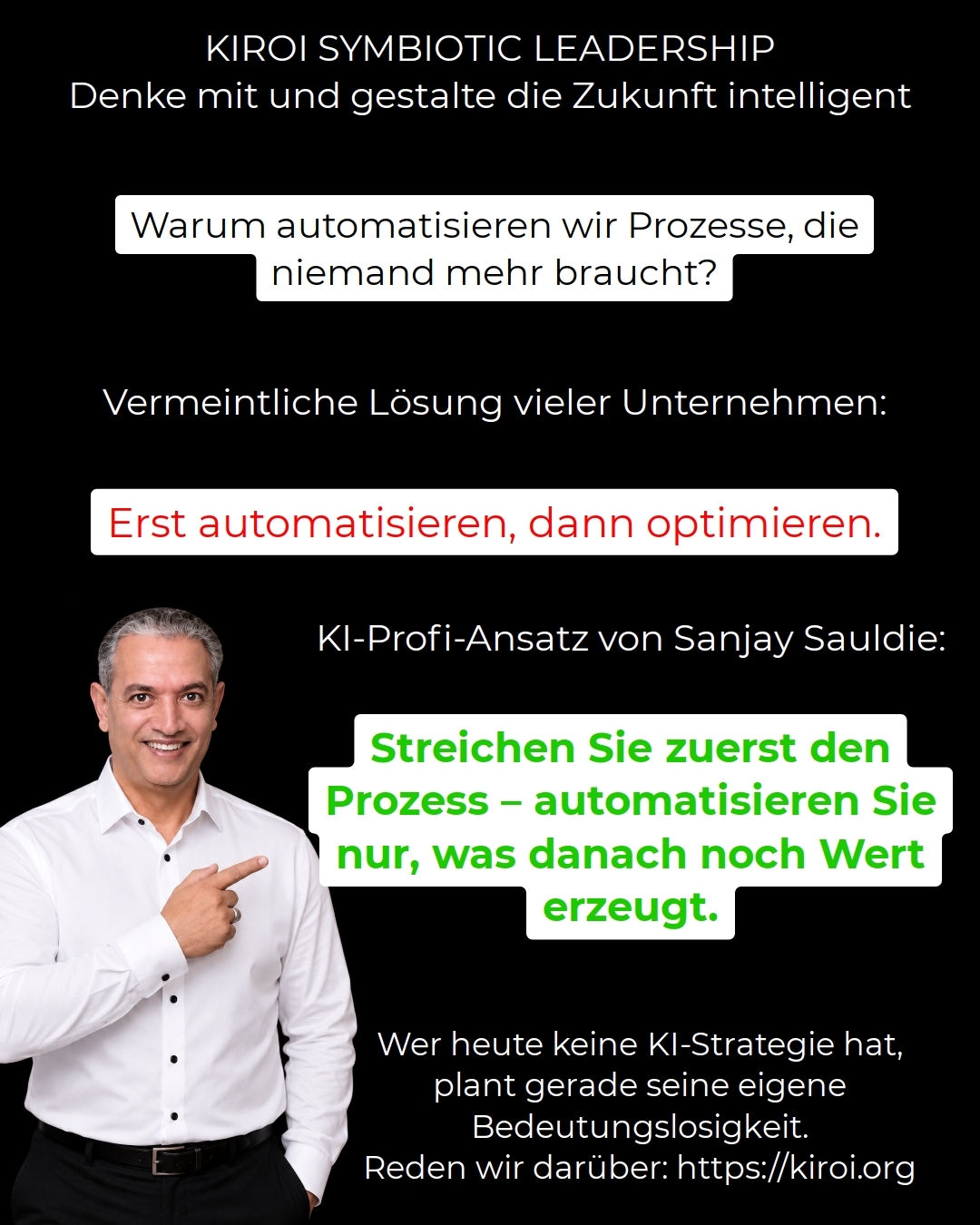
This question currently concerns countless decision-makers in organizations worldwide. They face a paradoxical phenomenon that runs like a red thread through the modern business world. High-tech digital solutions for processes are being developed everywhere, which in their original form should long ago have become obsolete. The AIROI strategy Here, it offers a radically different approach because it asks the fundamental question of whether a process even should exist. Instead of blindly automating everything, this approach requires a critical examination of every single step. Companies invest considerable sums in technology without first analyzing whether the underlying activities actually create any added value. The result is often elegantly programmed systems that ultimately produce only digital clutter.
The dilemma of the average organization: First automate, then optimize
In most organizations, digital transformation follows a predictable pattern. First, managers identify existing manual tasks that appear time-consuming. Then, they assign internal or external professionals to develop automated solutions. This approach sounds reasonable and logical at first, but it contains a fundamental fallacy in thinking. No one questions whether the activity itself still makes sense or whether it has long since become obsolete.
A typical example can be found in the handling of internal approval processes that have evolved over time. Many organizations have established multi-stage approval processes that were originally intended for control and compliance. Over the years, these processes have become increasingly complex, without anyone questioning their fundamental usefulness. Now that such an approval process is being automated, the throughput time has indeed increased significantly. However, the core problem remains untouched, because the process may no longer be needed at all.
The consequences of this approach are far-reaching and costly at the same time. Companies invest valuable resources in maintaining and managing automated processes that do not generate any real added value. Employees spend their time using digital systems instead of focusing on value-adding activities. The organization may be more efficient in what it does, but it continues to do the wrong things. This state of affairs can be compared to a car that is driving faster and faster but is going in the wrong direction.
Best practice with a AIROI customer
A medium-sized company had developed an elaborate system over the years to record working hours. Each employee had to prepare detailed reports on their activities daily and submit them for approval. The management initially decided to fully digitize this process using a modern software solution. However, after implementation, it turned out that the data captured was hardly analyzed. As part of a transruptive coaching, the team, together with AIROI consultants, analyzed the entire process from scratch. The result was surprising and at the same time sobering at the same time. More than seventy percent of the captured information was never used or analyzed. The original purpose of time tracking, namely project costing, could be achieved with a fraction of the data. The company subsequently completely scrapped the bulk of the process and only automated a slim remaining process. The savings amounted to several hundred thousand euros annually, because employees were able to work productively again.
The AIROI strategy: Eliminating unnecessary tasks as a fundamental principle
The AIROI approach It differs fundamentally from conventional digitization strategies through its radical premise. Before even a single line of code is written, every process must undergo critical scrutiny. The central question is not how to automate a process, but whether it should even exist at all. This perspective requires courage and the willingness to fundamentally question established structures. Only activities that generate verifiable value after this review are considered for automation.
The practical implementation of this strategy begins with a comprehensive review of all existing processes. Workshops and analysis sessions document and categorize all processes based on their actual contribution to value creation. It is often revealed that a significant proportion of daily routines have grown organically over time and no longer provide measurable benefits. These findings can initially be uncomfortable, as they challenge established habits and responsibilities. But this is precisely where the transformative potential of the AIROI approach lies, offering guidance in such change projects.
Another example illustrates the effectiveness of this methodology in the field of internal communication. Many organizations have established complex reporting systems in which information is prepared and forwarded multiple times. While automating such reporting chains can reduce manual effort, it does not eliminate the fundamental inefficiency. When reports are created that no one reads or that do not influence decisions, then even the automated version wastes valuable resources. The AIROI strategy would first ask which reports are actually read and used before any form of digitalization begins.
Practical application of the AIROI strategy in everyday life
Implementation requires a systematic approach that involves all stakeholders and creates transparency. In the first step, all recurring activities are captured and documented in a structured overview. Subsequently, an interdisciplinary team evaluates each individual process based on clear criteria such as customer benefit, compliance relevance, and strategic importance. This evaluation leads to a classification into three categories: immediately delete, retain, and automate, or retain in manual form.
Experience from numerous projects shows that on average between thirty and forty percent of all processes fall into the first category. This finding is at first surprising because it reveals the extent of organizational inefficiency. At the same time, it opens up enormous potential for real improvements and cost savings. Employees often report a noticeable relief when unnecessary activities are eliminated. They can finally focus on the things that are truly important and make a difference.
Best practice with a AIROI customer
Over the years, a large organization had developed an extensive system for documenting meetings. Each meeting was recorded, the records were archived and sent to defined distribution lists. The original intention was to create transparency and make decisions more comprehensible. However, as part of an AIROI project, it turned out that less than ten percent of the records were ever consulted again. Most ended up unread in digital archives, using up significant storage resources. The transruptions coaching team accompanied the team in redesigning the entire documentation system. Together, the participants developed a streamlined system that only retains strategically relevant decisions. The time savings for all employees amounted to several hours per week, which were now available for productive work. Additionally, storage costs were significantly reduced because less unnecessary data was produced and archived.
Overcoming the psychological hurdles in implementation
The biggest obstacles to the application of AIROI strategy These changes are often not of a technical nature but rather human in nature. Established processes are often closely linked to personal responsibilities and competencies. When a process is cancelled, it can trigger uncertainty or even resistance among those responsible. They question whether their work has been pointless so far or whether their position within the organization is at risk. These concerns must be taken seriously and actively addressed so that the transformation can succeed.
Open communication about the goals and benefits of change is therefore essential for success. Leaders should make it clear that the goal is not to make employees redundant or to downgrade their previous work. Rather, it is about freeing valuable human capacities from pointless routines and using them for more meaningful tasks. This perspective can significantly increase acceptance of change and reduce resistance. Insights from transruptive coaching support leaders in sensitively guiding such change processes.
A third example from practice shows how such resistance can be successfully overcome. In one company, a complex approval process for purchases existed that had to go through several hierarchical levels. The employees in the relevant department were initially skeptical about the changes because their work was questioned as a result. However, as part of the AIROI project, they were given the opportunity to actively participate in the redesign and to contribute their own ideas. This involvement led them to recognize for themselves which steps were unnecessary and could be scrapped. In the end, they not only embraced the change but became active advocates of the new, leaner system.
Long-term benefits of the AIROI strategy for organizations
The consistent application of this approach leads to sustainable improvements on several levels at the same time. First, the costs for developing and maintaining automated systems drop significantly because fewer processes need to be digitized. At the same time, the quality of the remaining automations increases because they focus on value-adding activities. Employees experience their work as more meaningful and fulfilling, which has a positive impact on motivation and commitment. The organization as a whole becomes more agile because it is free from unnecessary overhead and can react faster to changes.
Another important aspect concerns the quality of data and the reliability of analyses within the organization. When less, but more relevant data is collected, the basis for informed decisions improves significantly. Executives receive clearer insights into the actual performance of their departments and can steer more purposefully. The risk of erroneous decisions due to misleading or unnecessary information decreases noticeably. This improvement in decision quality has a positive long-term effect on the overall success of the organization.
Best practice with a AIROI customer
An internationally operating company faced the challenge of modernizing and digitizing its extensive reporting system. The original plans envisioned the introduction of an expensive business intelligence system that would automatically generate all existing reports. However, as part of an AIROI project, it was first analyzed which reports were actually used for decision-making. The result was sobering, because more than half of all reports never led to concrete actions [1]. This realization led to a fundamental realignment of the entire project and the project strategy. Instead of fully implementing the planned system, the company decided on a significantly leaner solution. This focused exclusively on the reports that were demonstrably influential on business decisions. The savings in implementation costs amounted to several million euros over a five-year period. At the same time, user acceptance of the system improved significantly, as it provided them with relevant information.
My AIROI Analysis
The consideration of numerous transformation projects leads to a clear conclusion regarding the causes of failures in digitalization. The most common mistake lies not in choosing the wrong technology or in the lack of technical expertise among the participants. Rather, projects fail because they ask the wrong questions and therefore solve the wrong problems. The question should never be how to automate an existing process without questioning its fundamental usefulness. Instead, every organization must first determine which of its activities still generate value and which are merely historical baggage.
The AIROI strategy It offers a structured framework for this fundamental examination and the resulting decisions. It requires courage because it fundamentally challenges established structures and established habits. At the same time, it opens up potential that conventional digitization approaches could never achieve. Organizations that take this path often report a noticeable improvement in their agility and innovation capabilities [2]. They are better able to focus on the essentials and deploy their resources where they bring the greatest benefit.
Accompanying experienced partners can be crucial to success because change processes are complex. External perspectives help identify blind spots and break out of entrenched mindsets. Transruptive coaching supports leaders in successfully shaping such transformations and bringing their teams along for the ride. The path is not always easy, but the results speak for themselves. Organizations that consistently phase out automation create the foundation for a sustainable and value-creating digital future. They avoid the trap of becoming ever more efficient at things that no one needs anymore and instead focus on genuine innovation.
Further links from the text above:
[1] McKinsey Digital Insights on digitalization
[2] Harvard Business Review on digital transformation
Are you a leader and would you like to learn how you can genuinely introduce AI into your company in a valuable and sustainable way, away from the hype? Take part Contact us or read more blog posts on the topic Artificial intelligence here.







 Deutsch
 English (UK)