
Will your profession in the financial and tax industry soon be taken over by intelligent machines, and what can you do now to stay relevant?
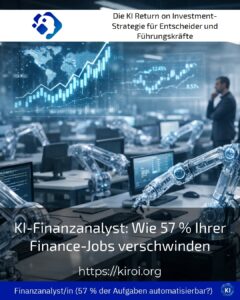
This question currently concerns hundreds of thousands of professionals in a field of work that was traditionally considered crisis-proof and future-proof. Digitization and the rapid progress in the field of technology are changing the way we work and the way we live. AI tax advisors They are fundamentally changing the world of work. Current analyses show that approximately one-third of all activities in this sector could be replaced by intelligent systems. This development affects not only entry-level professionals but also experienced experts with decades of experience. The transformation is advancing faster than many industry experts had predicted even a few years ago. Therefore, it is crucial to address the possibilities and limitations of this technology early on.
The data for this development come from, among others, the Job-Futureometer of the Institute for Employment Research [1]. This scientifically based tool enables an accurate assessment of the automation potential of various job profiles. If you are active in this field and want to actively shape your future, the AIROI-Seminars offer an excellent opportunity for further education. The current dates can be found under https://risawave.org/de/live-events-mit-sanjay-sauldie/ [2]. These events provide hands-on strategies for successfully dealing with artificial intelligence in professional everyday life.
Which activities can be automated by the AI tax advisor
The analysis of the automation potential reveals a differentiated picture. Routine tasks such as capturing documents, categorizing expenses, and creating standardized reports can already be efficiently automated today. A concrete example is the automatic text recognition of invoices, which accounting systems are now performing with high accuracy. Similarly, intelligent systems can analyze account movements and independently detect inconsistencies. Calculating depreciation according to established rules is no longer a challenge for modern software.
Furthermore, digital assistants are increasingly taking on the role of communicating with clients regarding standard inquiries. Chatbots often answer frequently asked questions about deadlines, filing deadlines, and simple procedural questions around the clock. The automatic review of tax returns for formal errors takes seconds. The compilation of documents for operational audits is also significantly accelerated by intelligent search functions. These developments show that the transition to digital workflows is accelerating rapidly. AI tax advisors It is already in full swing.
Another example concerns payroll accounting, where systems automatically calculate social security contributions and generate reports. The creation of sales tax pre-filing is already largely automated in many law firms. Furthermore, modern programs can generate complex billing schedules from naturally-spoken descriptions and process them independently.
Best practice with a AIROI customer A medium-sized law firm with twenty employees faced the challenge of modernizing its processes without compromising the quality of personal support. As part of AIROI the onboarding process, a comprehensive analysis of the existing workflows was first conducted to realistically assess the actual automation potential. The firm decided to fully digitize the filing process and employ an intelligent assistant for pre-sorting. The employees received intensive training to effectively use the new tools and focus their work on value-added activities. After six months, the management reported a time savings of approximately thirty percent on administrative tasks. At the same time, client satisfaction increased because inquiries could be processed more quickly. The time gained was used by the team for intensive consultations and strategic planning with the clients. AIROI The strategy helped to structure the transformation process and avoid overburdening the workforce.
Limits of automation in the consulting sector
Despite all technological advancements, essential core competencies remain in human hands. Strategic advice on complex business decisions requires experience and empathy. An example of this is the support provided in corporate succession, which requires not only technical knowledge but also interpersonal sensitivity. Representing companies before financial authorities in contentious cases also remains a domain of human expertise. Interpreting ambiguous legal norms and developing creative design solutions require judgment that machines do not possess.
Personal trust relationships with clients represent another area that technology cannot replace. Clients often report that in difficult financial situations they need a human contact. The emotional component in business start-ups or economic crises requires empathy and understanding. Assessing ethical issues in tax planning remains a genuine human task. The AI tax advisors Therefore, it will be a hybrid model that combines technology and human expertise.
Another example is seen in international matters involving multiple jurisdictions. The analysis of complex holding structures and the advice on cross-border transactions require comprehensive contextual knowledge. Negotiating with financial authorities during external audits remains a task that requires human negotiation skills.
The role of AIROI strategy in transformation
AIROI The strategy offers a structured framework for successfully integrating artificial intelligence into existing business models. Seminars, lectures, and workshops provide hands-on, practical methods that are immediately applicable. Participants learn to distinguish between meaningful automation and indispensable human work. A concrete tool is the analysis of one’s own job profiles in terms of automation potential. The strategy helps professionals redefine their positioning in the market.
Furthermore, AIROI the events provide impulses for communication with clients about technological changes. Many clients are uncertain about reports on artificial intelligence and need thorough information. The workshops show how advisors can turn this uncertainty into trust. The selection of suitable software solutions and the evaluation of providers are also discussed. The AIROI guidance helps to avoid costly misjudgments in the digitalization process.
Another example involves the development of new service offerings that are only possible through technology. Real-time analysis of financial data enables proactive advice instead of reactive year-end financial statements. Automated monitoring of deadlines and thresholds also adds value to clients.
Best practice with a AIROI customer A solo practitioner in a rural region faced declining client numbers and rising price pressure. By participating in AIROI a seminar, he recognized the potential of digital tools for his practice. He initially implemented a cloud-based accounting system that enabled clients to submit documents directly. He used the time gained to conduct intensive consultations that he had previously neglected due to a lack of time. He developed a new offering for young entrepreneurs that included monthly analyses and proactive optimization suggestions. This offer set it apart from the competition and appealed to a new, digitally-savvy target group. Within a year, he was able to expand his client base by fifteen percent while simultaneously reducing his workload. AIROI The mentoring provided him with the necessary guidance and confidence for this transformation process. He later reported that the strategic realignment had given his profession new meaning and joy.
Practical steps for future-proofing
Successful adaptation to the changed circumstances requires concrete measures. A first step is to honestly assess one’s own operations in terms of their potential for automation. Professionals should analyze which tasks could already be performed more efficiently using software today. An example is the manual transmission of data between different systems, which can easily be automated. Regular creation of standardized reports also offers significant optimization potential.
The second step consists of targeted further training in areas that are not automated. The development of consulting skills and communication skills is becoming increasingly important. Understanding of entrepreneurial contexts and strategic planning is also becoming increasingly important. The AIROI seminars provide an excellent starting point for this, with practical content. The ability to explain complex issues in an understandable way becomes a crucial competitive advantage.
Another example of future-proof competencies is specializing in specific industries or client groups. Deep industry knowledge is difficult to automate and creates real added value for clients. Developing niche offerings for specific problem areas also offers potential for differentiation.
The AI tax advisor as a future model
The professional profile will undergo fundamental changes, but it will by no means disappear. The advisor of the future uses intelligent systems as powerful tools for increasing efficiency. One example is the use of analytical software, which within seconds identifies optimization potentials in annual financial statements. The human interprets these results and develops tailored recommendations for the client. The combination of machine capabilities and human judgment creates added value that no one could achieve alone.
Collaboration with other professional groups will also intensify. Lawyers, business consultants, and financial experts are increasingly working in interdisciplinary teams. The ability to collaborate across professional boundaries is becoming a key competence. The model of AI tax advisorss therefore also includes advanced network capabilities and collaboration capabilities.
Another example concerns the use of platforms that connect clients and advisors digitally. These technologies open up new opportunities for client acquisition and customer retention. At the same time, they require a rethinking of the positioning and marketing of one’s own services.
Best practice with a AIROI customer A larger law firm with multiple locations decided to undergo a comprehensive transformation of its working methods. The management realized that the current approach would not remain competitive in the long run. In AIROI several workshops, the leadership team developed a strategy for the gradual digitalization of all core processes. Special emphasis was placed on involving the employees, whose concerns and ideas were systematically recorded. The firm introduced a competency matrix that defined the skills relevant for each position in the future. Based on this, individual development plans were created for all employees and training measures were organized. After a year, it was revealed that the feared employee turnover had completely disappeared. Instead, team satisfaction increased significantly, as many routine tasks that were perceived as burdensome were eliminated. The firm successfully positioned itself as an innovative partner for growth-oriented companies. AIROI The mentoring proved to be a crucial success factor for this successful transformation process.
My AIROI Analysis
The development towards AI tax advisors With an automation potential of about one-third of all activities, this represents a significant transformation that brings both challenges and significant opportunities. My analysis clearly shows that those professionals who embrace technology as a tool rather than perceiving it as a threat will be successful. AIROI The strategy provides a proven framework for structuring and successfully navigating this transformation without neglecting the core human competencies.
The examples from practice demonstrate impressively that the integration of intelligent systems can lead to efficiency gains and higher client satisfaction. At the same time, they show that the human factor remains indispensable for strategic consulting, emotional support, and creative problem solving. The 34 percent of activities that can be automated are therefore not a threat, but a liberation from routine work in favor of value-adding tasks.
Professionals who AIROI now invest in their further education and use the seminars gain a decisive advantage in the competition. The transformation offers the opportunity to actively shape their own professional image instead of being passively swept along by developments. The AIROI coaching supports this by using proven methods and offering strategic guidance for the individual transformation path.
Further links from the text above:
[1] Job-Futuromat of the Institute for Employment Research
[2] AIROI seminars and live events with Sanjay Sauldie
For more information and if you have any questions, please contact Contact us or read more blog posts on the topic Artificial intelligence here.







 Deutsch
 English (UK)