
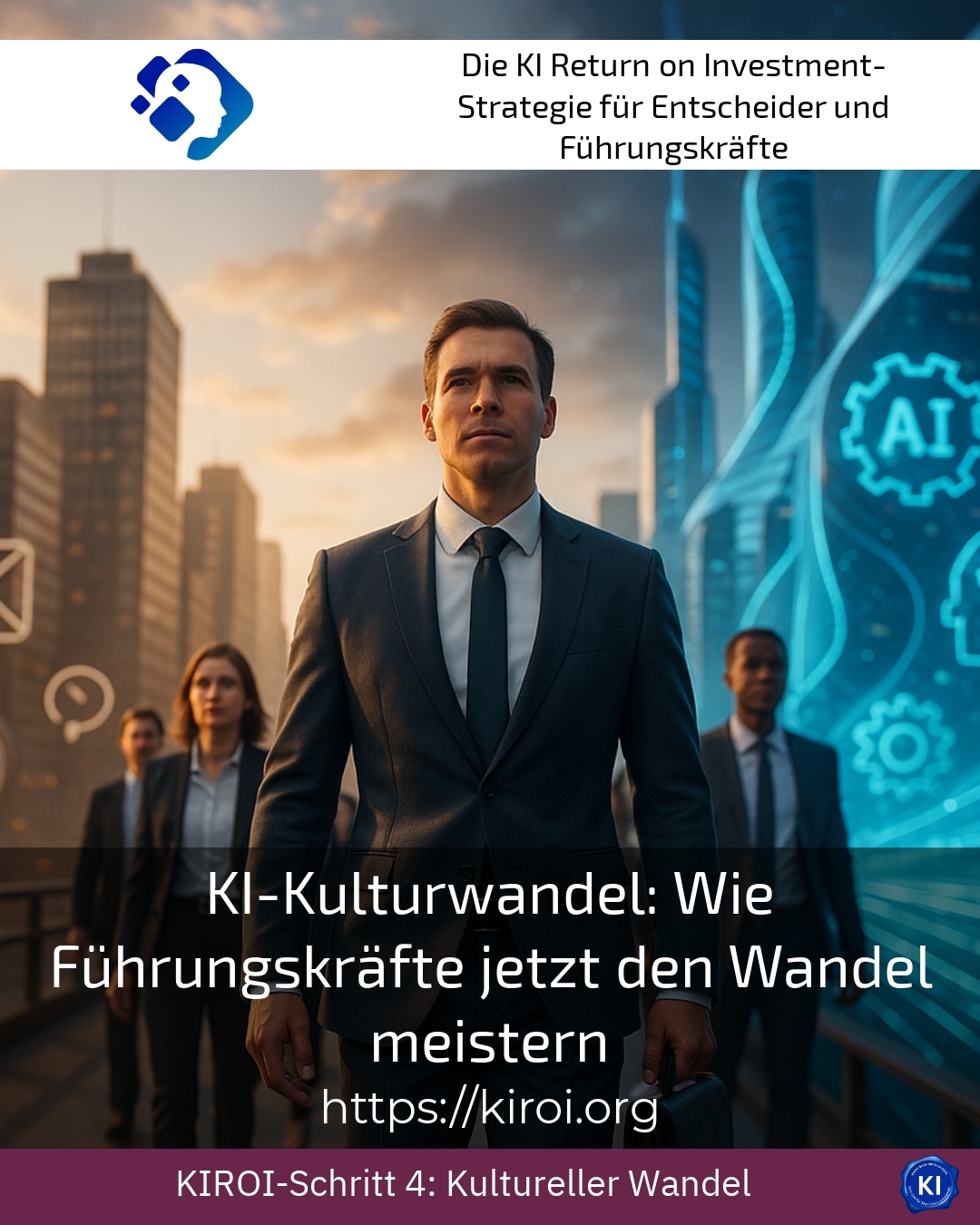
The digital revolution has long since begun. It is changing companies from the ground up. Executives face one of the biggest challenges of their careers. AI cultural change: How leaders are now mastering the transformation It involves decision-makers across industries. Teams react with uncertainty to new technologies. Processes must be redesigned. At the same time, the pressure from competitors is growing. Those who do not act now risk losing their position. This article shows you concrete ways and proven strategies for your organization.
Why the AI culture change: How leadership is now crucial to mastering the change
The introduction of intelligent systems does not only affect technical departments. It permeates all business areas. Employees in the HR department use automated selection procedures. Sales teams work with predictive analysis tools. Production managers rely on predictive maintenance systems. These changes require a fundamental change in corporate culture. Leaders play a central role as role models and pioneers [1].
Clients often report similar challenges in their organizations. They experience resistance from long-standing employees. Younger team members demand faster changes. Middle management feels torn between the two fronts. Human resources faces the task of developing training programs. The finance department must release budgets for unknown technologies. Marketing teams are experimenting with automated content creation.
For example, a medium-sized machine manufacturer implemented intelligent quality control systems. The production workers initially feared the loss of their jobs. A logistics company implemented autonomous route planning for its vehicle fleet. Drivers saw their experience and knowledge being devalued. An insurance company relied on automated claims processing. Claim handlers felt replaced rather than supported by the technology.
Understanding the emotional dimension of change
Technological transformation triggers profound emotional reactions. Fear of job loss is at the forefront. In addition, there is concern about not being able to keep up with new demands. Some employees perceive the changes as criticism of their previous work. Others see their years of accumulated expertise being devalued. These emotional aspects deserve special attention from leaders.
Transruptive coaching supports executives in these complex change processes. It helps them recognize the emotional needs of their teams. Together, they develop impulses for respectful communication. The coaching is conducted in a practical manner and tailored to the specific situation [2].
Best practice with a AIROI customer
An internationally operating automotive supplier faced the challenge of modernizing its entire production control and equipping it with intelligent systems. The workforce of over eight hundred employees initially reacted with considerable resistance to the announced changes. The management then decided on a guided transformation strategy within the AIROI framework. First, all department managers were prepared in intensive workshops for their new role as change facilitators. They learned to take their team members’ fears seriously and to address them constructively. In parallel, the human resources department developed a comprehensive qualification program for all employees. The involvement of the works council members from the very beginning was particularly important. They were made active participants in the transformation. After six months, the mood in the company had fundamentally changed. The acceptance of new technologies increased measurably. Productivity increases of over twenty percent were achieved. At the same time, the turnover rate fell to a historic low.
Communication as the key to successful transformation
Transparent communication forms the foundation of any successful change. Leaders often underestimate the information needs of their employees. One pharmaceutical company introduced weekly information sessions on its digitalization projects. Participation was voluntary, but the interest was enormous. Another energy provider set up an internal platform for questions and answers regarding the introduction of technology. Employees could anonymously express their concerns. A retail company specifically trained its executives in change communication [3].
Communication should address several levels at the same time. On the rational level, it is about facts and information. Employees want to understand what is changing in concrete terms. On the emotional level, they need security and appreciation. They want to feel that their work remains important. On the practical level, they need clear instructions for action. What does the change mean for their specific work routine?
Constructively utilizing resistance for the cultural transformation of AI
Resistance to change contains valuable information. It indicates where employees are unsure. It reveals which aspects of the transformation have not yet been sufficiently explained. It points to possible weaknesses in the implementation. Wise leaders therefore view resistance as a resource, not an obstacle.
A telecommunications company used the objections of its employees to improve its implementation strategy. Customer advisors had criticized that automated systems would deteriorate the quality of the conversations. This feedback led to a customized solution with more leeway for individual advice. A bank systematically collected improvement suggestions during the introduction of new analytical tools. Many of these suggestions were incorporated into later system updates. A chemical company established an innovation lab where employees could test new technologies in a protected environment [4].
Best practice with a AIROI customer
A large media company with several subsidiaries decided to gradually introduce automated editorial tools into its various publications. The reactions of the editors initially were extremely critical and sometimes negative. Many experienced journalists feared that their creative work could be replaced by machines. The company decided on a participatory approach with AIROI guidance. Initially, so-called technology ambassadors were appointed in each editorial department. They received intensive training and were intended to act as multipliers. At the same time, workshops were held where editors could freely express their concerns. These feedback were systematically documented and incorporated into the further planning. The management made it clear that the technology was intended to support rather than replace human work. Specific examples showed how routine tasks could be automated, freeing up more time for investigative research and creative formats. After a year, over eighty percent of the editors regularly used the new tools and reported an improved quality of work.
Developing competencies and empowering teams
The qualification of the workforce determines the success of the transformation. This involves more than just technical skills. Competencies such as critical thinking and problem-solving are also important. Employees must learn to work with intelligent systems. They must understand when human judgment is required. Developing these skills takes time and targeted investment [5].
A healthcare provider developed a multi-stage qualification program for its employees. The first stage focused on a basic understanding of the new technologies. The second stage provided application-specific skills for everyday work. The third stage trained internal experts who serve as contact points. A construction company collaborated with a university to develop customized training programs. A food manufacturer established an internal academy for digital skills.
Leadership skills for the digital age
Leaders themselves need to develop their competencies. They need a fundamental understanding of new technologies. They need to be able to lead their teams through uncertainty and change. They should be able to reflect on ethical issues related to the use of technology. These requirements initially overwhelm many leaders.
Transruptions coaching supports leaders in developing these new competencies. It provides guidance for personal development in the digital context. The coaching is provided individually and takes into account the specific challenges faced by each leader. Clients often report an increased sense of security when dealing with change processes.
An industrial company sent its entire senior management through an intensive development program. The participants learned to strategically align technological capabilities. A hotel chain trained its executives in handling automated booking and service processes. A logistics company established regular reflection rounds for management on digitalization topics [6].
Adapting structures and processes in the AI cultural transformation: How leaders are now mastering the change
Cultural change also requires structural adjustments. Traditional hierarchies often conflict with agile working methods. Rigid processes hinder the use of flexible technologies. Existing departmental boundaries hinder cross-functional collaboration. Leadership therefore needs to rethink organizational frameworks as well.
A financial services provider created cross-functional teams for its digitalization projects. Employees from different departments worked together on solutions. A retail company implemented agile methods in its IT department and later extended them to other areas. A machine manufacturer created a new position for the coordinated management of all technology initiatives [7].
Best practice with a AIROI customer
A traditional family business in the furniture industry faced the challenge of adapting its established structures to the digital age. The management recognized that technological investments alone would not be sufficient. With the support of the AIROI-Frameworks project, a comprehensive transformation process was initiated. First, the project team analyzed the existing workflows and identified areas with high optimization potential. Employees were actively involved in the analysis and interviewed based on their experiences. In the next step, new work forms were introduced on a pilot basis in selected departments. The production department experimented with intelligent assistance systems for furniture manufacturing. The sales department tested automated customer advisory tools. The experiences from these pilot projects were incorporated into the company-wide strategy. The continuous exchange between the pilot departments was particularly valuable. Successful approaches were quickly transferred to other areas. Problems and obstacles could be identified and resolved early on. After eighteen months, the company had significantly strengthened its competitiveness and improved employee satisfaction.
Performance measurement and continuous improvement
Transformation is not a one-time project with a defined endpoint. It requires continuous observation and adaptation. Leaders should define appropriate metrics for the progress of transformation. These metrics must reflect both hard factors and soft aspects. Regular reviews enable timely countermeasures in case of problems.
One insurance company implemented quarterly transformation reviews that considered both technical and cultural aspects of change. One technology company used employee surveys to measure transformation acceptance. One healthcare company established a dashboard with real-time metrics for digital transformation progress [8].
My AIROI Analysis
The AI cultural transformation: How leaders now master the change presents organizations with multifaceted challenges. The technological dimension is only one aspect among many. At least as important are the cultural, emotional, and structural factors. Leaders who underestimate this complexity risk the failure of their transformation efforts.
From my experience in guiding numerous transformation projects, several success factors emerge. First, a clear vision is needed that provides employees with direction. This vision must be communicated in a comprehensible manner and regularly reaffirmed. Second, the active involvement of the workforce is indispensable. People support change; they were involved in its design. Third, transformation requires time and patience. Rapid implementations often lead to resistance and quality problems.
The AIROI-Framework offers a structured approach to these complex change processes. It takes into account both technical and organizational factors as well as human factors. The accompanying support provided by transruptive coaching helps leaders overcome their personal challenges. Together, we develop strategies that are tailored to the specific situation of your organization. Change is challenging, but with the right guidance it can be successfully managed.
Further links from the text above:
[1] McKinsey – Leading the Human Side of AI Adoption
[2] Harvard Business Review – Change Management
[3] Prosci – Change Management Communication
[4] Gartner – Digital Transformation Insights
[5] World Economic Forum – Future of Jobs Report
[6] BCG – Digital Transformation
[7] Deloitte – Organization Transformation
[8] Forbes Tech Council – Digital Transformation
For more information and if you have any questions, please contact Contact us or read more blog posts on the topic Artificial intelligence here.











 Deutsch
 English (UK)