
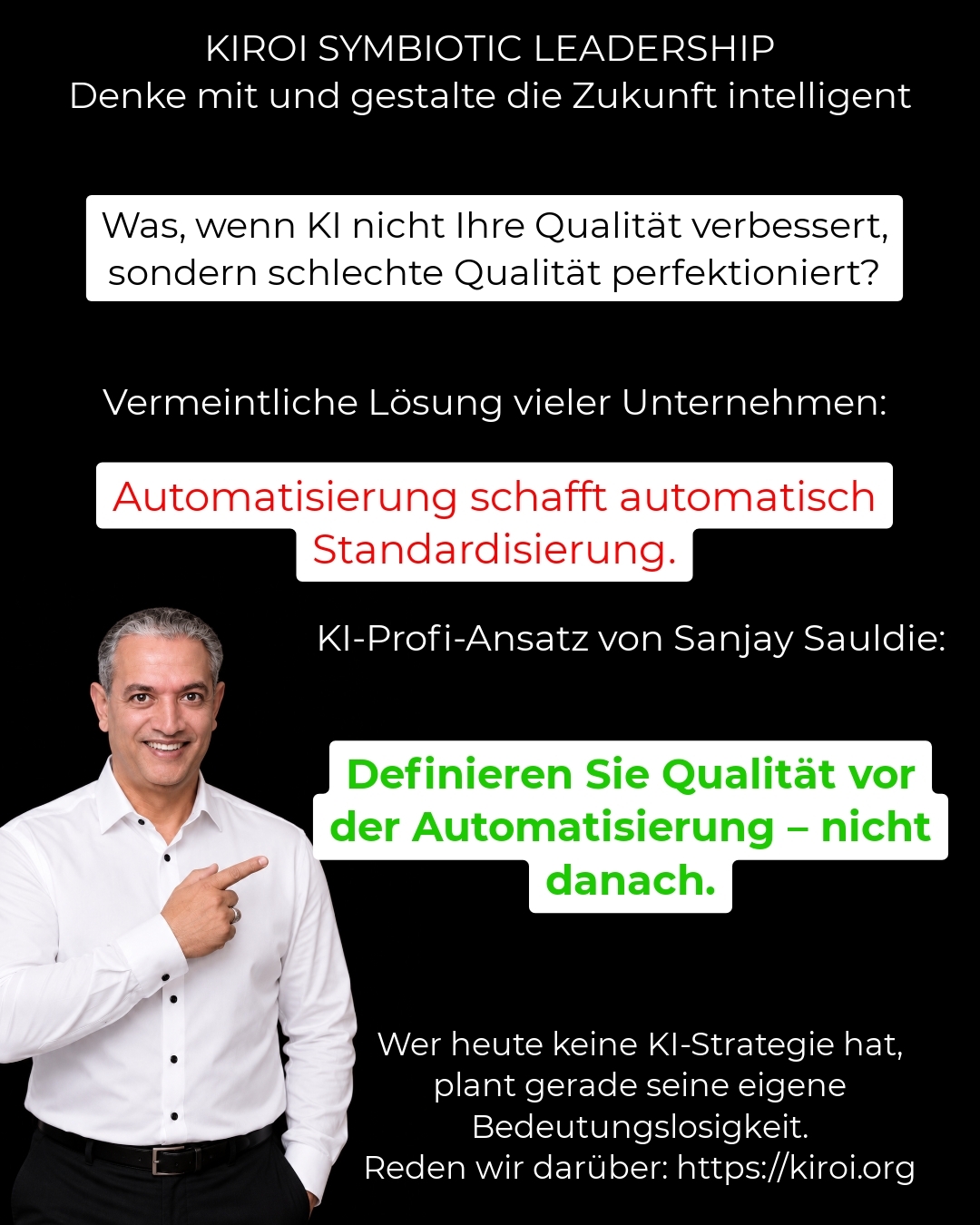
What actually happens when your company doesn’t get better through intelligent automation but simply works moderately faster?
This question currently concerns numerous decision-makers in organizations that have invested heavily in algorithmic systems and are now having to realize that the hoped-for quality leaps are not occurring. Instead, they are experiencing a phenomenon that at first appears paradoxical: The technologies used reproduce existing weaknesses at a speed and precision that were previously unthinkable. The concept Quality before automation This gains a completely new meaning because it marks the fundamental difference between genuine improvement and accelerated mediocrity. In this post, I show you why average companies fail on this problem and how the AIROI-methodology offers a sustainable solution [1].
Understanding the paradox of accelerated mediocrity
Many organizations assume that technological systems lead to better results automatically once they are implemented. In practice, this assumption often turns out to be misleading. Intelligent systems learn from existing data and processes. If these already exhibit weaknesses, these weaknesses are magnified.
Consider, for example, a trading company that has its product descriptions automatically created. If the previous texts were already inaccurate, interchangeable, or grammatically flawed, the system now produces thousands of such texts per day. The speed increases dramatically. The quality remains at the same low level or even continues to decline further.
Another example can be found in the area of customer correspondence. A service company uses automated responses. However, the underlying templates were already worded in a distant and less customer-oriented manner. The result is now hundreds of identical messages daily, which rather annoy customers than satisfy them.
This pattern is also evident in the field of data analysis. When historical data already contained biases or gaps, algorithm-based evaluations reproduce exactly these problems. The decisions based on them are not made better, but merely faster.
Why automation does not automatically lead to standardization
Average companies often approach this problem with a common misconception. They firmly believe that the deployment of intelligent systems leads automatically to uniform standards. This assumption sounds logical, but rarely holds up in reality.
Standardization requires first a clear definition of what should be considered a standard. Without this groundwork, automated processes merely copy what already exists. And when the existing is inconsistent, an automated inconsistency arises.
For example, a manufacturing company implemented a system for automated quality control. However, the training data came from a phase in which different inspectors had set different standards. The system learned about these inconsistencies and now applies them systematically.
In another case, a financial services provider used automated risk assessments. However, the historical evaluations had been created by different teams using different criteria. The new system now perpetuates these differences with machine efficiency.
The problem is particularly pronounced in the area of personnel selection. If previous decisions were already influenced by unconscious preferences, algorithmic systems continue to follow these patterns. The results then appear objective, even though they are not.
The hidden costs of rapid implementation
The urge to introduce quickly significantly exacerbates the described problem. Companies are under competitive pressure. They do not want to fall behind. Therefore, they implement systems before the fundamentals are clarified.
For example, a logistics company implemented a system for automated route planning within a few weeks. However, the existing processes had never been systematically analyzed. The system now optimizes routes based on erroneous assumptions and inefficient underlying structures.
A similar situation occurred with a media company that accelerated its content production. The editorial guidelines existed only in a fragmented form. The automated system now produced content without clear guidelines, leading to brand dilution.
These cases clearly show why Quality before automation This is not an optional consideration; it is a mandatory prerequisite for sustainable success.
AIROI The solution: Define quality before automation
The AIROI-methodology addresses this fundamental problem with a structured approach. The core idea is this: Only when quality is clearly defined can technology meaningfully scale it. This order of things seems simple, but in practice it is surprisingly often overlooked.
As part of AIROI the guidance process, organizations first undergo a phase of quality definition. What does quality actually mean for your products, processes, and customer relationships? This question must be answered before technological systems are put into use.
For example, an insurance company initially defined precisely what constitutes high-quality claims processing in the AIROI-process. Only then was the automation planned. The result were systems that actually met the defined quality standards [2].
In another project with a retailer, the question initially focused on what quality characteristics the customer advisory service should have. These characteristics were operationalized and made measurable. Only then were supporting technologies introduced.
Best practice with a AIROI customer
A medium-sized company in the field of technical services faced the challenge of accelerating its offer creation without compromising the individual quality of the documents. The previous offers had been created by different employees and showed significant variations in quality, with some documents being detailed and precise while others appeared superficial and riddled with errors. As part of the AIROI coaching process, a comprehensive workshop was initially conducted in which the participants jointly defined what constitutes a qualitatively high-quality offer, what elements are essential, which formulations reflect the company culture and which structural requirements must be met. This definition was documented in a quality guideline that served as the basis for all further steps. Only after this preliminary work did the implementation of a supporting system take place, which now works based on these clear guidelines. The result surprised even the initial skeptics within the company: the creation of offers accelerated by about sixty percent, while at the same time quality metrics significantly increased, because each document now met the defined standards and the individual note remained intact through targeted human revision.
Quality before automation as a strategic imperative
The decision was made Quality before automation This is not a technical question. It is a strategic decision that must be made at the leadership level. Because it requires investments in preliminary work that initially produces no visible output.
However, this investment pays off many times over. For example, a pharmaceutical company invested three months in defining its documentation standards before implementing automated systems. Those three months later saved years of rework and compliance issues.
A telecommunications provider, in turn, first defined precisely what quality features its customer service should meet. The support systems subsequently introduced could thus be specifically tailored to these features.
This approach is also evident in the educational sector. A training institution initially defined its didactic quality standards before automating parts of content creation. The result were materials that met pedagogical requirements.
Practical steps for implementation in your own company
The implementation of the principle Quality before automation AIROI The methodology follows a structured process. It always begins with an honest assessment of the current quality situation.
In the first step, you identify the processes that are suitable for automation. Then, for each of these processes, you ask the crucial question: Does the current quality meet the standards we want to scale up in the future?
An example from the real estate sector illustrates this. A real estate company wanted to automate its property descriptions. The honest analysis showed that the previous texts were stylistically inconsistent and often too generic. Before the automation, these fundamentals had to be improved.
During their analysis, a healthcare provider recognized that the documentation of patient conversations varied greatly. Before automated support systems were introduced, the team developed uniform documentation standards.
A mechanical engineer found that his technical documentation was factually correct but structurally inconsistent. The definition of clearer structural specifications was prerequisite for automation.
The role of leaders in the transformation process
Leaders play a crucial role in successfully implementing this approach. They must have the courage to curb the drive for automation until the quality foundations are in place.
In transruptions coaching, I help leadership teams master this difficult communication task. Internally, it must be explained why the path to automation leads through a detour that can initially seem like a step back.
A manager from the energy sector described his experience as follows: The decision to invest three months in quality definition was difficult to communicate internally. Today, however, it is clear that this investment was the foundation for everything else.
A department head from the banking industry reported similar challenges. The management’s impatience was great. But the persistence paid off, because the systems that were later introduced actually delivered the desired quality [3].
My AIROI Analysis
The central insight from numerous projects is this: technological systems are amplifiers, not enhancers. They scale up what is already available without optimizing it independently. This characteristic makes them powerful tools when the fundamentals are right. And dangerous accelerators of problems when they are lacking.
The AIROI-methodology addresses this fundamental misunderstanding through a clear sequence: first define quality, then automate. This order may sound obvious, but in practice it is surprisingly often ignored. The reason often lies in time pressure and the assumption that technology solves problems that are actually organizational in nature.
My observation from accompanying numerous transformation projects also shows that companies that take this detour arrive at their destination faster in the long run. The rework, corrections, and re-implementations that arise with hasty implementation cost more time and resources than the initial quality work. Therefore, investing in clear definitions and standards before technological scaling is not only of qualitative but also economic significance. Organizations that choose this path often report higher acceptance of the new systems by their employees because they experience that the technology actually improves their work and not just speeds it up.
Further links from the text above:
[1] AIROI-Strategy for sustainable transformation
[2] Leadership Transruptions Coaching
[3] AIROI-Blog with additional case studies
Are you a leader and would you like to learn how you can genuinely introduce AI into your company in a valuable and sustainable way, away from the hype? Take part Contact us or read more blog posts on the topic Artificial intelligence here.










 Deutsch
 English (UK)