
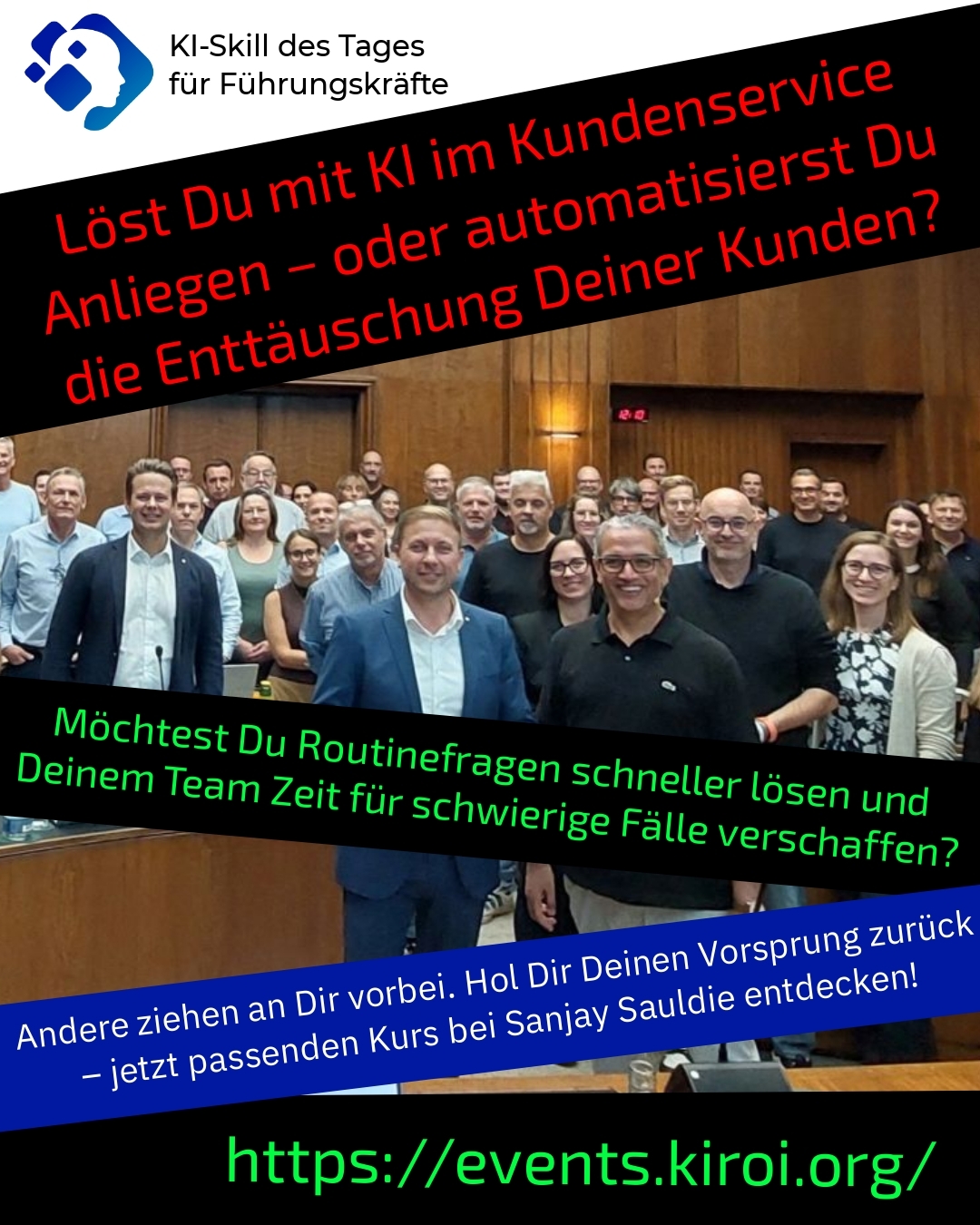
Have you ever wondered why so many companies still frustrate their customers despite the latest technology – and even faster than ever before?
The introduction of AI in customer service Promises efficiency, cost savings, and better accessibility. But the reality often looks different. Many organizations implement intelligent systems without understanding their true potential. They automate processes that previously did not work. This leads to digital dead ends that leave customers frustrated. The central question is therefore: Do you create real value through automation, or do you merely exacerbate existing problems with greater speed?
The illusion of perfect automation
Many decision-makers believe that intelligent systems will solve all problems in customer contact. This assumption regularly leads to serious misjudgments. A chatbot that answers frequently asked questions does not replace a well-thought-out service strategy. It merely reinforces what is already in place – whether positive or negative.
Imagine an energy provider implementing a virtual assistant. This assistant is supposed to capture meter readings and answer billing questions. But the system does not understand complex tariff changes or the emotional complaints of frustrated customers. The result: People get stuck in endless loops and become increasingly frustrated. A telecommunications provider experiences a similar situation when its bot fails to detect technical malfunctions. And an insurance company loses trust when claims disappear in the digital wilderness. These examples clearly show that technology alone is not a solution.
The real challenge lies not in the technology itself. It lies in the strategic integration and the willingness to fundamentally rethink processes. Without this willingness, any automation remains superficial and ineffective.
Why AI in customer service often becomes a frustration accelerator
The causes of failed implementations are manifold and often system-related. First, there is often a lack of clear objectives for the deployment of intelligent systems. Companies do not ask themselves what problems they really want to solve. They implement technology because the competition does so or because it seems modern.
Another problem is the lack of integration into existing structures. If a virtual assistant has no connection to the CRM system, it cannot provide personalized responses. If it does not have access to order histories, every interaction becomes arbitrary and impersonal. An online retailer experiences this daily when customers ask about their package status. A financial services provider feels it when investors seek individual portfolio information. And a travel provider notices it when vacationers require flexible rescheduling options.
Additionally, many organizations underestimate the emotional dimension of customer contact. People do not just turn to the service for factual questions. They bring with them anger, disappointment, and sometimes despair. A system that ignores these emotional nuances only exacerbates the situation. It signals to the customer that their feelings do not matter.
Best practice with a AIROI customer
A medium-sized company in the technical services sector came to us with a specific problem. The company had already implemented a chatbot, but it produced more complaints than solutions. The customers did not feel understood and ended conversations frustrated. Together, we analyzed the typical customer concerns and their emotional components. We identified key moments where human intervention was indispensable. The transruptions coaching accompanied the team in reorienting the entire service strategy. Instead of automating all requests, we defined clear handover points between human and machine. The employees received training to effectively use the information prepared by the system. Within three months, the complaint rate dropped by almost forty percent. The average processing time also significantly reduced. What was crucial in this case was not the technology itself, but the strategic guidance of the entire transformation process. Today, the company understands that AI is a tool in customer service and not a miracle weapon.
Finding the right balance between humans and machines
The key to success lies in the intelligent combination of human and machine capabilities. Automation is ideally suited for repetitive, clearly defined tasks. The answering of opening hours, the confirmation of orders or the forwarding to the relevant departments work flawlessly digitally. But as soon as complexity or emotions come into play, people are needed.
A hospital can automate appointment scheduling, but not the worries of anxious relatives. A car manufacturer can communicate maintenance intervals digitally, but not a complaint from a disappointed customer. A educational institution can digitize course registrations, but it cannot replace the counseling sessions about career opportunities. This distinction is fundamental and must not be diluted.
The best results are achieved when intelligent systems support human employees rather than replacing them [1]. They can prepare information, create summaries, and provide recommendations for action. This frees service employees up to focus on what really matters: genuine conversations and individual solutions.
Practical insights for successful AI in customer service
First of all, it is advisable to conduct an honest assessment of the current level of service quality. What problems exist before automation is implemented? Where are there frictional losses, and why? Only after these questions have been answered can technology be used in a meaningful way.
Furthermore, you should define clear escalation paths. Customers must always have the option to switch to a human. This option must not be hidden or made more difficult. A software company learned this the hard way when its customers massively switched to competitors. A fashion retailer experienced a similar situation when return requests got lost in the bot maze. And a logistics service provider had to painfully realize that lost packages require human empathy.
After all, continuous learning is indispensable. Intelligent systems must be regularly reviewed and adapted [2]. Customer feedback should be systematically evaluated and translated into improvements. Only in this way can a cycle be created that actually creates added value.
Preserving the human dimension
Despite all the enthusiasm for technological possibilities, one must not forget one thing: customer service is fundamentally a human matter. People want to be heard, understood, and respected. They seek solutions, but also empathy and recognition.
This dimension cannot be fully captured by a machine. It can recognize patterns and calculate probabilities. It can process language and generate responses. But true understanding, genuine empathy, and genuine creativity remain reserved for humans. A funeral home knows this intuitively and would never employ a bot to conduct grief conversations. A luxury hotel understands that personal attention makes the difference. And a craft business thrives on the direct relationship it has with its regular customers.
The art lies in using technology in a way that strengthens this human dimension instead of weakening it. It should give employees the freedom to focus on the essentials. It should take on routine tasks and provide information. But it should never pretend to be what it is not: an empathetic conversational partner.
Best practice with a AIROI customer
A healthcare services company faced a particular challenge in the area of service. The clientele was predominantly older and less tech-savvy than the average population. At the same time, the volume of requests was constantly growing and overloaded the existing team. Full automation was not feasible for ethical and practical reasons. The transruptive coaching accompanied the organization in developing a hybrid model. Simple appointment changes and reminders were handled by an intelligent system with particularly easy operation. In case of medical questions or emotional concerns, a prompt referral was made to trained personnel. The employees received all relevant information directly on their screen, allowing them to immediately join the conversation without time-consuming research. The satisfaction levels increased measurably, and employee turnover also decreased. This example impressively shows what well-thought-out implementation can look like. It’s not about either/or, but about an intelligent both-and approach.
My AIROI Analysis
The introduction of intelligent systems in customer contact is neither a panacea nor a curse. It is a tool whose effectiveness depends entirely on the way it is used. Organizations that approach it with a clear strategy and realistic expectations achieve impressive results. They reduce waiting times, improve information quality, and relieve their employees of the burden of performing demanding tasks.
Organizations, on the other hand, that view technology as a substitute for basic service work only compound their problems. They automate disappointment and accelerate the loss of customer trust. The decision is yours: Do you want to create real solutions or just fail faster?
The experiences from numerous accompanying projects consistently show the same pattern. Successful transformations begin with honest self-reflection and clear goals [3]. They require the willingness to fundamentally question existing processes. And they require patience, because lasting changes do not happen overnight. Transruptive coaching offers valuable impulses and structured support. It helps to ask the right questions and find individual answers. Because in the end, it is not about technology, but about people.
Further links from the text above:
[1] McKinsey: AI-enabled customer service
[2] Harvard Business Review: Artificial Intelligence
[3] Gartner: AI in Customer Service
For more information and if you have any questions, please contact Contact us or read more blog posts on the topic Artificial intelligence here.









 Deutsch
 English (UK)