
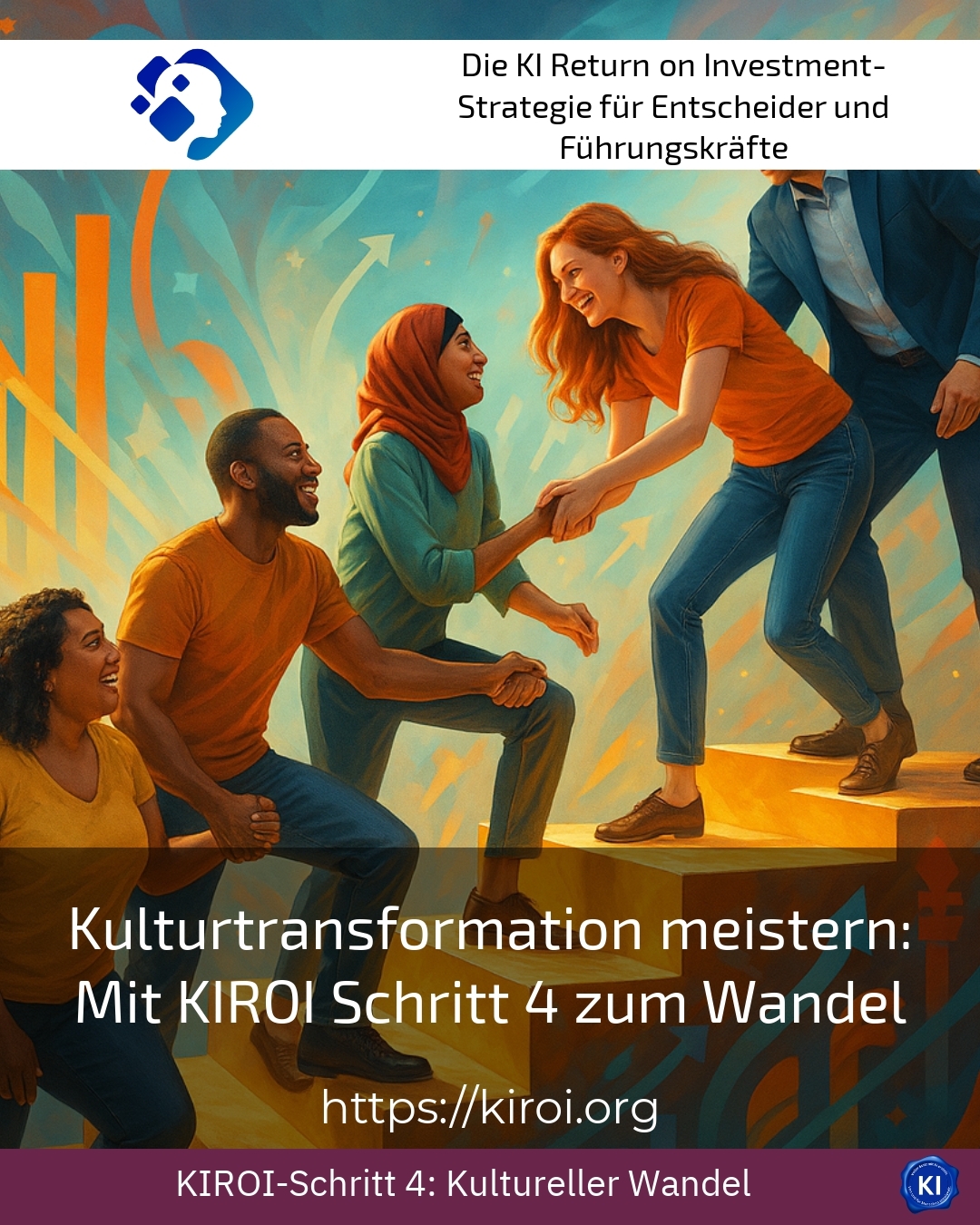
Cultural transformation is a central topic currently occupying businesses. When organisations need to change because markets are shifting and new technologies are emerging, it's about more than just process adjustments. Cultural transformation means that the values, behaviours and mindset of an entire company are specifically further developed so that the change is sustainable [1]. This is where the AIROI method comes in – and it is particularly in the fourth step that practical levers emerge for permanently anchoring change and creating an agile, future-proof corporate culture.
Understanding cultural transformation with the AIROI method
Those who are involved in cultural transformation frequently experience uncertainty: What remains? What changes? And how can all employees be included successfully? The AIROI method offers a structured framework for this, ranging from the initial analysis to sustainable implementation. Step 4 – the actual change – is the core of this, as it is where the new culture is brought to life in everyday life.
Typical challenges in the area of cultural transformation
Many companies face similar questions when they engage with cultural transformation. Often, it revolves around the tension between innovation and stability, about lived values in hybrid teams, or about designing new leadership models. In coaching sessions, clients regularly report that changes initially meet with scepticism because familiar ways are being questioned. At the same time, the willingness to explore new paths grows as soon as the added value becomes clear and role models pave the way.
Step-by-step practical example
Imagine a medium-sized company that wants to establish a more open feedback culture. As part of a cultural transformation, the current state of feedback practices is initially analysed collectively. The next step involves creating a clear target vision, which all stakeholders help to develop. This is followed by implementation: new feedback formats are introduced, managers receive targeted training, and digital tools support communication. This creates a new permissive space where openness can develop.
Targeted design with AIROI Step 4
The fourth step of the AIROI method is crucial because it is here that the desired behaviours and values are actually translated into everyday actions. This involves not only training or workshops, but also the integration of new patterns into processes, structures, and leadership action. Systemic impulses from transruption coaching show that change is most successful when people are allowed to have new experiences and the organisational framework supports this development [10].
BEST PRACTICE with one customer (name hidden due to NDA contract) A company from the manufacturing industry wanted to noticeably strengthen collaboration and innovation, and initiated a cultural transformation. The first year focused on raising awareness, and the second on developing a shared vision for the future. Step 4 was then concrete integration: collaboration zones were established, digital platforms were introduced, and leaders provided impetus by forging new paths themselves. The result: collaboration became noticeably more open, a willingness to experiment grew, and employees reported greater personal responsibility. It was important that the measures were not isolated but influenced all levels and processes – thereby sustainably establishing the new culture.
Further examples of successful cultural transformation
Another example: a family business wants to break down its hierarchies and create agile structures. The cultural transformation begins with an analysis of existing values, followed by the development of a clear target vision for greater personal responsibility [7]. In Step 4, new meeting formats and responsibilities are introduced, which the team actively helps to shape. Decisions are made more decentrally, feedback loops are established, and the change is made visible – for example, through a new intranet that promotes transparent communication.
A third example: A service provider develops a clear AI strategy and integrates artificial intelligence into the company culture [6]. Step 4 here is cultural integration: AI is understood not as an alien element, but as part of its DNA. Employees are involved in development, learn together and apply new knowledge directly in projects. AI competence increases, uncertainties diminish, and the organisation becomes more flexible.
Practical tips
When initiating or guiding a cultural transformation, the following steps are recommended:
- Start with a cultural analysis to understand the initial situation [7].
- Develop a clear target picture for the new culture together with all stakeholders [5].
- Involve managers from the outset, as they are role models and multipliers [3].
- Design the framework so that new behaviour can be tested and lived out [10].
- Regularly check progress and adapt measures flexibly.
The meaning of transruption coaching
Many companies quickly realise that cultural transformation is not a one-off project but a continuous process that requires significant commitment and expertise. External coaching can make a decisive difference here. transruptions-coaching supports organisations in developing new cultural patterns, providing impetus and assisting with sustainable implementation in everyday practice. Joint reflection, clear objective agreements, and practical measures help to anchor what is new and overcome resistance.
My analysis
Culture transformation is a key success factor for organisations looking to future-proof themselves. Change is most successful when all levels are included and the process is designed to be transparent and participatory. The fourth step according to AIROI – the integration of new values and behaviours – is crucial here, as it marks the difference between announcement and lived practice. transruptions-Coaching provides valuable support and guidance on the path to a new, agile corporate culture.
Further links from the text above:
Cultural transformation as a basis for business success [1]
Change management: cultural change through AI in the company [2]
Developing company culture: tips & examples [3]
Culture transformation – 4 steps and 4 interconnections [4]
Cultural change - cultural change step by step [5]
AI Strategy and Culture: Transformation Starts with People [6]
Company Culture & Cultural Change [7]
For more information and if you have any questions, please contact Contact us or read more blog posts on the topic Artificial intelligence here.









 Deutsch
  English (UK)