
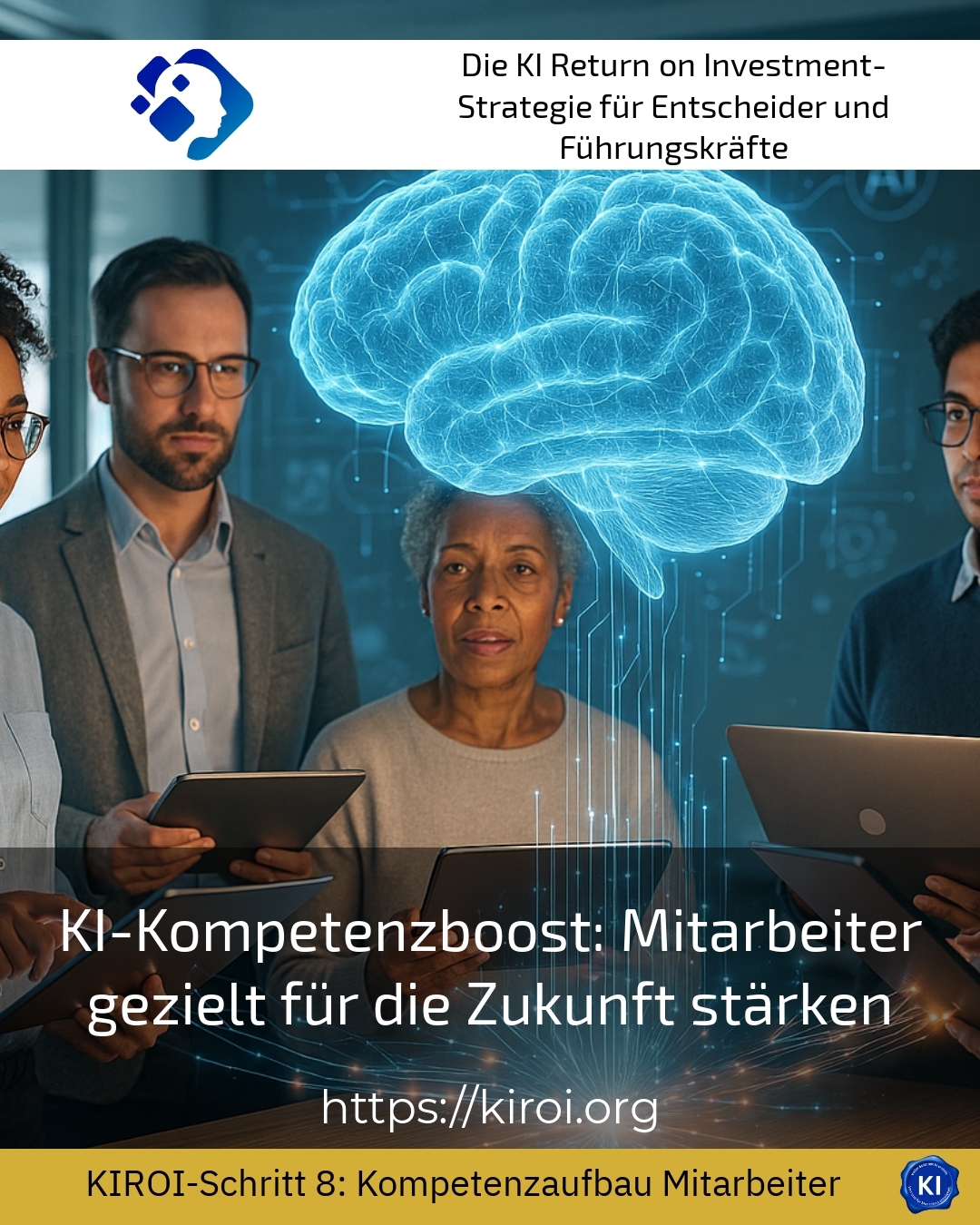
The rapid pace of technological development is fundamentally changing jobs. Companies face a crucial challenge. They must prepare their teams for entirely new requirements. The AI Skills Boost: Specifically Strengthening Employees for the Future becomes a strategic success factor. Those who do not act now will fall behind. But how can this transformation truly be achieved? Which paths lead to sustainable competence development? This article presents concrete approaches and tried-and-tested strategies.
Why an AI skills boost is essential today
Digital transformation is sweeping across all industries with enormous speed. This is creating entirely new job profiles and fields of activity. At the same time, traditional tasks are disappearing or fundamentally changing. Employees often perceive these changes as threatening. They fear for their relevance within the company. This is where professional support comes in, providing important impetus. Transruption coaching supports organisations in successfully shaping this transformation. It guides teams through phases of uncertainty and change.
Clients often report similar challenges in their daily work. They feel overwhelmed by new technical requirements. Some experience anxiety about losing their existing expertise. Others, however, recognise the opportunities but don't know where to start. These issues lead people to seek counselling and guidance. The demand for structured skills development is constantly growing and requires well-thought-out concepts.
Strategic AI skills boost through individual learning paths
Every person brings different preconditions and learning habits. Standardised training programmes therefore only effectively reach some of the workforce. Modern skills development takes this diversity into account and creates individual approaches. For example, in manufacturing companies, machine operators benefit from practice-oriented simulations. However, administrative staff in insurance companies need different learning formats and content. Managers, in turn, require strategic knowledge about the application possibilities and limitations of new technologies.
Transruption coaching clearly positions itself as support for projects addressing these issues. It helps companies develop and implement tailor-made learning architectures, always keeping people at the centre of all considerations. Technology serves as a tool, not as an end in itself or a threat. This perspective noticeably relieves many employees and opens up new areas for thought.
Best practice with a KIROI customer
A medium-sized company with around three hundred employees faced significant challenges. Management recognised the urgent need for action in the area of technological competencies. At the same time, there was great uncertainty among the workforce about upcoming changes. Many long-serving employees feared their expertise might be devalued. As part of the KIROI support, a comprehensive stocktake was initially carried out. This revealed that many informal competencies were already present within the company. These were made visible and used as a basis for further development. The company established internal learning partnerships between experienced and younger employees. Older colleagues contributed their process knowledge, while younger ones contributed technical know-how. This mutual cross-pollination significantly strengthened team cohesion. After six months, managers reported a noticeable increase in openness to change. Employee satisfaction improved measurably in corresponding surveys. Particularly noteworthy is the sustainable embedding of the new learning culture within the company.
Leaders as key figures of transformation
Without committed leaders, every skills initiative will remain ineffective and fizzle out. Managers significantly shape the learning culture of their departments through their own behaviour. If they themselves demonstrate curiosity and a willingness to learn, teams will follow suit. This is particularly evident in craft businesses when introducing digital tools. Foremen who openly experiment with new systems motivate their journeymen to emulate them. In hospitals, in turn, chief physicians crucially shape the acceptance of new diagnostic methods.
"Transruption" coaching supports leaders intensively in this role-modelling and role clarification. It helps them to act authentically and credibly. This is because employees quickly sense whether readiness for change is genuine or just feigned. This authenticity cannot be mandated, but it can be developed and cultivated. Leadership development therefore forms a central building block of any successful competence strategy. It creates the basis for sustainable change at all levels.
Practical implementation of the AI skills boost in everyday life
Theoretical knowledge alone does not equip anyone for the practical application of new skills. It is only through regular practice in everyday work that competencies are permanently and sustainably anchored. Companies are therefore increasingly creating protected experimental spaces for their employees. In logistics companies, teams can try out new route planning tools there without pressure. Banks set up so-called innovation labs for testing new consulting formats. Similar free spaces for pedagogical experiments with digital media are also being created in educational institutions.
These experimental rooms work best with clear rules and psychological safety. Mistakes are understood as learning opportunities rather than being penalised. This encourages employees to try new approaches and think creatively. Clients often report surprising insights from such protected environments. They discover abilities within themselves that they were previously unaware of. These experiences sustainably strengthen self-confidence and willingness to change.
Best practice with a KIROI customer
A municipal administration with over a thousand employees wanted to digitise its services. Initially, the staff had considerable reservations about this project. Many feared job losses due to automated processes and digital citizen services. In the KIROI project, significant effort was initially put into addressing these fears. Workshops provided space for open exchange and honest discussions about concerns. It became clear that many worries were based on insufficient information. The administration management subsequently communicated more transparently about planned changes and their impact. At the same time, specific further training courses were developed and made accessible to all employees. Particularly successful were small learning groups that met weekly for exchange. There, colleagues helped each other with technical questions. Experienced administrative professionals contributed their knowledge of processes and citizen concerns. Tech-savvy younger employees provided support in operating new systems. This combination proved to be extremely fruitful for all involved. After one year, attitudes towards digitisation had noticeably changed. Critics became constructive co-creators of the change processes.
Understanding and constructively using resistance
Changes almost always generate resistance among affected individuals and groups. This resistance is not a disruption, but a valuable source of information for organisations. It indicates where fears exist and which needs have not yet been taken into account. In law firms, for example, experienced partners often resist new research systems. Their concerns contain important clues about potential quality problems or data protection issues. In architectural firms, long-serving draughtspeople worry about the appreciation of their manual skills.
Transruption coaching takes such resistance seriously and works through it constructively. It helps companies to look beneath the surface of rejection. There, justified concerns and important perspectives for better solutions are often found. This integration of different viewpoints ultimately strengthens the quality of change processes. It leads to more sustainable results than simply pushing through innovations.
AI skills boost through collaborative learning
Learning is far more effective in a group setting than in solitary confinement. People motivate one another, share experiences and help each other when difficulties arise. Companies are increasingly applying this insight to their skills development strategies and learning formats. In retail companies, branch staff meet regularly to share experiences of digital tools. Care homes organise learning circles in which carers explore new documentation systems together. Informal networks are also emerging in engineering firms to share knowledge about new design software.
These collaborative learning formats offer several advantages over isolated training measures. They promote cohesion and a sense of belonging within the company. Employees experience themselves as part of a learning community with shared goals. At the same time, the inhibition threshold for asking questions or admitting uncertainties decreases. Social embedding makes learning both easier and more sustainable [1].
Sustainable anchoring of new competencies
One-off training sessions rarely leave a lasting mark on participants' daily work. Without continuous application, new knowledge quickly fades and is lost. Companies therefore need strategies for the sustainable anchoring of acquired competencies in everyday life. In tax advisory firms, new digital workflows are directly integrated into existing work processes. Advertising agencies create fixed times for the application and deepening of new creative tools. In manufacturing companies too, the regular use of new systems is incorporated into work schedules.
Transruptions coaching supports companies through this critical phase of consolidation [2]. It helps to identify and overcome barriers to implementation. Clients often report slipping back into old patterns after an initial burst of enthusiasm. These setbacks are normal and do not signify failure. With the right support, they can be turned into opportunities for learning.
Best practice with a KIROI customer
A family business steeped in tradition in the mechanical and plant engineering sector was seeking support. The third generation wanted to make the company fit for the future, while simultaneously preserving the valuable experience of its older employees. This apparent tension between tradition and innovation initially shaped discussions. Within the KIROI process, a shared vision for skills development was first established. All generations contributed their perspectives and expectations to this process, revealing surprisingly much common ground in fundamental values and goals. The company then developed a mentoring programme with intergenerational tandems. Experienced skilled workers supported younger colleagues with complex tasks, while in return, the younger employees introduced their mentors to new digital tools. This mutual appreciation had a noticeable, positive impact on the working atmosphere. Older employees felt needed and relevant to the company's development once more. Younger employees benefited from the wealth of experience and developed a deeper understanding of interdependencies. The project won a regional innovation award for exemplary personnel development.
My KIROI Analysis
The systematic development of future-relevant competencies is decisive for the competitiveness of companies. This goes far beyond technical knowledge or operating new software. At its core lies the ability for continuous adaptation and lifelong learning. Companies that embed this ability in their culture will be the winners of change [3].
The AI Skills Boost: Specifically Strengthening Employees for the Future It requires a holistic approach. Isolated measures quickly fizzle out and leave frustration among all involved. Only the interplay of leadership development, a learning culture, and practical application opportunities leads to success. These elements must be strategically aligned and professionally supported.
The practical examples presented show that sustainable competence development is possible and achievable. It requires patience, resources, and the willingness to constructively address resistance. Companies that take this path report positive side effects far beyond the actual learning objectives. Employee retention, willingness to innovate, and job satisfaction increase tangibly and sustainably.
Transruption coaching offers valuable support with these complex change projects. It brings experience, proven methods, and an unvarnished outside perspective. The KIROI methodology has proven itself in numerous projects across various industries. It combines strategic clarity with human sensitivity for the emotional aspects of change. Companies benefit from this combination of systematic approach and empathy on their transformation journey.
Further links from the text above:
[1] Federal Ministry of Education and Research – Further Education
[2] Haufe – Competence Development in Companies
For more information and if you have any questions, please contact Contact us or read more blog posts on the topic Artificial intelligence here.











 Deutsch
  English (UK)