
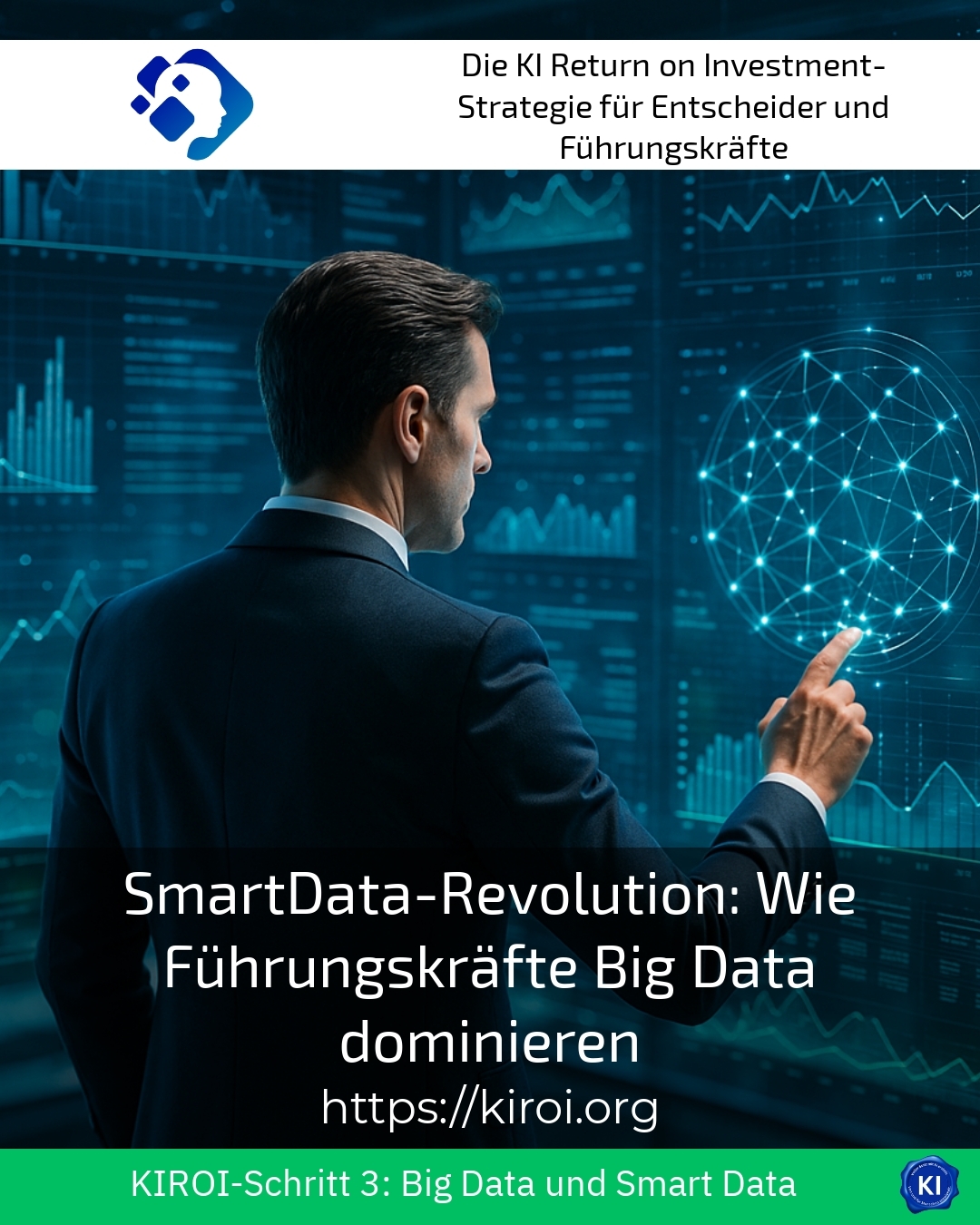
Have you ever wondered why some companies seemingly make decisions that turn out to be brilliant in retrospect, while others, despite enormous resources, repeatedly commit strategic mistakes? The answer often lies in the way leadership handles conflict. SmartData-Revolution How to get around it and how they manage to extract actionable insights from the flood of available information. At a time when unimaginable amounts of digital information are created every day, professional guidance is exactly what separates the wheat from the chaff at this point, and this is where leadership support comes into play to help leaders master this challenge.
The transformation of decision-making in modern organizations
The business world has fundamentally changed in recent years. Decisions are no longer based solely on gut instinct. Instead, successful leaders use intelligent data analysis. This development is changing entire industries from the ground up. This change is particularly evident in the financial sector. Banks analyze customer behavior in real time and adapt their offerings accordingly. Insurance companies use predictive models to assess risk. Investment firms rely on algorithmic trading strategies that complement human analysts [1].
In retail, we are observing similar changes. Large retail chains are optimizing their supply chains through intelligent predictive systems. They anticipate fluctuations in demand and proactively adjust inventory levels. Fashion houses analyze trends from social media. These insights are directly incorporated into design decisions. Supermarkets personalize their offerings based on individual shopping behavior. This creates tailored customer experiences that were previously unthinkable.
The healthcare sector is also benefiting significantly from this development. Clinics are using analytical tools to optimize treatment paths. Pharmaceutical companies are accelerating their research through intelligent data analysis. Health insurance companies are developing preventive programs based on health data. These examples illustrate how cross-industry collaboration is essential for the success of this sector. SmartData-Revolution What it does and why executives need to understand it.
Best practice with a AIROI customer
A medium-sized logistics company faced the challenge of making its route planning more efficient while simultaneously increasing customer satisfaction. The management realized that traditional planning methods were no longer sufficient to compete in the market. As part of our support, we developed a strategy together to intelligently utilize existing transport data. The team learned how to extract actionable insights from delivery times, traffic information, and customer feedback. Within six months, average delivery times were reduced by twelve percent. Customer satisfaction increased measurably, and fuel costs significantly decreased. Particularly noteworthy was that employees embraced the new tools enthusiastically. They recognized the added value for their daily work and brought forward their own suggestions for improvement. This case study exemplifies how transruptive coaching supports organizations in successfully implementing data-driven decision-making processes.
How the SmartData Revolution Redefines Leadership Skills
Modern leaders require a changed skill profile. However, technical understanding alone is not enough. Rather, it is about the ability to ask the right questions. What information is truly relevant for strategic decisions? How do you distinguish signal from noise in the data deluge? These questions concern leadership across industries and clients often report that this is where their biggest uncertainties lie.
In the automotive industry, we observe this development particularly vividly. Production managers use sensor data to proactively maintain machines. Sales managers analyze configuration data to identify trends. Development teams analyze vehicle data to continuously improve products [2]. These use cases require a new understanding of leadership. It is no longer enough to interpret results. Leaders must understand how insights arise.
The energy sector offers further insightful examples. Grid operators predict peak loads with high accuracy. Energy providers optimize their generation capacities based on weather data. Municipal utilities develop intelligent tariff models for their customers. All of these applications require that executives understand the underlying concepts and be able to strategically prioritize them.
The media industry is also witnessing remarkable developments. Streaming services recommend content based on usage patterns. Publishers analyze reading behavior to optimize their editorial strategy. Advertising agencies personalize campaigns in real time. These examples illustrate the breadth of possible applications.
The SmartData Revolution as a Catalyst for Organizational Change
The integration of intelligent analytical methods not only changes decision-making processes; it transforms entire organizational structures and corporate cultures. Silo thinking is increasingly giving way to data-driven collaboration across departmental boundaries. Marketing, sales, and production are working more closely together than ever before. This development requires new forms of leadership and collaboration [3].
In the telecommunications industry, we see this transformation particularly clearly. Customer service teams use analytics tools to proactively solve problems. Network engineers optimize capacity based on usage data. Product managers develop new services based on customer behavior. This cross-departmental use of insights creates significant competitive advantages.
Similar patterns are also evident in tourism. Hotels personalize guest experiences through intelligent analysis of past stays. Airlines optimize their pricing dynamically. Tour operators develop customized offerings based on customer preferences. These applications require a close collaboration between various business areas.
Best practice with a AIROI customer
A traditional family business in the manufacturing sector approached us with a clear goal: the next generation of management should be prepared for the challenges of a data-driven future. The previous decision-making processes were heavily based on experience and personal relationships. Both should be retained and, at the same time, complemented by analytical expertise. In intensive coaching sessions, we worked together to develop an understanding of the capabilities of modern analytical tools. The leadership development team learned to ask critical questions and evaluate data quality. They developed an awareness of when quantitative analysis is appropriate and when qualitative assessments are more important. Today, they make decisions that combine tradition and innovation. The company has strengthened its market position while maintaining its corporate culture. This case illustrates how transruptive coaching offers individual support that addresses specific needs.
Practical strategies for dominance through intelligent data utilization
The path to successful use of intelligent analysis methods requires a structured approach. Leaders are best off starting with an honest inventory of the current situation. What information is already available? What questions remain unanswered at the moment? This analysis forms the foundation for all further steps.
The pharmaceutical industry demonstrates how such strategies can be practically implemented. Research departments use analytical tools to identify promising drug candidates. Clinical trials are accelerated through intelligent patient selection. Sales teams optimize their activities based on prescription data. These applications require specific competencies and resources [4].
Innovative applications are also emerging in the construction industry. Project managers use analysis tools for cost estimation and scheduling. Site managers monitor progress through digital twins. Architects optimize designs based on simulation data. These examples illustrate the diversity of applications.
Agriculture also benefits from intelligent analytical methods. Precision agriculture optimizes the use of fertilizers and plant protection products. Harvest times are optimized by weather and crop data. Livestock farms monitor animal health through sensor technology. These applications increase yields while simultaneously conserving resources.
SmartData Revolution: Overcoming Challenges and Taking Advantage of Opportunities
The path to a data-driven organization is not without obstacles. Data protection and ethical issues require careful consideration. Employees must be involved and qualified. Technical infrastructure must be built and maintained. However, these challenges are solvable if they are approached systematically.
The financial services sector shows how organizations can find this balance. Banks use customer data responsibly to prevent fraud. Insurance companies develop fair pricing models taking regulatory requirements into account. Asset managers combine algorithmic analysis with personal advice. These examples demonstrate that innovation and responsibility can go hand in hand [5].
In the education sector, promising applications are also emerging. Universities analyze data on student progress to improve curricula. Training providers personalize learning content based on individual progress. Schools use analytics tools to identify support needs early on. These applications support learners on their individual journey.
Public administration is also discovering the possibilities of intelligent analysis. Cities optimize traffic flows through real-time data. Authorities improve citizen services through predictive capacity planning. Health departments use epidemiological data for prevention. These examples demonstrate societal benefits beyond economic applications.
Best practice with a AIROI customer
A healthcare executive came to us with a specific challenge: she was to lead a new analysis project, but felt technically uncertain and doubted her competence to communicate with the involved experts on an equal footing. In our collaboration, we first developed a solid understanding of the relevant concepts and methods. We jointly developed a questionnaire that enabled critical evaluation of technical proposals without needing to be a programmer expert ourselves. The executive learned to ask the right questions and to relate findings to their professional expertise. The project was successfully completed and the gained insights led to measurable improvements in patient care. Particularly significant was that the executive was able to significantly increase her confidence in dealing with data-driven projects. Today she leads further initiatives in this area and shares her knowledge with colleagues.
My AIROI Analysis
Examining numerous industries and use cases reveals a clear pattern: organizations whose executives understand the principles of intelligent data utilization and strategically employ them achieve sustainable competitive advantages in an increasingly dynamic market environment. This is not about becoming technical experts or developing complex algorithms ourselves. Rather, the key lies in the ability to formulate relevant questions, critically evaluate results, and translate insights into strategic decisions.
My work with executives from a wide variety of industries has shown that the biggest obstacles are rarely of a technical nature. Clients often report uncertainties in dealing with a seemingly complex subject area. They feel overwhelmed by the speed of change. Or they struggle with organizational resistance to change. These issues can be addressed if they are openly discussed.
Transruptions coaching provides valuable support for projects related to data-driven transformation. It involves individual impulses that empower leaders to confidently fulfill their role in a changing business world. SmartData-Revolution It is not a threat to experienced leaders. On the contrary: it opens up opportunities for everyone who is willing to continuously learn and develop themselves. The future belongs to those who understand technology as a tool and combine it with human judgment. Strengthening this connection is the goal of my work.
Further links from the text above:
[1] McKinsey Analytics – Executive Insights on Data Strategy
[2] Harvard Business Review – Data and Analytics
[3] Gartner – Data and Analytics Insights
[4] Forbes Technology Council – Data Leadership
[5] World Economic Forum – Data Science and Society
For more information and if you have any questions, please contact Contact us or read more blog posts on the topic Artificial intelligence here.









 Deutsch
 English (UK)