
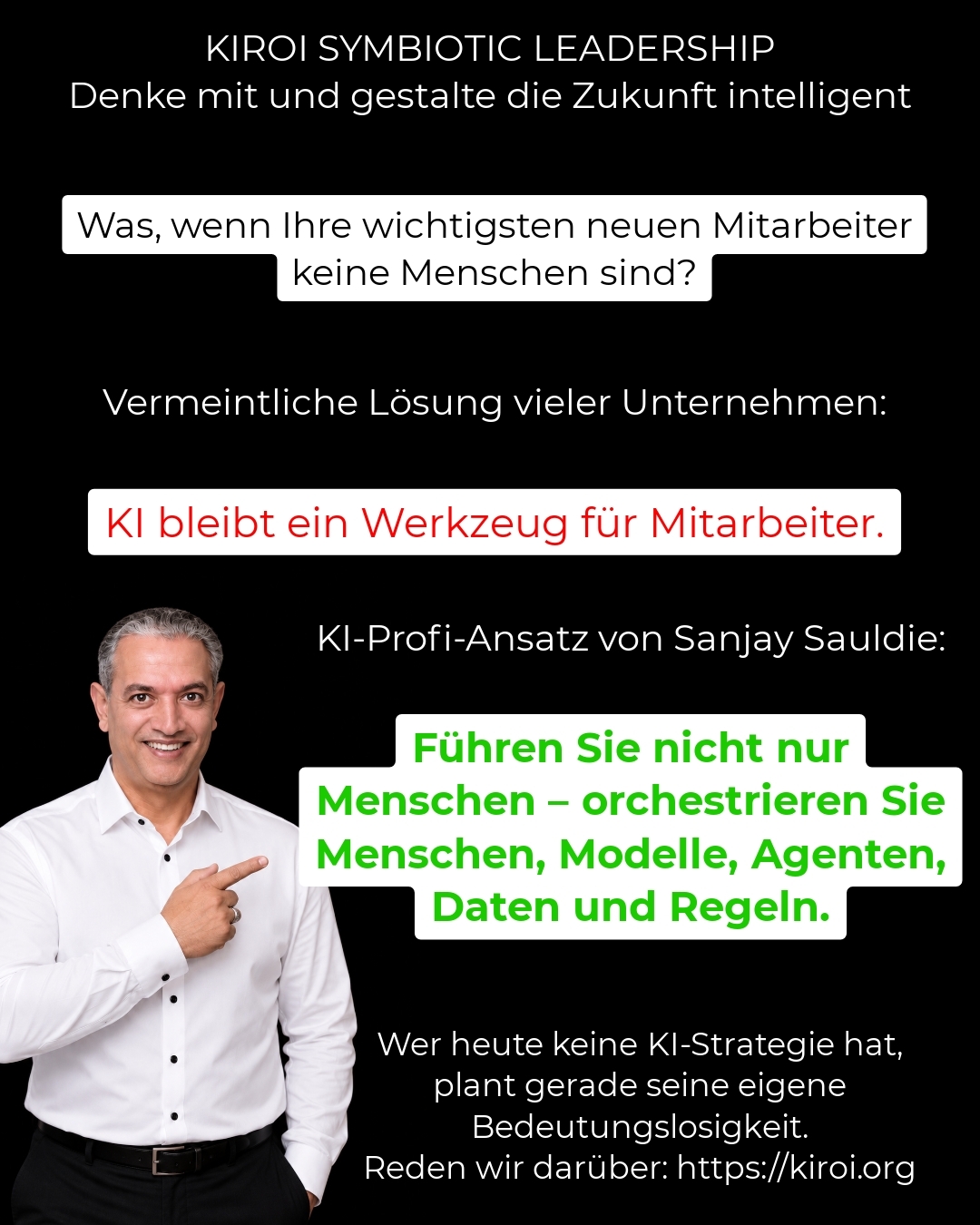
Have you ever wondered why some organizations seemingly master digital transformation effortlessly, while others, despite enormous investments, stagnate? The answer often lies not in the technology itself, but in a fundamental misunderstanding of how modern work environments actually work. More and more executives report that their most significant new hires in the team have not undergone a job interview. These new team members do not need desks, break rooms, or salary negotiations. They work around the clock, continuously learn, and change the way we think about Don’t just lead people – orchestrate people, models, agents, data, and rules We need to think. Welcome to an era in which the traditional understanding of team leadership needs to be fundamentally questioned.
The conventional approach: If intelligent systems are considered only as tools
Most organizations are reacting to this new reality with remarkable restraint. They treat advanced digital solutions solely as tools that are operated by employees. This perspective initially seems reasonable and low-risk. However, it overlooks a crucial point. Modern intelligent systems are no longer passive instruments. They make decisions, generate content independently, and interact directly with customers. In many companies, we observe that this approach leads to significant loss of efficiency.
For example, a medium-sized service provider implemented an advanced analytics system. The employees should have used it like a better spreadsheet program. The result was disappointing, because no one recognized the strategic opportunities. A manufacturing company introduced automated quality control without involving the process managers. The result was conflict between human inspectors and machine recommendations. A retail company relied on automated customer communication, but without clear governance, inconsistent brand messages emerged. These examples illustrate a recurring pattern.
The fundamental problem lies in their organizational framework. When intelligent systems are considered merely as tools, they lack a place in the organizational structure. No one feels responsible for their further development. No one coordinates their interaction with human colleagues. And no one defines clear rules for their decision-making authority. This creates digital silos that create more problems than they solve.
The perspective: Don AIROI't just lead people – orchestrate people, models, agents, data, and rules
The AIROI-approach offers a fundamentally different perspective on this challenge. It recognizes that modern organizations have become hybrid ecosystems. In these ecosystems, people, algorithmic models, autonomous agents, data streams, and rules work together. The task of leaders is to orchestrate this interaction. It is no longer about simply managing employees and providing technology.
Imagine an experienced conductor. He works not only with the musicians, but also with the instruments, the acoustics of the room, the scores, and the performance rules. Only the harmonious interplay of all these elements creates great music. Just as it is with modern corporate management. A logistics company that has adopted this philosophy reports remarkable improvements. Route planning is performed by algorithmic models, but human dispatchers retain the final decision in special cases. Autonomous agents monitor delivery times and escalate proactively in case of delays. Data flows from various sources are combined in real time. Clear rules define when which instance should intervene.
Another example comes from the healthcare sector. There, diagnostic algorithms work closely with medical professionals. The models provide probabilities and recommendations, but the final diagnosis remains with the human being. At the same time, the systems learn from each case and continuously improve. Data governance ensures that patient data remains protected. Ethical guidelines define the limits of automated decision-making. This interplay requires a new way of leadership.
Best practice with a AIROI customer
A service company with several thousand employees faced a complex challenge because customer requests had increased exponentially and the existing processes were no longer sufficient to ensure quality and speed alike. As part of a transruptive coaching project, a comprehensive inventory was first conducted, identifying all relevant processes, data sources, and decision points. Together with the management team, we developed a hybrid model that integrated autonomous agents for standard requests, human experts for complex cases, and algorithmic models for prioritization and resource planning. Particularly important was the development of a clear set of rules that defined when which instance has decision-making authority and how escalations should proceed. The employees were involved from the very beginning and received training to understand and assume their new role as orchestra leaders. After implementation, the teams reported a significantly reduced workload while simultaneously increasing customer satisfaction. The executives emphasized that the decisive success factor was not the technology itself, but the thoughtful interplay of all elements in the sense of Don’t just lead people – orchestrate people, models, agents, data, and rules.
The five dimensions of orchestration
To practically implement this approach, leaders must keep five dimensions in mind: first, the people with their skills, motivations, and development potential; second, the models, that is, the algorithmic systems that recognize patterns and make predictions; third, the agents that can act autonomously and interact with the environment; fourth, the data that serve as the basis for all decisions; and fifth, the rules that coordinate the interaction and set boundaries.
In practice, this means, for example, that a manufacturing company must rethink its production planning. Human planners bring experience and creativity. Optimization models calculate efficient machine scheduling. Autonomous agents respond to disruptions and adapt plans in real time. Sensor data from the production flow continuously into the systems. And clear rules define priorities, safety limits, and escalation paths. A financial services provider orchestrates its risk management according to similar principles. Analysts assess complex situations that algorithms cannot capture. Models calculate probability of failure and correlations. Agents monitor portfolios and generate automatic alerts. Market data and customer information are intelligently linked. Compliance rules and ethical guidelines limit the scope of action of automated systems.
Practical implementation: Don’t just lead people – orchestrate people, models, agents, data, and rules in everyday life
The theoretical foundations are understandable, but how does the practical implementation take place? In general, change begins with a change in the leaders’ self-perception. They must see themselves as conductors, not as superiors in the traditional sense. This requires new competencies and often a rethinking of corporate culture. Transruptions coaching assists leaders in completing this transformation and anchoring it sustainably.
A concrete starting point is mapping the current ecosystem. What human roles exist and how are they defined? Which algorithmic models are in use and who is responsible for them? What autonomous agents exist and what decisions do they make? Which data sources are used and how do the information flow? Which explicit and implicit rules govern the interaction? This analysis often reveals surprising insights. For example, a trading company discovered that three different departments had developed similar predictive models without knowing about each other. An insurance company recognized that autonomous agents were making decisions that no one else was checking anymore. A technology company found that important data sources were not being systematically used.
After the inventory, the definition of responsibilities follows. Who is responsible for the performance of the models? Who monitors the behavior of the agents? Who ensures the data quality? Who updates the rules when requirements change? These questions may seem trivial, but in many organizations they remain unanswered. The result is governance gaps that can pose significant risks.
The role of communication in hybrid teams
An often underestimated aspect concerns the communication between the various elements of the ecosystem. How do human employees learn about the recommendations of the models? How are they informed about the actions of the agents? How can they provide feedback that feeds into the further development? An energy provider developed a dashboard to bring together all relevant information. A media company introduced regular review meetings where algorithmic decisions are jointly analyzed. A pharmaceutical company established a feedback system through which researchers can evaluate the quality of data analyses.
Transparency about the capabilities and limitations of the various actors is particularly important. Human employees must understand what the models can and cannot do. They must know in what situations they can trust the recommendations. And they must recognize when their own expertise is needed. This transparency creates trust and enables genuine collaboration. Without it, either blind dependence or baseless rejection arises.
Best practice with a AIROI customer
An international consulting firm wanted to fundamentally modernize its project management processes and was looking for an approach that went beyond pure automation. As part of the collaboration, we jointly identified all the points of contact between human consultants, analytical systems, and automated processes. We developed an integrated concept in which project managers retained strategic control while models predicted resource utilization and risks. Autonomous agents took on routine tasks such as scheduling coordination and status queries, so that human employees could focus on value-adding activities. Particular emphasis was placed on developing a framework that clearly defined escalation paths and decision-making capabilities. The consultants reported that they were initially skeptical, but after a few weeks appreciated the benefits of the new working method. The project impressively demonstrated how Don’t just lead people – orchestrate people, models, agents, data, and rules In practice, it can work if all the involved parties are included and supported.
The future of leadership: new skills for a new era
What does this change mean for leaders personally? Which competencies become more important, which ones recede into the background? First, systemic thinking gains importance. Leaders must understand complex connections and be able to anticipate interactions. Additionally, they need to possess technological judgment, that is, the ability to realistically assess the potential and limitations of various systems. Ethical reflection is also becoming more important, as autonomous systems make decisions that have moral dimensions.
At the same time, classic leadership skills remain relevant. Empathy and communication skills are indispensable for guiding teams through change. Strategic thinking enables setting the right priorities. And decisiveness is required when complex decisions need to be made. The challenge lies in integrating these different competencies. A telecommunications company developed a special leadership program to address this. An automotive supplier established mentoring partnerships between technically and professionally oriented managers. A consumer goods manufacturer created new roles that serve as a bridge between human teams and technical systems.
My AIROI Analysis
The central insight of this article can be summarized as follows. Organizations that view intelligent systems only as tools waste enormous potential and at the same time create new risks. The AIROI-approach offers a compelling alternative by placing the orchestration of all relevant elements at the center. This requires a fundamental change in mindset among executives and in corporate culture. The practical examples show that this change is possible and worthwhile. Companies from various industries report improved results, higher employee satisfaction, and increased adaptability.
What is crucial here is the realization that it is not about technology versus people. Rather, it is about the intelligent interplay of various actors and resources. The role of the leader is transforming from a supervisor to an orchestrator. This is challenging but also rewarding because it opens up new design possibilities. Transruptive coaching can support and accompany this change by providing impulses and helping with practical implementation. The future belongs to those who understand hybrid ecosystems and can navigate them with confidence. The first step is to map out one’s own ecosystem and consciously take on the orchestrating tasks.
Further links from the text above:
[1] McKinsey – The State of AI
[2] Harvard Business Review – Artificial Intelligence
[3] Gartner – Artificial Intelligence Insights
You are a leader and would like to learn how to truly implement AI in your company in a valuable and sustainable way, away from the hype? Contact us: Contact us or read more blog posts on the topic Artificial intelligence here.










 Deutsch
  English (UK)