
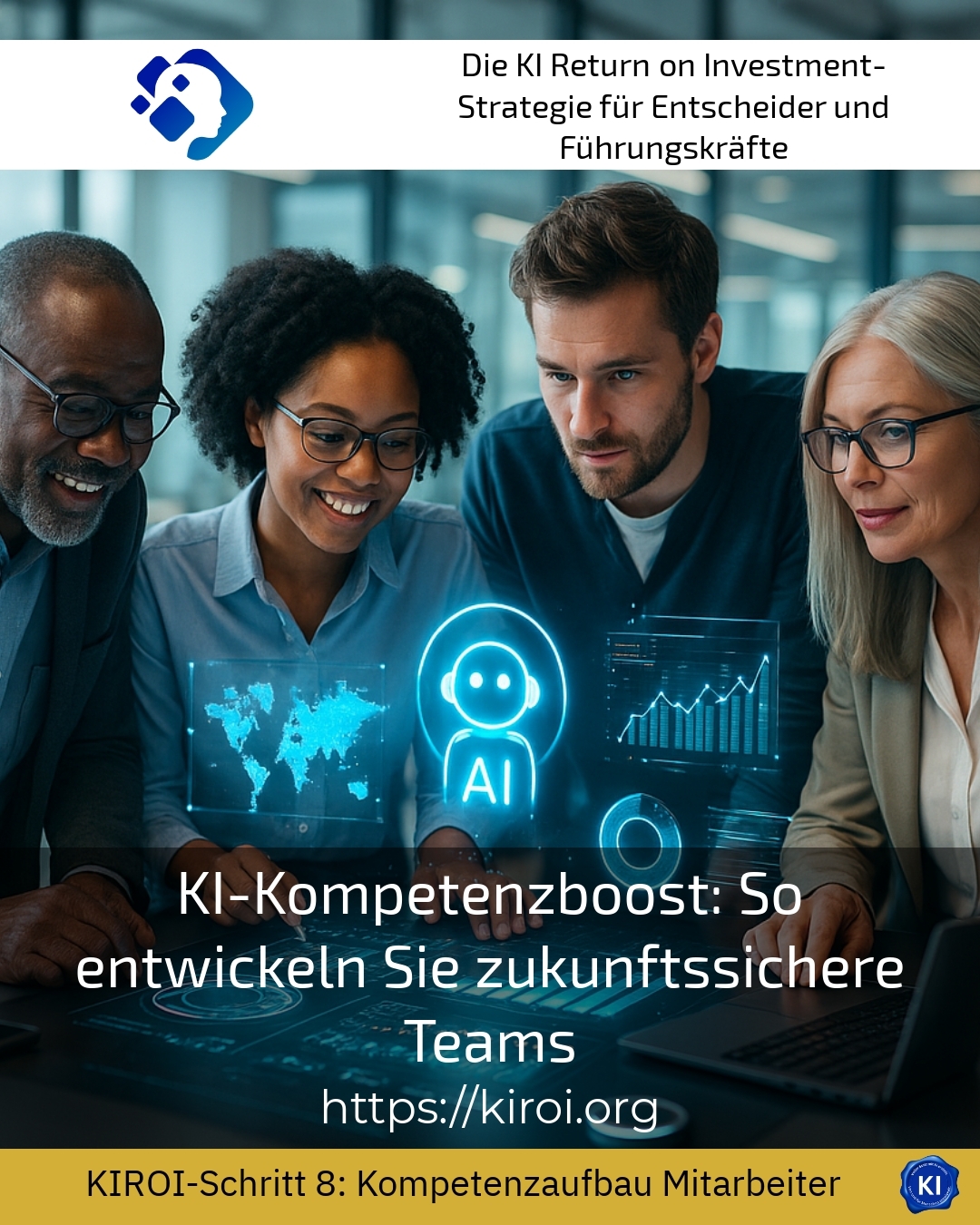
Imagine your employees confidently navigating a world where intelligent systems are fundamentally transforming daily work. While some companies are still hesitating, innovative organisations have long been systematically AI Skills Boost, to build future-proof teams. The question is no longer whether this transformation is coming, but how quickly you are preparing your workforce for it. Because those who invest in their people's skills today secure the overall competitiveness of the company tomorrow.
Why the AI skills boost is becoming a strategic imperative
The world of work is undergoing a profound transformation. Intelligent algorithms are taking over repetitive tasks. At the same time, entirely new fields of activity are emerging. This development requires a fundamental rethink in personnel development. Managers increasingly recognise that technological investments alone are not enough. The decisive success factor lies in empowering employees. Only competent teams can fully exploit the potential of new tools. Therefore, systematic skills development is moving into the focus of strategic planning.
This transformation is particularly evident in manufacturing companies. Machine operators today work with systems that carry out quality checks independently. They interpret complex data analyses and make decisions based on them. In customer service, intelligent assistants help process enquiries. Employees take on the challenging tasks of quality assurance and escalation management. Automated processes are also fundamentally changing job profiles in the finance sector. Accountants are evolving into data analysts who identify anomalies and make strategic recommendations.
The change affects all hierarchical levels and functional areas. Marketing teams use predictive analytics for personalised campaigns. HR managers rely on data-driven selection processes. Sales employees work with intelligent recommendation systems. These examples illustrate the breadth of the changes. At the same time, they make it clear why proactive skills development has become indispensable.
Best practice with a KIROI customer
A medium-sized logistics company faced the challenge of preparing its dispatch department for new planning systems. Initially, the workforce showed significant reservations towards the technological innovations. As part of comprehensive support from transruptions-coaching, we developed a multi-stage qualification programme. First, we conducted workshops to explain the functionality of the new systems understandably. Subsequently, employees trained in the practical use of the tools in protected practice environments. In parallel, we supported management in redesigning work processes. The dispatchers learned to critically evaluate and optimise the systems' suggestions. After six months, employees reported significantly increased job satisfaction. The error rate in route planning decreased by more than a third. At the same time, the teams gained time for strategic tasks such as customer service and process improvement.
The five pillars of sustainable AI competency enhancement
Effective skills development is based on several supporting elements. First, a solid fundamental understanding of the underlying technologies is needed. Employees don't need to become programmers. However, they should understand how intelligent systems work and where their limitations lie [1]. This foundational knowledge creates the prerequisite for a critical and constructive approach to new tools.
The second pillar is practical application skills. Theoretical knowledge alone is not enough. Employees need sufficient opportunities to experiment and practice. In production environments, this means, for example, working with simulations. Sales teams can initially test new tools in role-playing exercises. Customer service employees can train how to use assistance systems with realistic case studies. This practical practice phase reduces apprehension and promotes acceptance.
As a third pillar, the development of judgment proves to be essential. Intelligent systems produce results and recommendations, and people must be able to evaluate these outputs. They decide when to follow the suggestions and when to deviate. This capability requires expertise, experience, and well-trained critical thinking. In the financial industry, analysts examine automatically generated risk assessments. In healthcare, professionals evaluate diagnostic clues. In human resources, recruiters question algorithm-based candidate suggestions.
The fourth pillar encompasses communication and collaboration skills. Teams are increasingly working in a hybrid manner with both human and machine actors. This collaboration requires new forms of communication. Employees are learning to formulate precise requests. They are practising how to prepare and present results comprehensibly. In development teams, project managers coordinate the work of human colleagues and automated systems. In marketing, creative directors align human idea generation with data-driven recommendations.
The fifth pillar is the willingness to engage in continuous learning. Technologies are developing at a rapid pace. Skills that are relevant today may already be outdated tomorrow. Employees therefore need the ability and motivation for lifelong learning. Companies support this through allocated learning time, resources, and a culture that tolerates mistakes. In consulting firms, employees schedule regular further training periods. In technology companies, teams share new insights through knowledge-sharing formats.
Leadership skills for the AI skills boost in teams
Managers play a key role in the skills development of their teams. They create the conditions for successful learning. At the same time, they act as role models in dealing with new technologies. Therefore, the transformation process also requires targeted management development [2]. Managers learn to accompany change processes and address resistance constructively. They develop an understanding of the psychological aspects of technological upheavals.
In manufacturing companies, foremen and supervisors guide their teams through the introduction of new production systems. In retail, branch managers support their staff in using intelligent inventory management tools. In banks, department heads introduce their employees to automated advisory systems. These leadership tasks require, in addition to technical understanding, above all emotional intelligence and strong communication skills.
Support from external expertise can effectively aid this process. Transruption coaching offers leaders inspiration and space for reflection. Within protected settings, they explore their own reservations and uncertainties. They develop strategies for dealing with sceptical team members. They learn to communicate realistic expectations and avoid overload. This support work strengthens transformation competence at all management levels.
Best practice with a KIROI customer
An insurance company wanted to optimise its claims processing using intelligent systems. The aim was to relieve claims processors of routine tasks so they could concentrate on complex cases. However, many employees feared a loss of professional relevance. As part of the collaboration, we first developed a communication concept for the management team. In workshops, the managers developed concrete answers to their teams' concerns. They practiced empathetic communication skills in simulated situations. In parallel, we organised information events for the workforce. There, experienced colleagues explained the new work processes from their perspective. Employees were able to ask questions and express concerns. Subsequently, we supported the gradual introduction with regular feedback sessions. After implementation, the claims processors reported increased job satisfaction due to more challenging tasks. The team leaders felt well-prepared for their changed leadership role thanks to the intensive preparation.
Practical implementation strategies for different organisational sizes
The specific design of competence development programmes depends on various factors. Large corporations often have their own academies and extensive resources. Medium-sized companies frequently work with external partners and tailor-made solutions. Small businesses increasingly rely on informal learning and targeted individual measures. However, regardless of company size, some proven principles apply.
Initially, a thorough assessment of existing competencies is recommended. Companies systematically identify strengths and areas for development. In industrial companies, HR managers map the technical skills of the workforce. In the service sector, they record digital competencies and willingness to change. This analysis forms the basis for targeted development measures [3].
In the next step, companies define concrete competence profiles for various roles. What skills will a production planner need in five years? How will the profile of requirements for a customer advisor change? These future scenarios provide a clear direction for competence development. In logistics companies, new profiles are emerging, such as a data-driven fleet manager. In retail, sales assistants are evolving into omnichannel advisors with digital expertise.
Ideally, implementation takes place using a mix of methods. Formal training provides structured foundational knowledge. Practical projects allow for application under real-world conditions. Mentoring programmes facilitate knowledge transfer between experienced and new employees. Learning communities create spaces for peer exchange. In technology companies, teams experiment with new tools in innovation labs. In authorities, pilot groups test digital administrative processes.
Overcoming challenges and transforming resistance
The introduction of new technologies and the associated skills development often encounter resistance. Employees worry about their professional future. They doubt their ability to learn or feel that the changes devalue their previous expertise. These reactions are human and understandable. A successful AI skills boost explicitly takes these emotional dimensions into account.
Open communication forms the foundation of a successful transformation. Managers explain the reasons for change in a transparent manner. They also acknowledge uncertainties and maintain an ongoing dialogue with their teams. In manufacturing plants, plant managers provide regular updates on the progress of automation projects. In administrative departments, department heads report on progress with digitalisation. This transparency builds trust and reduces rumours.
Participation significantly increases the acceptance of change processes. Employees who actively co-design new processes develop ownership. They identify with the results and support their implementation. In hospitals, nurses co-design digital documentation systems. In skilled trades companies, fitters contribute suggestions for improvement to new planning tools. This involvement leverages valuable practical knowledge and fosters motivation.
Quick successes build learners' self-confidence. Companies therefore start with low-threshold applications and simple use cases. Complexity increases gradually. This way, employees experience their growing competence immediately. In tax consultancies, clerks initially automate simple data entry tasks. Later, they take over the control of more complex analysis processes. This progression avoids overload and systematically builds skills.
Best practice with a KIROI customer
A medium-sized mechanical engineering company was planning the introduction of predictive maintenance systems in its production halls. The experienced maintenance technicians reacted sceptically to the announcement. Many felt that the data-based prognoses called into question their decades of experience. In the coaching process, we first worked with the management team on an appreciative communication strategy. The technology was consciously positioned as a supplement and not a replacement for existing knowledge. In workshops, the technicians contributed their expertise to the calibration of the systems. They defined relevant parameters and validated the algorithms using real case studies. This active participation transformed initial resistance into constructive co-operation. The technicians developed pride in their role as indispensable experts in the human-machine interaction. The implementation was successful on schedule and with high acceptance among the workforce. Furthermore, the quality of the prognoses improved significantly through the incorporated experience.
My KIROI Analysis
The development of future-proof teams through systematic skills building is proving to be one of the most important strategic tasks of our time. Organisations that proactively tackle this challenge create decisive competitive advantages for themselves. They retain qualified employees and position themselves as attractive employers. At the same time, they utilise the potential of new technologies more effectively than hesitant competitors.
Experience from numerous projects reveals recurring patterns of success. Companies benefit from a clear strategic direction in their skills development. They closely link training measures with concrete business objectives. They invest not only in technical training but also in leadership development and cultural change. They create psychological safety, which enables experimentation and learning from mistakes.
At the same time, many organisations underestimate the time required and the complexity of such transformation processes. Sustainable skills development is not a one-off project, but an ongoing task. It requires continuous investment in time, resources and attention. Support from experienced partners can provide valuable impetus and help to avoid typical pitfalls.
For leaders and decision-makers, this offers clear recommendations for action. Begin with an inventory and planning at an early stage. Actively involve your employees in the design process. Communicate openly and continuously about goals, progress and challenges. Create space for learning and experimentation. Celebrate successes and deal constructively with setbacks. This is how you develop teams that not only master the next technological wave, but actively shape it.
Further links from the text above:
[1] McKinsey: The State of AI
[2] Harvard Business Review: Leadership Development
[3] World Economic Forum: Future of Jobs Report
For more information and if you have any questions, please contact Contact us or read more blog posts on the topic Artificial intelligence here.











 Deutsch
  English (UK)