
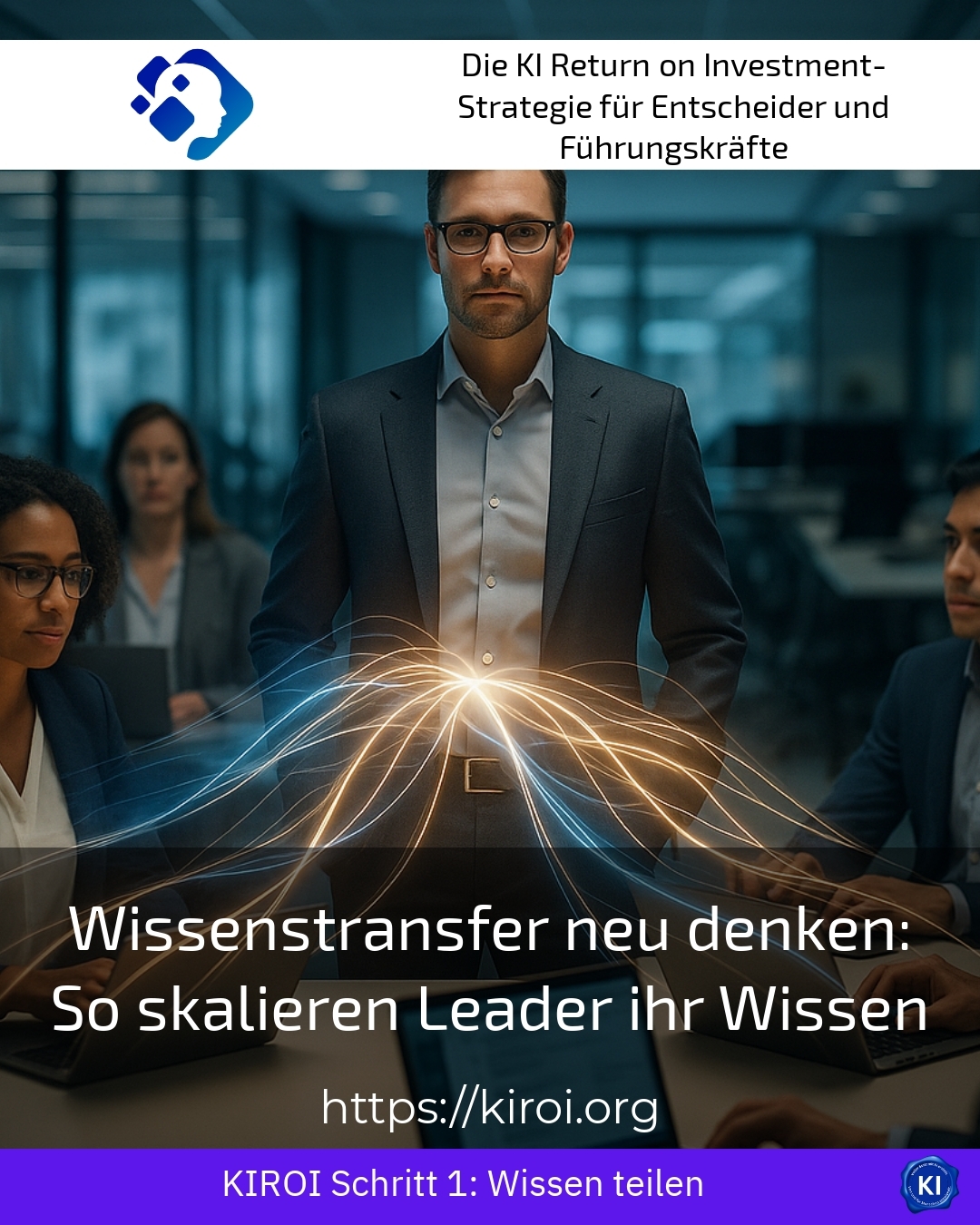
Imagine being able to pass on your most valuable insights and experiences to hundreds of employees without having to be there in person. This is exactly what a well-thought-out approach to Rethinking knowledge transfer, ...which enables leaders to systematically multiply their expertise. In an era where expertise becomes obsolete faster than ever before, many decision-makers are looking for ways to sustainably anchor their competence within the company. In doing so, they frequently approach us with the question of how to bridge the gap between day-to-day operations and strategic knowledge transfer. The answer lies not in longer working days, but in smarter systems and structures.
Why traditional methods reach their limits
The classic transfer of knowledge follows a linear pattern. An experienced person explains what they know to another. This model was perfectly satisfactory in the past. However, today companies face completely different challenges. Teams work distributed across multiple locations and time zones. New employees require faster onboarding than before. At the same time, the complexity of tasks is continuously increasing.
A prime example from the manufacturing industry illustrates this issue particularly clearly. A production manager has decades of experience with complex machinery. His knowledge extends beyond technical specifications; he also recognises the subtle signs of impending failures. This implicit knowledge is difficult to impart through traditional training. The logistics sector is similar. Dispatchers develop a feel for optimal route planning over years, considering factors that are not documented in any manual. In healthcare, experienced nurses likewise gather valuable observations. These small details can be crucial for patient care.
Rethinking knowledge transfer through systematic documentation
The first step towards scalable knowledge begins with structured capture. This isn't about dry process descriptions. Rather, managers should make their decision logic transparent. They should explain why they choose certain paths in specific situations. This context-dependent documentation creates significantly higher added value than standardised operating procedures.
In the financial sector, successful leaders are now utilising short video sequences. They explain their analysis methods for risk assessment in these videos. In the automotive supply industry, digital knowledge databases are being created. These contain not only design drawings but also the stories behind specific design decisions. This trend is also evident in the retail sector. Branch managers are sharing their experiences with difficult customer situations. They describe which approaches have proven effective in practice.
Best practice with a KIROI customer
A medium-sized company in the pharmaceutical industry was facing a particular challenge because several experienced laboratory managers were due to retire at the same time. The management recognised early on that valuable knowledge would be leaving the company with these individuals. As part of a transruptions coaching project, we supported the company in developing a comprehensive knowledge retention strategy. Firstly, we conducted structured interviews with the experienced managers, paying particular attention to tacit knowledge. The laboratory managers described not only standardised procedures, but also their personal heuristics for unexpected situations. These findings were then processed and documented in various formats. Short instructional videos, annotated case studies and interactive decision trees for common problem scenarios were created. After six months, the subsequent managers reported feeling much more confident when making complex decisions because they were able to access the combined experience of their predecessors.
Technological Support for Scalable Knowledge Transfer
modernen digitalen Werkzeuge eröffnen völlig neue Möglichkeiten für den Rethinking knowledge transfer Approach. Intelligent systems can analyse large amounts of documentation and provide relevant information in context. This means employees no longer have to search through archives for long periods. They receive suitable answers exactly when they need them.
In the energy sector, grid operators are relying on knowledge-based assistance systems [1]. These support technicians with on-site fault diagnosis. The system draws on the documented experience of many colleagues. In mechanical engineering, so-called digital twins of production facilities are being created [2]. These virtual replicas also contain the operational knowledge of the users. Innovative approaches are also emerging in traditional crafts. Master workshops are using augmented reality glasses for training. Apprentices can thus adopt the perspective of experienced craftspeople.
Rethinking knowledge transfer in leadership development
Scaling knowledge proves particularly challenging in the area of leadership competence. Leadership decisions often depend on situational factors. They cannot be translated into simple if-then rules. Nevertheless, there are patterns and principles that can be passed on.
Some corporations in the technology sector have established internal podcast series where experienced leaders discuss their most challenging decisions, openly reflecting on mistakes and lessons learned. In the banking sector, digitally supported mentoring networks are emerging, allowing junior staff to specifically search for mentors with particular experience profiles. In the media industry, editors-in-chief use annotated case studies to demonstrate how they made editorial decisions in critical situations.
The role of communities in knowledge transfer
Knowledge only unfolds its full value when it's shared. That's why communities play a central role in scaling expertise. In such networks, employees can ask questions and share experiences. Knowledge grows through the collective contribution of many participants.
In the consulting sector, specialist groups have a long tradition. Specialists discuss current developments there regularly. In software development, communities of practice have emerged around specific technologies. Members document proven solution approaches together there. This approach is also gaining importance in the public sector. Administrations in various municipalities are networking to learn from each other. Experiences with new citizen services are thus disseminated more quickly.
Best practice with a KIROI customer
An international logistics company wanted to make the knowledge of its best site managers systematically accessible. The challenge was that the branches worked in different countries with different cultural contexts. As part of transruptions coaching, we supported the development of a multilingual knowledge platform that explicitly took cultural differences into account. We first identified the critical areas of knowledge together with the management, focussing on topics such as personnel management, customer relations and crisis management. Experienced site managers then conducted moderated reflection discussions in which they analysed and articulated their success factors. These findings were presented in various media formats so that different types of learners could be addressed. The exchange function between the locations proved to be particularly valuable, as managers were able to ask questions and discuss issues directly. After one year, many participants reported concrete improvements in their branches, which were based on impulses from the community.
Overcoming barriers and creating acceptance
Technical options for scaling knowledge are widely available today. Nevertheless, many initiatives fail due to human factors. Some managers hesitate to share their knowledge. They fear losing importance thereby. Others underestimate the value of their own experiences.
In the insurance industry, companies have developed incentivised systems for knowledge sharing. Employees receive recognition for particularly valuable contributions. In the construction industry, experienced project managers are explicitly released from other duties to focus on documentation time. They do not have to complete this important task on the side. In the food industry, innovation awards are given for best-shared practices. Teams are recognised for paving the way for others.
Quality assurance and continuous updating
Documented knowledge can quickly become outdated. Therefore, successful knowledge systems require quality assurance mechanisms. Content must be regularly reviewed and updated. Outdated information can do more harm than good.
In the aviation industry, strict standards apply to technical documentation [3]. Every change is demonstrably recorded and communicated. Similar requirements exist in the healthcare sector for clinical guidelines. Evidence-based recommendations are adapted in light of new research findings. The importance of up-to-date knowledge bases is also evident in the legal sector. Law firms maintain extensive archives of precedents and their relevance.
My KIROI Analysis
Scaling leadership knowledge represents one of the most significant challenges for organisations, as it can determine the difference between sustainable success and recurring knowledge loss. Through our support on numerous projects, we have observed that successful companies follow three essential principles to, when Rethinking knowledge transfer to move forward. Firstly, they create a culture where sharing knowledge is seen as a strength, not a weakness. Secondly, they invest in suitable technological infrastructures that facilitate access to documented knowledge. Thirdly, they establish routines and processes that support the continuous capture and updating of experiential knowledge.
Clients often report initial resistance to the introduction of systematic knowledge transfer programmes. However, this resistance can be significantly reduced through transparent communication and early involvement of those affected. Investing in structured knowledge transfer pays off in the long term, as companies become more resilient to personnel changes. They can onboard new employees more quickly and develop a learning organisational culture. Transruption coaching can provide impetus on how individual solutions for specific company contexts can look. Every organisation brings its own prerequisites, which should be taken into account during the design process.
Further links from the text above:
[1] Accenture – Knowledge Management in the Energy Industry
[2] Platform Industry 4.0 – Digital Twins in Production
[3] EASA – Standards for Technical Documentation in Aviation
For more information and if you have any questions, please contact Contact us or read more blog posts on the topic Artificial intelligence here.











 Deutsch
  English (UK)