
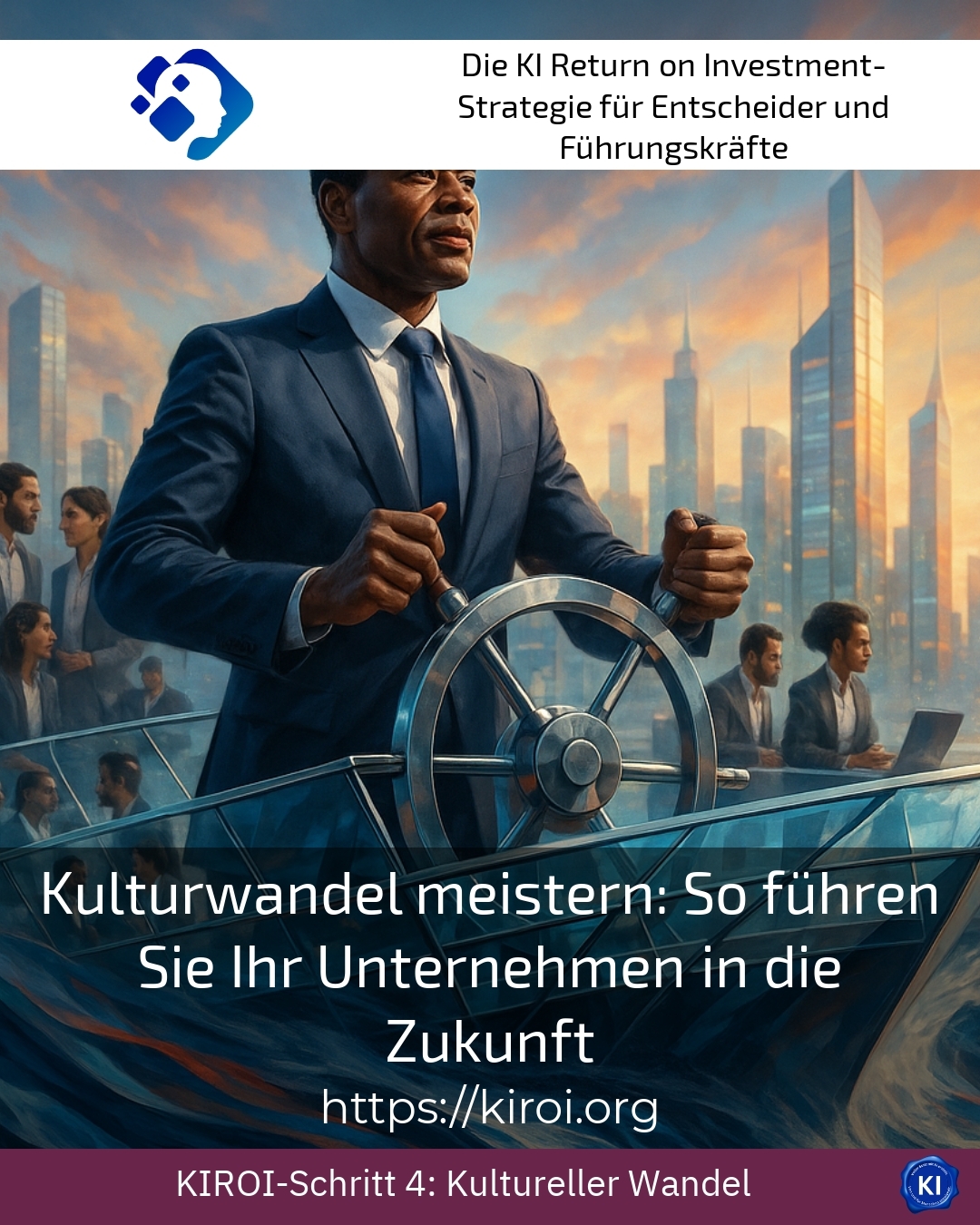
Imagine your company is at a crossroads, and the decisions you make today will determine whether you are still relevant in five years' time. This idea might sound dramatic, but it is the reality for many organisations wanting to master cultural change and meeting fundamental resistance. Transforming an established corporate culture is akin to trying to redirect an ocean liner on the open sea – it requires patience, foresight, and above all, the right tools and guidance from experienced partners.
Why traditional approaches often fail
Many executives underestimate the complexity of profound transformation processes within their organisations. They opt for quick fixes and expect immediate results. In doing so, they overlook that real transformation requires time and continuous support. In the financial sector, for example, we often observe banks introducing new digital platforms without adapting the underlying working methods. Employees then use modern technology but continue to work according to outdated processes. Insurance companies invest millions in customer portals, yet the personal advisory approach remains rigidly unchanged. Investment firms implement algorithmic trading systems while their decision-making structures continue to be based on hierarchical approval chains.
Transruption coaching helps companies to identify and gradually resolve these discrepancies. Clients often report that it is only through external input that they understand where the real obstacles lie. The support helps to identify blind spots in one's own perception. This leads to sustainable changes rather than superficial adjustments.
Mastering Cultural Change through Strategic Realignment
Successful transformation doesn't start with new technologies or processes, but with a fundamental shift in thinking at the leadership level. This means that boards and management teams must first question their own assumptions. In practice, we often see in private banks that traditional values like discretion and personal relationships are perceived as obstacles to digitalisation. In reality, however, these values can serve as a differentiating factor if they are cleverly integrated into modern concepts. Cooperative banks face the challenge of reconciling their democratic structures with agile decision-making processes. Direct banks, in turn, must learn that a pure focus on efficiency is not enough in the long term.
Best practice with a AIROI customer
A medium-sized regional bank with over two hundred branches faced the challenge of fundamentally realigning its customer advisory services. The prevailing culture was characterised by product-oriented sales targets and rigid consultation protocols. Employees felt like salespeople rather than advisors, leading to declining motivation and increasing staff turnover. As part of the AIROI support, we first analysed the existing beliefs and unwritten rules within the organisation. This revealed that middle management inadvertently acted as blockers. They had built their careers under the old conditions and feared for their status. Through targeted workshops and individual coaching sessions, we supported these key individuals in redefining their roles. Instead of controllers, they now acted as enablers for their teams. The results became clearly evident after about eighteen months. Customer satisfaction rose noticeably, and the referral rate improved tangibly. However, what was particularly remarkable was the increased employee retention, which was directly linked to the changed leadership culture.
Mastering the Role of Leaders in Cultural Change
Leaders act as key catalysts or the greatest obstacles to change. Their attitudes and daily behaviour send stronger signals than any corporate announcement. If the board of a building society talks about innovation but doesn't use digital tools themselves, employees notice this discrepancy immediately. Asset managers who preach sustainability but don't live according to corresponding practices internally lose credibility. Insurance brokers who reject flexible working models will fall behind in the competition for talent [1].
Transruption coaching picks up right here and offers leaders a safe space for reflection. Within this framework, they can address their own fears and reservations without fear of losing face. The guidance helps to develop authentic leaders who embody change rather than just demand it. The aim is not to be perfect, but to deal transparently with one's own learning processes.
Understanding and constructively using resistance
Resistance to change is not a weakness but a natural human response to uncertainty. Experienced credit analysts at commercial banks have developed an intuition over decades which is now to be supplemented or replaced by algorithmic credit checks. Their scepticism is understandable and often contains valuable indications of potential weaknesses in new systems. Customer advisors at savings banks fear that digital self-service offerings could make their role redundant. Actuaries see their expertise challenged by new risk models [2].
Instead of fighting these resistances, the AIROI methodology supports using them as a resource. Critical voices are actively involved and are given the opportunity to co-design new concepts. This creates a sense of shared responsibility, which significantly increases acceptance. Often, it is precisely the former critics who become the most convincing ambassadors for change.
Communication as the key to success
Transparent and honest communication forms the foundation of every successful transformation process. This is not about painting a rosy picture, but about sharing the reality with all its challenges. An asset management company planning job cuts should communicate this early on, while simultaneously highlighting prospects for affected employees. Credit institutions closing branches must make it clear to local teams what alternatives are available to them. Insurance groups building new sales channels should involve existing intermediaries as partners rather than bypassing them.
Best practice with a AIROI customer
A long-established insurance group planned to integrate a newly acquired InsurTech subsidiary into its existing structure. The cultures of both organisations differed fundamentally, leading to considerable tension. Established employees perceived the new colleagues as disrespectful of established structures, while the start-up team viewed the traditional working methods as outdated and obstructive. As part of our support, we initially organised structured dialogue formats in which both sides could present their perspectives without judgment. It became clear that many conflicts were based on misunderstandings and different communication styles. Together with the teams, we developed a hybrid working model that combined the strengths of both cultures. The agility and innovative spirit of the start-up were combined with the process security and customer trust of the group. After a twelve-month transition period, a new, shared identity had emerged. The fluctuation, which had initially been alarmingly high, returned to normal, and innovative projects were now being driven forward by mixed teams who brought the best of both worlds with them.
Mastering cultural change through continuous learning
Organisational transformation is not a one-off project with a defined end date, but rather an ongoing process of learning and adaptation. Private equity firms investing in portfolio companies must understand that cultural changes take time and cannot be accelerated by pressure. Asset managers looking to attract younger generations of clients need to fundamentally rethink their communication habits [3]. Payment service providers expanding into new markets require cultural competence that goes beyond superficial adjustments.
Transruption coaching helps organisations to develop and institutionalise a learning mindset. This means incorporating regular reflection loops and learning systematically from mistakes, rather than looking for scapegoats. It's about creating an atmosphere where experimentation is encouraged and failure is understood as a learning opportunity. Clients often report that this changed culture of dealing with mistakes is one of the most important achievements of their transformation.
Measurable progress and qualitative development
The financial sector is accustomed to thinking in terms of key figures and measurable results. However, cultural changes cannot be quantified exclusively. Nevertheless, there are indicators that point to successful transformation. A decline in employee sick days at a regional bank can suggest improved employee well-being. An increase in internal applications at a state bank shows that development opportunities are being taken up. More proactive suggestions at a fintech company indicate increased engagement.
The AIROI analysis combines quantitative metrics with qualitative observations to create a holistic picture of transformation progress. Regular surveys, structured interviews, and participant observation complement the classic key performance indicators. This creates a nuanced understanding of where the organisation stands and what interventions may be appropriate.
My AIROI Analysis
Experience from numerous support projects in the financial industry clearly shows that successful transformation requires far more than technological modernisation or process optimisation. The real lever lies in changing mindsets, behaviours and interpersonal dynamics that have developed over years or decades. Organisations that underestimate this aspect often invest significant resources in change initiatives without achieving sustainable results.
The AIROI methodology has proven particularly effective because it takes into account the systemic interrelationships within organisations. Instead of treating isolated symptoms, we work on the underlying patterns and beliefs. In doing so, we respect the history and identity of each organisation and build on existing strengths. Cultural transformation is not an act of destroying the old, but a careful process of further development.
What seems particularly important to me is the realisation that change cannot be imposed from above, but must grow from within. Leaders play a central role as role models and enablers, but the actual transformation takes place in the daily interactions of all those involved. Support from experienced coaches can assist, accelerate, and guide this process constructively. Ultimately, however, success lies in the hands of the people who shape and drive the change together.
Further links from the text above:
[1] Harvard Business Review – Organizational Culture
[2] McKinsey Insights – People and Organisational Performance
[3] Deloitte Insights – Leadership and Culture
For more information and if you have any questions, please contact Contact us or read more blog posts on the topic Artificial intelligence here.









 Deutsch
  English (UK)