
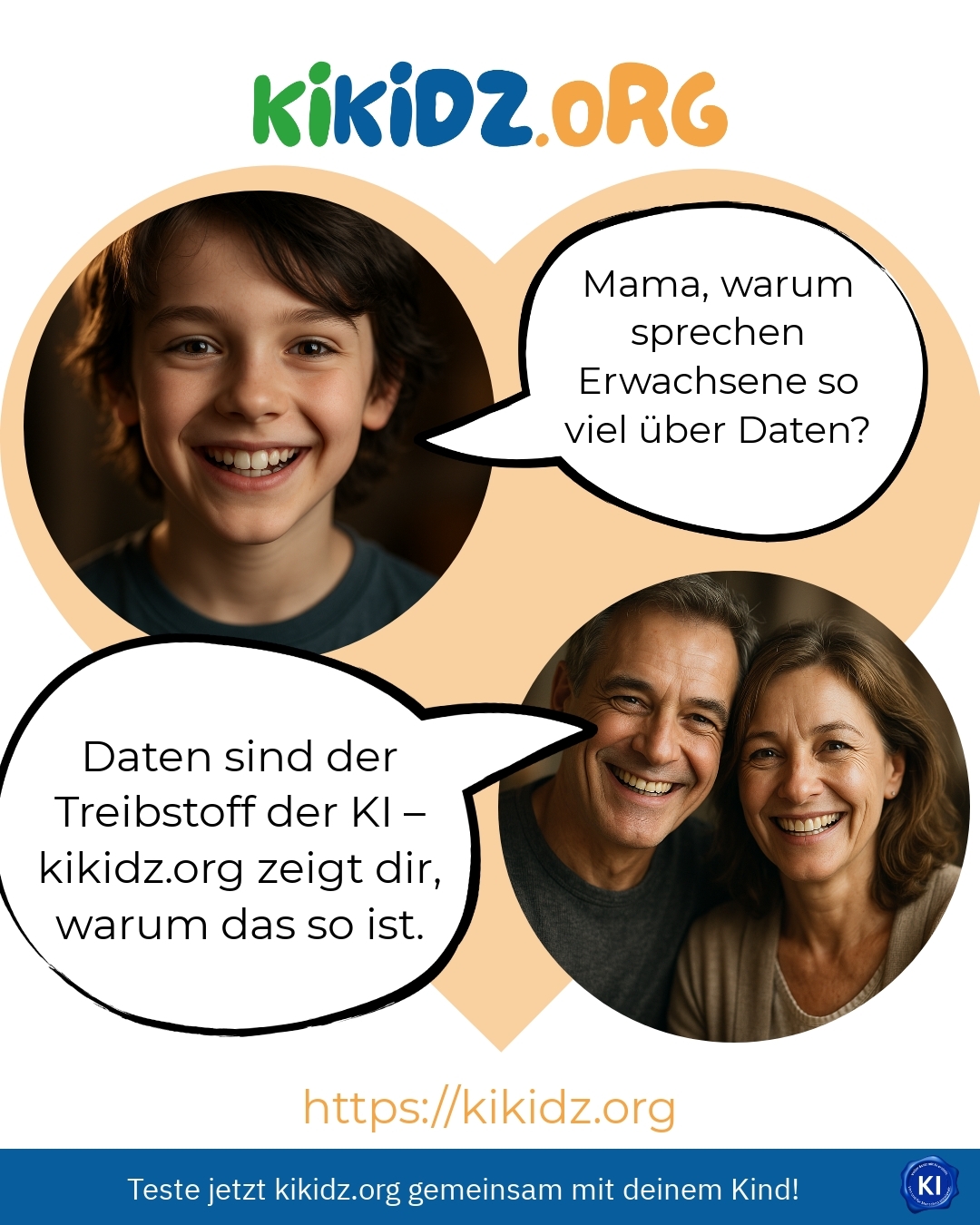
Mum, why do grown-ups talk so much about data? A child-friendly explanation
When children ask their parents, „Mum, why do adults talk so much about data?“, parents are often left at a loss. In this article, mums, dads, and educators will find well-founded answers, practical examples, and tips to explain the topic of data culture to children in an understandable way.
Data today: More than just numbers in a computer
Data accompanies us in everyday life: the favourite music played via streaming, the weather in an app, even shopping lists in the supermarket are based on data. Parents use these digital helpers daily, mostly without giving it much thought. And yet, children repeatedly ask: „Mum, why do adults talk so much about data?“
Working with data is more than a technical gimmick. It shapes how companies, schools, hospitals, and families make decisions. Data helps to recognise problems faster, find solutions, and adapt to changes. What used to be gut feeling is now often data analysis.
Parents often ask questions like „What happens to my photos when I put them online?“ or „Why is there a chip in every toy?“ They want to understand how a data culture emerges, what opportunities it offers, and how it can be used on a small scale, for example, during a family holiday.
Examples of everyday family life
Many parents look at their digital family calendar app together with their children, planning birthdays, homework, and leisure activities. Behind this is an initial form of data management that children actively experience. Health apps that count steps or document sleep phases also show how numbers and data turn into knowledge.
Increasingly, kindergartens are using digital educational offerings that individually track each child's learning behaviour. This data helps the educators to provide targeted support and assistance. And even the joint search for the best ice cream parlour using a review platform is part of modern data culture [4].
Fostering data culture at home
Parents can playfully show how important data is today. They encourage observing weather data and comparing it with forecasts. They support their children in conducting small surveys within the family, for example, about favourite foods or the best family outing. This data collection demonstrates how much information comes together and how decisions are made from it.
Learning to handle data securely
Children should understand early on that not all data should be shared with everyone. Parents explain why personal information does not belong online and how to protect their accounts. The right balance of curiosity and caution is important as children develop media literacy.
Why a data culture, then?
Data culture describes how people in companies and in everyday life interact with data and derive knowledge from it. It presupposes that everyone has the necessary skills to understand, analyse and use data [2]. Decisions become more transparent, and mistakes and successes easier to trace. A lived data culture promotes innovation, collaboration and creativity – values we are happy to pass on to children.
A data culture is not an end in itself. It helps in understanding complex contexts, for example, in news about climate change or the development of the coronavirus. Values such as openness, data protection, and critical thinking thus become self-evident building blocks of education.
Mum, why do adults talk so much about data? – Three perspectives
Parents frequently report how concerns surrounding school and digital education occupy families. They desire practical examples of how they can discuss data protection, digital media, and artificial intelligence with their children. The question „Mum, why do adults talk so much about data?“ is often the starting point for this.
A mother recounts: „My child asked why Dad always works on his tablet. Together, we looked at how companies use data to develop new products and make better offers to their customers.“ Another family discovered in the supermarket how prices are controlled digitally and changed their own shopping behaviour. Increasingly, parents are looking for training courses that explain the topic to them and their children in a clear and entertaining way.
Kikidz.org offers excellent training on the question, „Mum, why do grown-ups talk so much about data?“ The courses combine playful elements, real-life examples, and practical exercises for families. This makes the abstract topic of data tangible and sparks children's curiosity.
Many parents are looking for ideas on how to foster digital awareness at home. They notice that their children sometimes react enthusiastically, but often critically, to new technologies. Open dialogue and shared discovery strengthen understanding and media literacy in the long term.
My analysis
The question „Mum, why do adults talk so much about data?“ is symptomatic of digitalisation. Children sense that data is changing our lives and are looking for guidance. Parents can support their children by explaining how data helps, how it protects us, and how we can use it meaningfully. Fostering a healthy data culture starts small – when cooking together, playing, or exploring the environment.
It's worth discussing the topic openly, playfully, and critically. Courses like those offered by kikidz.org can help deepen knowledge together and reduce uncertainties. Those who understand data can shape the digital world – and that begins in the family.
Further links from the above text:
Data Culture & Data Culture at statworx [2]
Data Culture: Collaboration Makes Companies... [4]
Here's how to achieve transformation in 7 steps [6]
For more information and if you have any questions, please contact Contact us or read more blog posts on the topic Children and Artificial Intelligence here. You can find the courses here: Children and Artificial Intelligence Courses










 Deutsch
  English (UK)