
Have you ever wondered why some departments are just so eager to embrace innovative ideas while others have been stagnating for years and feel they never have the opportunity to fully unleash their creative potential? The answer often lies in a systematic ideation workshop, a structured method used to unleash hidden innovation potential and turn employees into true creators of their work environments. In a time when companies are increasingly under pressure to innovate, many executives report that they are looking for new ways to activate their teams while simultaneously initiating sustainable change processes that go beyond short-term brainstorming sessions.
The Ideas Workshop as a catalyst for department development
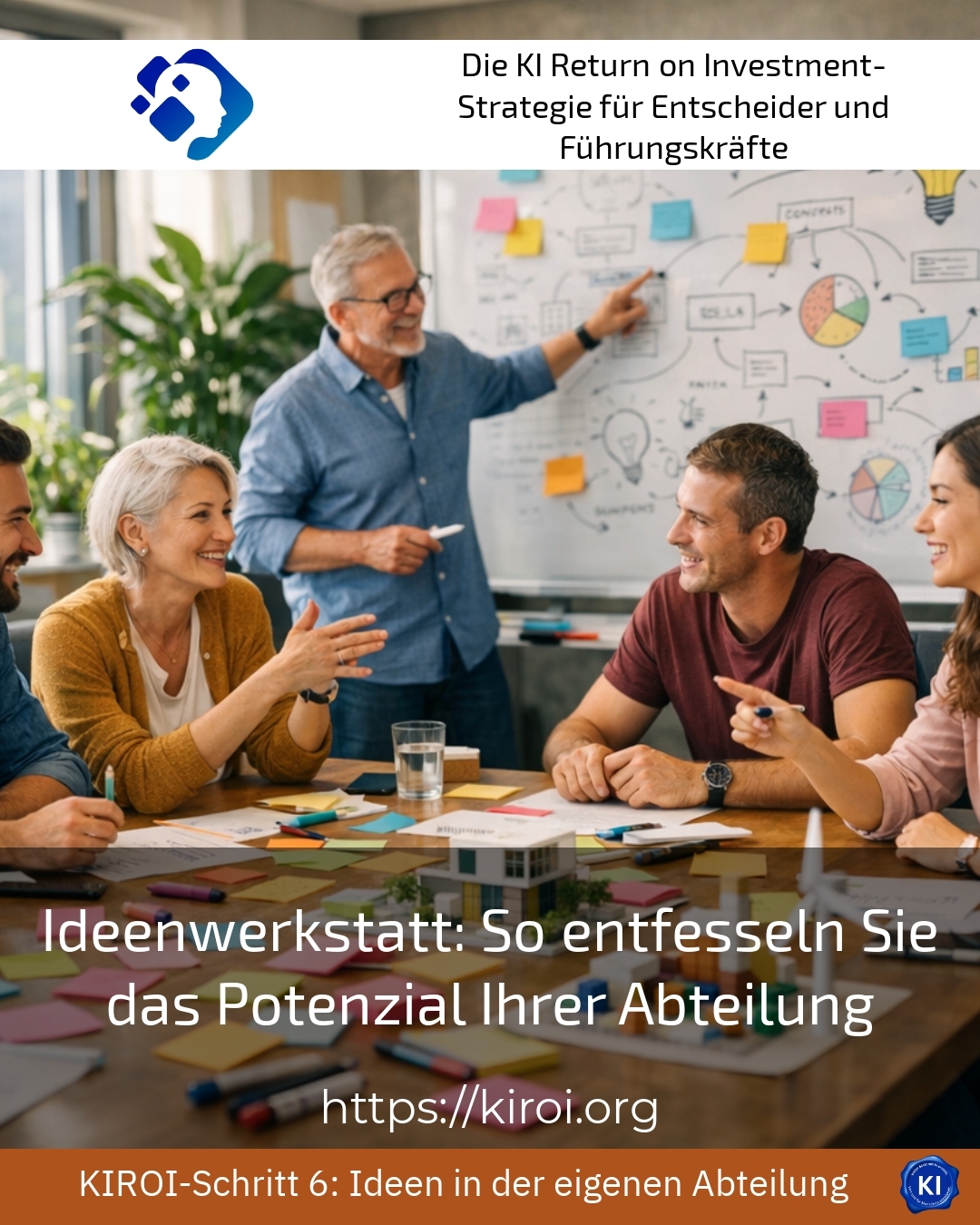
A well-designed idea workshop serves as a powerful catalyst. It creates spaces for creative thinking. It enables employees to bring their perspectives to the table. The method goes far beyond traditional meetings. It establishes a culture of continuous improvement. For example, a medium-sized machine manufacturer was able to reduce production lead times by twenty percent through regular innovation formats, because employees from different departments could for the first time systematically submit their optimization suggestions. In a logistics company, warehouse workers developed new picking routes together with IT specialists that no one had considered before. A financial services provider activated its customer advisors through moderated workshops, resulting in a completely new consulting product for young families.
The crucial difference lies in the structure. Random idea generation rarely works in a sustainable way. Therefore, companies need clear frameworks. These must be flexible enough to encourage creativity. At the same time, they need sufficient structure for measurable results.
Best practice with a AIROI customer A traditional family-run food processing company faced the challenge that important knowledge was stored exclusively in the minds of long-standing employees and was never systematically documented or shared. As part of a transruptive coaching process, the company initially implemented a monthly idea workshop in which production workers, quality managers, and sales experts worked together on concrete problems. The moderation was initially external, but was gradually handed over to internal multipliers so that the format could work independently in the long term. Within nine months, over sixty documented improvement proposals were created, twenty-eight of which were directly implemented. Particularly noteworthy was the fact that three of the proposals came from apprentices who had never previously been asked about them. The management reported on noticeably improved communication between the departments and a significantly increased commitment from the entire workforce.
Psychological foundations of successful innovation formats
The effectiveness of an idea workshop is based on psychological principles. People want to be heard. They strive for self-efficacy. They want to leave a mark. When leaders understand these basic needs, they can unleash extraordinary potential. In a hospital, the nursing service management established a weekly short format in which nursing staff could submit improvement ideas for their ward. A chemical company used similar formats to identify safety risks earlier. An advertising agency transformed its entire project management after junior employees were able to articulate their frustrations with inefficient processes.
Research consistently shows that intrinsic motivation is the strongest driver of creativity [1]. External incentives such as rewards can even have a counterproductive effect. Instead, employees need to feel that their ideas are taken seriously. They need timely feedback. They want to see that suggestions are actually implemented.
The role of psychological safety in the idea workshop
Psychological safety forms the foundation of any successful innovation culture. Amy Edmondson of Harvard Business School has intensively researched this concept [2]. Without psychological safety, employees remain silent. They hide mistakes. They avoid risks. Therefore, special rules must apply in an idea workshop. One automotive supplier implemented a rule that every idea must first be considered before criticism can be expressed. A software company established anonymous submission channels for sensitive proposals. A retail conglomerate specifically trained its executives to actively embrace even unusual suggestions.
Practical implementation of a sustainable idea workshop
The introduction of an idea workshop requires careful planning. At the same time, planning must not become an excuse for inaction. Clients often report that they spent years thinking about innovation formats without ever starting. The first step does not have to be perfect. It simply needs to be done. A construction company began with a simple whiteboard in the break room where employees could record ideas. A telecommunications provider started with a digital channel in its internal messaging system. A nursing home introduced short idea rounds during shift changes.
The methodological diversity is remarkable. Design Thinking offers structured phases from problem definition to prototype development. World Café enables large groups to exchange ideas on complex issues. The Walt Disney method deliberately separates the dreamer, realist, and critic perspectives [3]. Each method has specific strengths. The selection should fit the company culture. Transruptive coaching can help identify and adapt the appropriate methodology.
Best practice with a AIROI customer For years, an insurance company had been struggling with high employee turnover in its claims department and, as part of an analysis, found that employees did not feel heard and that their improvement suggestions regularly fell through the cracks. Together with a transruptive coaching partner, the department management developed a three-stage concept that combined short daily prompts, monthly idea workshop sessions, and quarterly innovation days. Crucial was the introduction of a transparent tracking system in which each suggestion could be tracked and employees could view the current status of their ideas at any time. Within a year, the turnover rate dropped by over thirty percent, because employees for the first time felt that their voice mattered and their expertise was valued. It is particularly noteworthy that several process improvements that emerged from the idea workshop led to measurable cost savings and the department thus received additional resources for training initiatives.
Digital tools for the modern idea workshop
Digitalization opens up new possibilities for collaborative innovation processes. Platforms like Miro or Mural enable virtual collaboration across locations. Idea management software can systematically capture and evaluate suggestions. Artificial intelligence begins to cluster similar ideas and highlight connections [4]. An international corporation now uses AI-powered analysis to identify innovation potential in employee feedback. A medium-sized retailer relies on a simple app through which store employees can send photos of problems directly to the headquarters. An energy provider combines physical workshops with asynchronous digital idea development.
Nevertheless, technology must never become an end in itself. The human factor remains crucial. Digital tools support the process. They do not replace personal interaction. They cannot convey appreciation. The best software is of little use if the leadership culture does not encourage innovation.
The leadership role in the creative idea workshop
Leaders play a key role in the innovation process. They set the framework. They demonstrate openness. They decide on resources. Clients often report that well-intentioned innovation initiatives failed due to a lack of leadership support. A managing director of a mechanical engineering company personally participated in each brainstorming session, thereby signaling its importance. A bank director explicitly allocated time for creative work to her department. A department head in a pharmaceutical company also recognized failed experiments as valuable learning experiences.
The challenge often lies in letting go. Many leaders feel they need to know all the answers. However, innovation arises precisely where non-knowledge is tolerated. Questions become more important than answers. Curiosity replaces routine. Transruptive coaching can accompany leaders in taking on and fulfilling this new role.
From the individual impulse to an innovation culture through systematic idea workshop formats
Individual workshops rarely create lasting change. True transformation comes through continuity. Regular formats embed innovative thinking in everyday life. They signal that creativity is desired. They create routine for the unusual. A media company established the „Friday spark“ as a weekly short format. An industrial company uses shift changes for short bursts of inspiration. A service provider integrated idea rounds into existing team meetings.
The transition from individual measures to culture requires patience. Clients often report setbacks in the first few months. Some ideas are not implemented. Participation fluctuates. Enthusiasm wanes. In these moments, the importance of perseverance becomes apparent. The companies that persevere report later on about profound changes [5].
Best practice with a AIROI customer A medium-sized company in the textile industry struggled with declining margins and increasing competitive pressure from Asia, which led the management to seek ways to create differentiation through internal innovation and strengthen employee engagement. In the context of a two-year transruptive coaching program, a comprehensive innovation culture was gradually built, starting with a monthly idea workshop and evolving into a multifaceted system consisting of a digital idea collection, quarterly innovation days, and an internal incubator program for particularly promising proposals. Notably, a production manager who had never previously been involved in strategic decision-making came up with a proposal for residual recycling that has now been expanded into its own business unit for upcycling products and generates significant additional revenue. The corporate culture has fundamentally changed, and the company is now regarded as an attractive employer in its region, attracting young talent and retaining long-standing employees.
My AIROI Analysis
The systematic establishment of innovation formats represents one of the most effective levers for organizational development that I have observed in my consulting practice. Time and again, it becomes clear that success depends less on the chosen methodology than on the seriousness with which leaders support and consistently pursue the initiative. Companies that view structured creative processes as a strategic investment rather than a nice added benefit achieve measurable improvements in productivity, employee satisfaction, and innovation capability. I observe the greatest success where three factors come together: a leadership level that is authentically interested in the involvement of its employees, clear structures that create commitment, and a realistic expectation regarding the time frame of development. Transruptions coaching can provide valuable guidance in this regard, especially during periods of uncertainty or when overcoming resistance. My recommendation to leaders is to take the first step and then remain consistent, because the fruits of systematic innovation efforts often do not become visible until six to twelve months have passed. However, the investment is almost always worth it, as the numerous success stories from various industries impressively demonstrate.
Further links from the text above:
[1] Harvard Business Review: What Motivates Employees More: Rewards or Punishments?
[2] Harvard Business School: Amy Edmondson Faculty Profile
[3] MindTools: Disney’s Creative Strategy
[4] McKinsey: The State of AI
[5] Gallup: Building a Culture of Innovation
For more information and if you have any questions, please contact Contact us or read more blog posts on the topic Artificial intelligence here.










 Deutsch
 English (UK)