
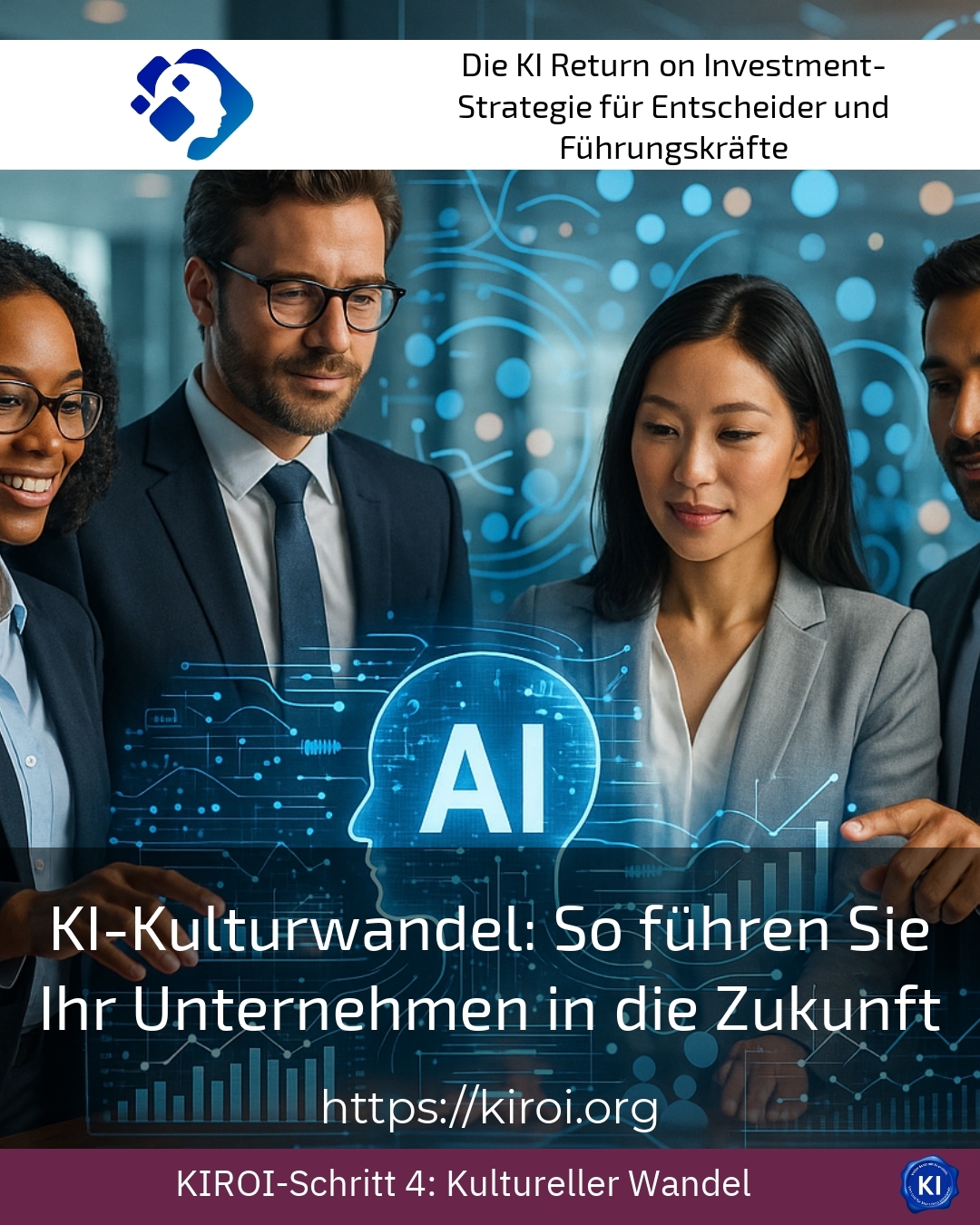
Imagine your company stands on the cusp of a completely new era, where machines not only take on tasks but actively think along and support decision-making. AI Culture Change: How to Lead Your Business into the Future is no longer a distant vision, but a concrete challenge that fundamentally changes leaders, employees, and entire organisational structures. Many decision-makers report uncertainty and resistance within their teams. At the same time, fascinating opportunities for growth and innovation are emerging. The question is no longer whether this change is coming, but how you can actively shape it.
Understanding the human dimension of technological disruption
When we talk about the use of intelligent systems in businesses, we often forget the most important factor: the people who are meant to work with them. Technology alone does not transform an organisation. It is always the employees who accept or reject new tools. That is why every successful transformation begins with a deep understanding of human psychology. Fears of job loss, being overwhelmed by new demands, and scepticism towards change shape the daily lives of many workforces. Leaders must take these emotions seriously and actively address them.
This phenomenon is particularly evident in the manufacturing industry. Production staff with decades of experience feel threatened by automated quality control systems. Machine operators fear that their manual skills may lose value. In the banking sector, customer advisors are experiencing similar uncertainties because intelligent chatbots are increasingly handling standard inquiries. In healthcare too, diagnostic support systems are causing discussions among doctors and nurses. These examples illustrate that the AI Culture Change: How to Lead Your Business into the Future above all a question of communication and trust.
Best practice with a AIROI customer
A medium-sized logistics company faced the challenge of introducing an intelligent route planning system. Initially, the drivers reacted with considerable resistance to this innovation. They felt their expertise was not valued and feared complete surveillance of their work. Transruption coaching supported the company over several months during this sensitive change process. Together, we developed workshops where drivers could openly voice their concerns. The insights gained from these discussions were directly incorporated into the system configuration. For example, employees were able to contribute their own practical experience regarding traffic volume and customer habits. The result was remarkable: after six months, over eighty percent of the workforce actively used the system and reported noticeable improvements in their work. Staff turnover decreased significantly, and employee satisfaction increased measurably. This case clearly demonstrates the importance of involving all stakeholders in the success of technological changes.
Leadership culture as the foundation of digital evolution
The role of leadership is fundamentally changing in the era of intelligent systems. Traditional hierarchies and control mechanisms are losing their significance. Instead, qualities such as empathy, willingness to learn, and a spirit of experimentation are coming to the fore [1]. Leaders are becoming enablers and mentors, providing their teams with direction in uncertain times. They must lead by example and demonstrate that change represents an opportunity. At the same time, they must admit to mistakes and communicate transparently.
In the retail sector, progressive companies are already experimenting with new leadership models. Store managers work closely with data-driven recommendation systems but retain final decision-making authority. In the insurance industry, intelligent analysis tools support claims handlers with complex damage cases. Here, the manager acts as an intermediary between humans and machines. Editorial leadership is also fundamentally changing in the media industry, as automated systems provide topic suggestions and analyse reader responses. These developments demand a completely new understanding of authority and expertise.
The AI cultural shift begins in the minds of decision-makers.
Before organisations can change, leaders must question their own beliefs. Many decision-makers have grown up with management methods that are no longer up-to-date. They must accept that they can no longer know all the answers. Instead, the ability to ask the right questions becomes a core competency. Clients often report a veritable paradigm shift in their understanding of leadership. Transruption coaching can effectively support these reflection processes and provide valuable impulses.
For example, a pharmaceutical company realised that its traditional research culture no longer kept pace with the speed of modern data analysis. The management of a mechanical engineering firm had to learn that younger employees often interact more intuitively with new technologies. In tourism, hotel managers found that guests increasingly expect personalised experiences, which can only be achieved through intelligent systems [2]. These insights are often uncomfortable, but they form the basis for genuine transformation.
Creating structures that enable change
Sustainable change requires organisational frameworks that foster innovation. Rigid departmental boundaries and lengthy approval processes are counterproductive here. Agile methods and cross-functional teams can help to break down silo thinking. At the same time, employees need safe spaces for experimentation where mistakes are allowed. The introduction of pilot projects has proven to be an effective approach. This way, experience can be gained before larger investments are made.
Dedicated innovation labs, operating independently of day-to-day business, are already emerging in the automotive industry. Energy providers are founding subsidiaries to test new business models with smart grids. In the education sector, universities are experimenting with adaptive learning systems in protected pilot groups. The public sector is establishing competence centres to support authorities in introducing automated processes. These examples show that structural innovation must precede technological innovation.
Best practice with a AIROI customer
A family business with a rich tradition in the food industry wanted to optimise its production planning with intelligent forecasting systems. The established structures and the workforce's strong identification with traditional working methods presented significant hurdles. Transruptions Coaching initially supported the management level in developing a clear vision for the company's future. Subsequently, we jointly identified key individuals from various departments who could act as multipliers. These so-called Change Agents received intensive training and were actively involved in the system design. We established weekly feedback rounds where experiences were exchanged and improvements discussed. Management committed to full transparency regarding the goals and impact of the changes. After one year, employees reported a noticeably more open communication culture throughout the company. Productivity increased by fifteen percent, while the error rate significantly decreased. This success would not have been possible without the careful guidance of the cultural change.
Competence development as a continuous process
The skills employees need today are fundamentally different from those of past decades. A basic understanding of technology is becoming a fundamental qualification in almost all professional fields. At the same time, social skills are gaining importance because routine tasks are increasingly being automated. Critical thinking and the ability to interpret the results of intelligent systems are becoming indispensable. Companies must therefore invest heavily in further training and make lifelong learning a matter of course [3].
Banks are training their employees in how to handle algorithmic lending decisions and their ethical implications. Trade businesses are qualifying journeymen for working with connected tools and augmented reality applications. In healthcare, specialists are learning to meaningfully integrate robotic assistance systems into their daily work routines. Marketing departments are developing skills for critically evaluating data-based campaign proposals. These examples illustrate the breadth of necessary training measures.
Ethics and Responsibility at the Heart of Change
As technological capabilities grow, so do the ethical demands on companies. Algorithms can reinforce prejudice if they have been trained with biased data. Automated decisions can perpetuate discrimination without human intent. Therefore, organisations must develop clear ethical guidelines and continuously review their adherence. Transparency towards customers and employees is becoming a decisive factor of trust.
Recruitment agencies face the challenge that automated pre-selection processes can discriminate against applicants. Insurance companies must ensure that intelligent risk assessments do not lead to unfair premiums. In journalism, questions arise about the mandatory labelling of automatically generated content. Retailers must also handle personalised pricing strategies responsibly. These ethical dimensions of AI Culture Change: How to Lead Your Business into the Future require continuous reflection and clear governance structures.
Communication as the key to acceptance
Change projects often fail due to a lack of, or unclear, communication. Employees want to understand why changes are necessary and what impact they will have. Leaders must report regularly and honestly on progress and setbacks. They should use language that all stakeholders can understand. Technical jargon and Anglicisms can create distance rather than build trust. Storytelling and concrete examples help make abstract concepts tangible.
A telecommunications company developed its own explanation formats for various target groups within the workforce. A chemical group used internal podcasts to disseminate success stories from pilot projects. In the skilled trades, practical workshops proved effective, allowing employees to try out new technologies themselves. Municipalities set up citizens' consultation hours to answer questions about the automation of public services. These approaches show that communication must be designed to be target-group-specific and dialogue-oriented.
Best practice with a AIROI customer
A large tax consultancy firm wanted to revolutionise its daily office routine through intelligent document analysis. The firm's partners recognised early on that technological superiority alone was not enough. They commissioned transruptions coaching to design a holistic change process. Together, we developed a communication strategy that involved all employees from day one. Monthly town hall meetings provided space for questions and critical discussions. An internal wiki documented learning experiences and best practices, accessible to everyone. Of particular importance was the establishment of an anonymous feedback channel, through which concerns could be voiced without fear of consequences. The firm's management demonstrably responded to the suggestions made and communicated this transparently. After eighteen months, over ninety percent of employees reported feeling well-informed and involved in the introduction of new technologies. Client satisfaction increased in parallel, as consultants gained more time for personal support.
My AIROI Analysis
Accompanying numerous transformation projects has shown me that successful change always begins with people. Technology is a tool whose effectiveness depends on how it is used. Companies that focus exclusively on technical implementation regularly fail due to cultural resistance. In contrast, organisations that systematically work on their culture achieve sustainable results. AI Culture Change: How to Lead Your Business into the Future requires patience, empathy, and a long-term perspective.
My experience shows that three factors are crucial for success. Firstly, leaders need the courage to admit their own uncertainties and learn together with their teams. Secondly, companies must invest in the skill development of their employees before embarking on major technological projects. Thirdly, continuous, honest communication is indispensable for building and maintaining trust. These principles apply across all industries and regardless of company size.
Transruption coaching can accompany companies on this complex journey and provide valuable impetus. We support leaders in redefining their own roles and guiding their teams through uncertain times. Our experience from various industries enables the transfer of success patterns and the avoidance of typical mistakes. We do not see ourselves as consultants with ready-made solutions, but as partners on an equal footing. Together, we develop individual approaches that fit the respective corporate culture and have a sustainable impact.
Further links from the text above:
[1] Harvard Business Review – Leadership and Management Insights
[2] McKinsey – People and Organisational Performance
[3] World Economic Forum – Future of Work
For more information and if you have any questions, please contact Contact us or read more blog posts on the topic Artificial intelligence here.










 Deutsch
  English (UK)