
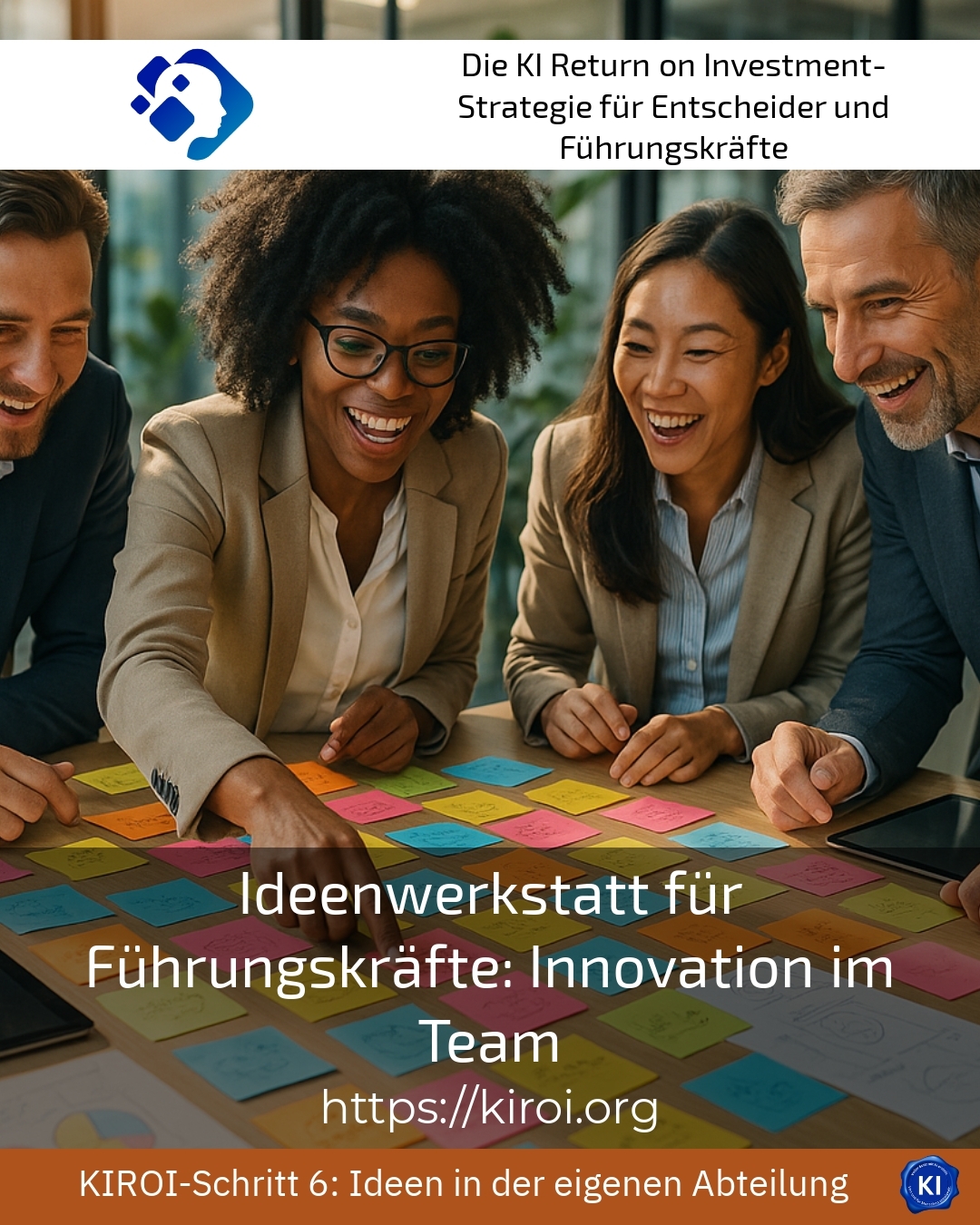
Imagine your best employees sitting in silence during meetings, while ground-breaking thoughts remain unspoken. The Ideas workshop for managers: Innovation in the team offers a decisive way out here. Because in a rapidly changing world, specialist knowledge alone no longer determines a company's success. Rather, those organisations that know how to systematically unleash and channel the creative potential of their teams are the ones that succeed.
Why traditional leadership models are reaching their limits
The world of work has fundamentally changed. Hierarchical structures that for decades were considered a guarantee of efficiency are increasingly proving to be brakes on innovation. Today's employees expect more than just top-down instructions. They want to help shape things and contribute their expertise. For managers, taking this need seriously means fundamentally rethinking their role.
In a medium-sized mechanical engineering company in southern Germany, the management observed a creeping decline in suggestions for improvement from the workforce over months. The engineers and technicians possessed enormous specialist knowledge, but this knowledge remained largely untapped. At the same time, market demands were increasing, and competitors from Asia were pushing into the market with innovative solutions. The leadership team recognised that a change in mindset was necessary.
A logistics company with several hundred employees faced similar challenges. The dispatchers on the ground had valuable insights into daily operations, but these findings did not find their way into strategic planning. As a result, the company was losing valuable opportunities for process optimisation. A comparable pattern is evident in the healthcare sector, as nursing staff and doctors develop practical solutions to recurring problems on a daily basis. However, these frequently remain at ward level without the entire hospital benefiting from them.
The Ideas Workshop for Managers: Innovation in the Team as a Strategic Tool
A structured framework for creative collaboration can overcome these barriers. This is not about spontaneous brainstorming sessions without follow-up. Rather, it requires a thoughtful process that gathers, evaluates and translates ideas into concrete actions. In this context, leaders take on the role of enablers and facilitators.
Transruptions coaching accompanies companies in this transformation. It supports management teams in establishing a culture of openness and constructive exchange. Clients frequently report that even the first steps lead to noticeable changes in the working atmosphere. Employees feel heard and taken seriously.
Best practice with a AIROI customer
A long-established family business in the food sector approached us with a request to support a comprehensive cultural transformation. The management team had recognised that the previous top-down communication was no longer fit for purpose. The production employees possessed years of experience with the machinery and processes. However, this knowledge remained largely untapped because there were no structures in place for sharing it. Together, we developed a format for regular innovation sessions in which staff from all departments could participate. The managers learned to ask questions rather than dictate answers. They practised initially accepting even unusual suggestions and developing them further. After six months, the production management reported a significant increase in process efficiency. Several improvement proposals were implemented and led to measurable savings. However, the most gratifying aspect was the changed atmosphere within the company. People spoke more openly with one another and jointly developed solutions for everyday challenges.
Methods and tools for creative collaboration
Various approaches have proven to be particularly effective in practice. Design Thinking, for example, puts the needs of users at the centre. Teams go through several phases ranging from problem definition and idea generation to prototype development [1]. This structured approach helps to ensure that the focus is not lost.
In software development, agile methods such as Scrum have already become widespread. However, the principles behind them can also be applied to other industries. Short iteration cycles and regular reflection sessions promote continuous learning. An architectural practice used these approaches to improve its project delivery. The architects and engineers met weekly for brief exchange sessions, during which they identified problems early on and jointly developed potential solutions.
An insurance company experimented with open-space formats where employees determined the topics for discussion rounds themselves. The response was overwhelming, as many staff members contributed actively to strategic considerations for the first time. In the trades, innovative businesses rely on regular workshop discussions. Journeymen and master craftsmen exchange views on new techniques and materials.
The role of the leader in creative processes
Leaders face the challenge of providing direction and creating space at the same time. This balance requires a high degree of self-reflection. It also means acknowledging one's own uncertainties and communicating transparently. Authenticity builds trust, and trust is the foundation for open exchange.
In the banking sector, we are observing an interesting shift. Branch managers are increasingly developing into coaches for their teams. They support employees in finding their own solutions for complex customer requests. A technology company introduced so-called „reverse mentoring“ programmes. In these, younger employees pass on their knowledge of digital trends to experienced executives. This inversion of the traditional direction of learning promotes intergenerational dialogue.
In the hotel industry, some establishments are experimenting with rotating leadership roles. Various team members temporarily take on coordinating tasks. This experience broadens horizons and fosters an understanding of others' perspectives. The Ideas workshop for managers: Innovation in the team benefits from such diverse perspectives.
Overcoming obstacles and transforming resistance
Not all employees welcome change with open arms. Some have had negative experiences in the past. Others fear that their accustomed way of working will be called into question. Taking these concerns seriously is crucial to the success of any transformation. Transruptions coaching provides valuable impetus here [2].
A manufacturing company in the automotive supply industry was facing massive resistance. Long-standing employees saw no point in the new collaboration formats, perceiving them as an additional burden with no discernible benefit. The management team reacted with patience and persistence. They created small wins and communicated these transparently. Gradually, acceptance grew.
Similar dynamics are evident in the education sector. Teachers who have planned their lessons independently for years sometimes struggle with collegial collaboration. Schools that have nevertheless established joint planning times report positive effects. The quality of lessons improves, and job satisfaction increases. An advertising agency resolved resistance in an unusual way. It invited critical voices to actively help shape the change process.
Best practice with a AIROI customer
A regional energy supplier was looking for ways to make its organisational culture fit for the future. The sector is facing massive upheaval due to the energy transition. The company recognised that it needs the knowledge and creativity of all employees to master these challenges. We accompanied a process designed to last several months. Initially, we held discussions with employees at all levels and in all departments. In doing so, we identified both potentials and obstacles for greater collaboration. Subsequently, together with the executive board, we developed a concept for cross-departmental innovation groups. These groups were given specific tasks on strategically relevant topics. The results were regularly presented to and discussed with management. Particularly successful was a group that dealt with the digitalisation of customer processes. Their proposals led to the introduction of a new service platform that both reduced costs and increased customer satisfaction.
Sustainability and long-term embedding
One-off events quickly fizzle out. The real value is created through continuous practice. Rituals and regular formats help to embed new behaviours. Leaders should prioritise and protect these formats, even when operational pressure is high.
A pharmaceutical company has firmly scheduled weekly „innovation hours“ in the calendars of all departments. This time is protected and must not be used for other appointments. During this hour, teams discuss new developments and work on ideas for improvement. The results are documented and shared in a company-wide system.
In retail, some companies use digital platforms for asynchronous idea sharing [3]. Employees can submit suggestions there at any time and comment on the ideas of others. A rating system helps to identify promising approaches. A fashion chain has already developed several product innovations in this way. The ideas came directly from the sales assistants, who are in daily conversation with the customers. The Ideas workshop for managers: Innovation in the team thereby becomes a living process.
Measurability and monitoring of success for the leadership ideas workshop
Creative processes sometimes evade simple quantification. Nevertheless, it is important to make progress visible. Qualitative indicators such as employee satisfaction or the perceived culture of innovation can provide valuable insights. Regular surveys help to capture changes.
Quantitative metrics supplement this picture. The number of submitted suggestions for improvement or the implementation rate provide indications of the activity and effectiveness of the formats. Following the introduction of its innovation rounds, a metal processing company recorded a doubling of suggestions within one year.
In the IT sector, some companies measure the time from idea to market maturity. This time-to-market has shortened significantly at many innovation-oriented firms. A software company reports that this timespan has been halved. In the consulting sector, the referral rate is among the important indicators. Teams that work well together deliver better results and are recommended more often.
My AIROI Analysis
The systematic promotion of team innovation is not a luxury, but a strategic necessity. Companies across all industries are facing complex challenges that can no longer be managed with traditional approaches. Activating the collective intelligence of employees is a key factor in this. Leaders who actively shape this change give their organisations a decisive competitive advantage.
Transruption coaching offers guidance through this transformation. It helps management teams to develop new competencies and overcome old patterns of thought. Experience from numerous projects shows that change is possible. However, it requires patience, consistency and the courage to break new ground. Organisations that embark on this path report positive momentum. Employees show greater commitment and identify more strongly with the company.
Particularly noteworthy is the transferability of the approaches to different contexts. Whether in manufacturing, the service sector or public administration – the basic principles remain the same. It is about appreciation, openness and the willingness to learn together. These values form the foundation for sustainable innovative capability. In a time of increasing uncertainty, this capability becomes the decisive success factor.
Further links from the text above:
[1] Design Thinking Methodology and Framework
[2] Transruptions Coaching – support for change processes
[3] Harvard Business Review – Innovation Insights
For more information and if you have any questions, please contact Contact us or read more blog posts on the topic Artificial intelligence here.








 Deutsch
 English (UK)