
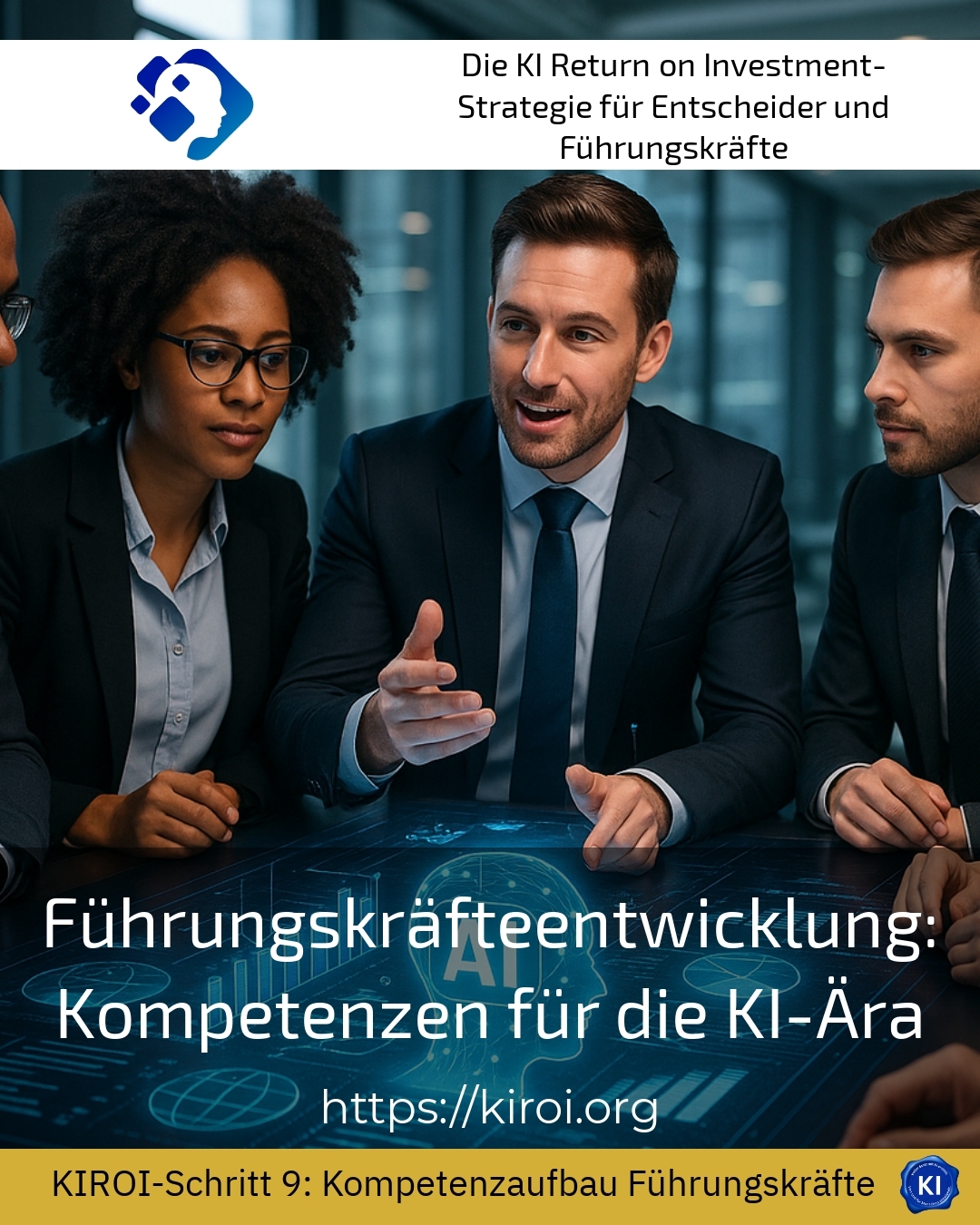
The digital transformation is fundamentally and irrevocably changing every aspect of our working world. Anyone in a leadership position today faces completely new challenges. The Leadership Development: Competencies for the AI Era is therefore increasingly moving to the forefront of strategic human resource management. Algorithms are taking on tasks that were still reserved for humans yesterday. Decisions are supported in fractions of a second by machine learning. At the same time, the need for human interpretation, ethical reflection and emotional intelligence is growing. These seemingly contradictory developments are shaping the modern world of work. They demand leaders who can combine technological competence with deeply human qualities.
The Transformation of the Leadership Role in the Digital Age
Traditional hierarchies and control mechanisms are increasingly losing importance in the interconnected world of work. This is leading to flatter structures and more agile organisational forms. Employees today expect autonomy, purpose, and opportunities for continuous development. Leaders must therefore fundamentally rethink their roles. They are transforming from instru tors to enablers and mentors. For example, a medium-sized manufacturing company has realigned its entire management structure. Team leaders there now act as coaches who promote self-organisation. A financial services provider has retrained its managers to be innovation drivers. They support their teams in integrating intelligent automation solutions. A logistics company relies on distributed decision-making with algorithmic support. The leadership level there focuses on strategic direction-setting and cultural development.
The Leadership Development: Competencies for the AI Era This encompasses far more than technical understanding. It's about a fundamental reorientation of the very concept of leadership. Those who bear responsibility today must be able to tolerate ambiguity. Clear-cut answers are becoming rarer in a world of constant change. At the same time, the necessity of making quick decisions under uncertainty is increasing. These seemingly contradictory demands require a high degree of self-reflection. Leaders must know and be able to question their own patterns.
Best practice with a KIROI customer
A medium-sized company from the manufacturing industry turned to us because the management level showed massive uncertainty in dealing with new technologies. The management reported resistance to automation projects from middle management. Clients often report similar situations in their organisations. We provided the management team with intensive support over a period of nine months. We combined basic technological work with personal development. The participants first learnt to recognise their own fears and reservations. They then developed a deeper understanding of the possibilities of intelligent systems. The transruption coaching helped them to work on the emotional aspects of the change. Each manager received individual support with specific projects in their area of responsibility. At the end of the process, the participants had not only acquired technical knowledge. Above all, they had developed a new attitude towards change. Staff turnover in the company fell significantly and employee satisfaction increased measurably. The project shows how transformative support can facilitate sustainable change.
Emotional Intelligence as a Core Competency in Leadership Development: Competencies for the AI Era
While machines can increasingly analyse, calculate, and optimise, emotional intelligence remains a profoundly human domain. Empathy, intuition, and interpersonal sensitivity cannot be put into algorithms. For this very reason, these skills are becoming ever more valuable for leaders. One technology company has completely aligned its leadership development with emotional competencies. There, leaders learn to interpret non-verbal cues and manage team dynamics. A healthcare provider relies on regular supervision for all managers. Participants there reflect on their interaction patterns and continuously develop them. A consulting firm has established a mentoring programme that systematically imparts experiential knowledge. Young leaders benefit from the emotional maturity of their mentors.
The ability for self-regulation gains particular importance during stressful transformation processes. Leaders must be able to know and manage their own emotions. Only then can they act as a stabilising force for their teams in turbulent times. Mindfulness practices and resilience training are therefore increasingly becoming part of development programmes. These approaches support leaders in acting with composure even under pressure. Investing in emotional competence pays off in multiple ways. Teams with emotionally intelligent leaders show higher engagement and better results.
Technological understanding as a basis for leadership decisions
Leaders don't need to become programmers, but they do need a solid understanding of digital technologies. Only those who understand the basic principles of intelligent systems can responsibly manage their deployment. This knowledge allows for the formulation of realistic expectations and the setting of ethical boundaries. A retail company has trained all its leaders in the fundamentals of machine learning. This enables them to communicate competently with technical teams and evaluate projects. An insurance group provides its management with regular technology updates through internal experts. These formats create a shared understanding and promote cross-departmental collaboration. A media company has introduced work shadowing opportunities in technical departments for its leaders. Direct insight into working with data and algorithms creates valuable changes in perspective [1].
Technological understanding also protects against unrealistic promises from providers. Managers can ask critical questions and better assess risks. They understand where intelligent systems have strengths and where their limitations lie. This knowledge is essential for responsible technology decisions within a company. It allows for a nuanced perspective beyond technological euphoria or blanket rejection.
Ethical judgement in algorithmic decision-making
With the increasing use of intelligent systems, ethical challenges are also growing exponentially. Algorithms can amplify bias, perpetuate discrimination, or make opaque decisions. Leaders are responsible for ensuring that technological solutions meet ethical standards. A human resources service provider has established an ethics committee that reviews all algorithmic systems. Leaders from various departments collectively reflect on fairness and transparency there. A credit institution has developed binding guidelines for the use of scoring systems. The leadership level bears personal responsibility for compliance with these standards. A retailer regularly reviews the impact of its recommendation algorithms on different customer groups. Leaders are trained to recognise and correct potential biases [2].
The Leadership Development: Competencies for the AI Era must systematically promote the ability for ethical reflection. It is not enough to follow technical compliance rules. Leaders need the ability for independent moral judgment. They must be able to make difficult trade-offs between efficiency, fairness, and other values. This competence develops through practice, discourse, and continuous engagement with concrete cases.
Best practice with a KIROI customer
A service company approached us because they had ethical concerns about a planned automation project. The managers were unsure how to weigh up efficiency gains against the potential impact on employees. Clients often report such conflicting goals between economic and social aspects. We facilitated a structured reflection process with the entire management team. Together, we developed a decision-making framework for ethically complex technology issues. The managers learnt to systematically incorporate different perspectives. They practised actively involving those affected in change processes. The transruption coaching helped them to deal with the emotional burden of difficult decisions. The end result was a transformation plan that combined economic goals with social responsibility. The employees became active shapers of change rather than passive stakeholders. This example shows how ethical reflection can lead to better and more sustainable decisions. The process has strengthened trust in management throughout the company.
Communication and transparency in times of change
Change triggers uncertainty and fears in many people. Leaders must take these emotions seriously and address them proactively. Transparent communication builds trust and reduces resistance to necessary transformations. An industrial company has established regular dialogue formats between management and employees. Technological developments are openly discussed there, and questions are answered directly. A telecommunications provider uses internal podcasts to give leaders a voice. The personal approach creates closeness and makes change processes more tangible. A pharmaceutical company has developed communication training for all managers. Participants learn to convey even difficult messages in an appreciative and clear manner.
Authenticity is more important than perfect rhetoric here. Employees can sense when leaders are uncertain themselves. Openness about personal learning processes and challenges can strengthen trust. It shows that leaders don't have to be infallible experts. Learning and developing together thus becomes a cultural norm for the organisation [3].
Willingness to learn and adaptability as leadership virtues
The half-life of knowledge is dramatically shortening in many areas. What is considered best practice today can be outdated tomorrow. Therefore, leaders must make continuous learning a habit. They should be role models for a learning organisation and make their own development processes visible. A technology group expects documented continuing education activities from all leaders. These are discussed in development talks and assessed as a leadership competence. A mechanical engineering company has established learning partnerships between leaders from different areas. The exchange across departmental boundaries promotes new perspectives and mutual learning. An energy provider enables leaders to take sabbaticals for intensive further training phases. The investment in personal development is understood as a strategic contribution to the company's development.
Adaptability also means being able to question cherished beliefs. Leaders must be willing to regularly review their mental models. What has worked in the past is no guarantee of future success. This openness requires a solid sense of self that is not dependent on infallibility. Those who do not constantly have to prove themselves can learn more easily from others.
Leadership development as a strategic investment
Organisations that systematically invest in the development of their leaders are better equipped for change. A well-thought-out strategy in this area pays off in many ways. It improves leadership quality, increases employee retention, and boosts innovation capacity. A family business has established a three-year development programme for aspiring leadership talent. Participants move through various stages and are accompanied by experienced mentors. A service group uses regular potential analyses to identify development needs. Individual development plans address both professional and personal competencies. A media company has provided external coaches for all leaders on the first three levels. Continuous support helps with current challenges and promotes personal development.
Investment in leadership development should be understood as a core component of corporate strategy. It is not a cost centre, but a crucial competitive factor. Companies with strong leaders navigate transformation phases more successfully. They attract talented employees and can retain them long-term [4].
My KIROI Analysis
Developing leadership skills for the age of intelligent technologies is not an optional add-on task. It is a strategic necessity for any organisation wishing to remain relevant. The demands on leaders have fundamentally changed. Technical understanding, emotional intelligence, ethical judgment, and a willingness to learn continuously form a new competency profile. This profile differs significantly from traditional leadership models of the past.
Based on my experience with numerous organisations, a clear pattern emerges. Companies that systematically prepare their leaders for new demands master change more successfully. They manage to leverage technological opportunities without neglecting the human dimension. "Transruption coaching" can provide valuable impetus in this regard. It supports leaders in connecting personal development with organisational change processes.
Crucial in this is the understanding that leadership development cannot be a one-off event. It must be understood and designed as a continuous process. The challenges will continue to change, and with them the required competencies. Those who invest in the development of their leadership team today lay the foundation for future success. The future belongs to organisations with adaptive, agile and humanly competent leaders. They will be able to utilise technological possibilities without losing their humanity.
Further links from the text above:
[1] Harvard Business Review – Leadership Development
[2] McKinsey – Insights on People and Organisational Performance
[3] Forbes – Leadership
[4] Gartner – Leadership Development
For more information and if you have any questions, please contact Contact us or read more blog posts on the topic Artificial intelligence here.











 Deutsch
  English (UK)