
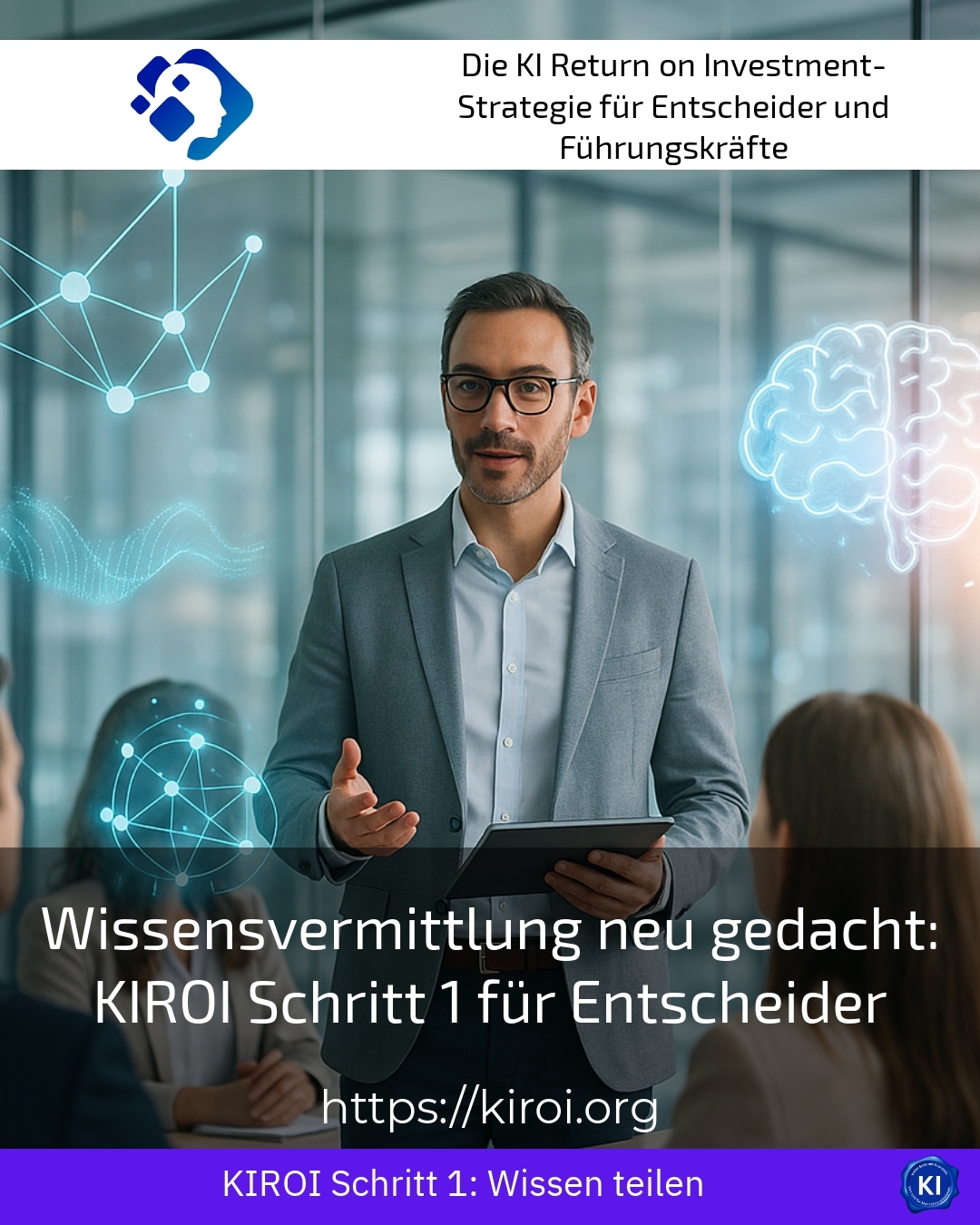
Modern **knowledge transfer** is continuously evolving to meet the demands of an increasingly dynamic economy and society. Decision-makers often face the challenge not only of capturing knowledge but, above all, of imparting it effectively and sustainably. Targeted support in knowledge transfer projects plays a central role in this. AIROI Step 1 offers an innovative approach to making knowledge transfer more efficient and effective.
Rethinking Knowledge Transfer – What AIROI Step 1 Means for Decision-Makers
Knowledge transfer is no longer just a one-way process of simply passing on information. Instead, it's about active exchange and the sustainable integration of knowledge into the workflows and thinking of all those involved. AIROI Step 1 sees itself as a strategic companion for decision-makers who want to realign their projects in the context of knowledge dissemination and learning support.
A key advantage of this approach lies in the combination of tried-and-tested methods and contemporary technical solutions. For example, the use of interactive videos can emotionally enrich learning content, thereby increasing employee engagement. Group-based learning, which brings together different perspectives, is also considered enriching by many companies by fostering creativity and problem-solving skills.
Another example from practice shows how targeted mentoring programmes can help to transfer experiential knowledge directly and personally. Furthermore, the documentation of knowledge in digitally accessible manuals helps companies to minimise the risk of knowledge loss when employees leave.
Practical applications of knowledge transfer in daily business operations
In many industries, decision-makers frequently encounter the challenge of effectively sharing knowledge within teams. A classic example is the onboarding of new employees, where structured knowledge transfer is essential. AIROI Step 1 focuses on a blend of real-world exchange formats such as workshops and digital tools to individualise learning experiences and make them flexibly accessible.
In the field of technical development, software companies document their best practices in interactive knowledge bases, thus ensuring the availability of core competencies regardless of their employees' location. Also important is the support provided by experienced coaches, who facilitate knowledge acquisition with concrete impulses and thus reduce uncertainty in complex processes.
In sales, many companies rely on storytelling as a method to communicate complex product features comparably. Here, too, the linking of emotionally appealing content with concrete practical tips plays a significant role. This allows sales teams to expand their knowledge and adapt it individually in order to make customer conversations more successful.
BEST PRACTICE with one customer (name hidden due to NDA contract) And then the example: In a medium-sized industrial company, AIROI's Step 1 drastically reduced the onboarding time for new female technicians. Using a mix of a digital knowledge base and personal coaching, it was possible to impart complex operating instructions in a practical way and significantly ease the entry into the role. At the same time, the combination of personal support and multimedia learning materials helped to sustainably increase motivation.
Shaping knowledge transfer strategically – Tips for decision-makers
Decision-makers benefit from a clear strategy when implementing knowledge transfer. They should combine different methods and always keep the needs of learners in mind. A practice-oriented approach, for example, involves the following steps:
- Analysis of existing knowledge resources and identification of gaps.
- Selection of suitable communication and learning formats such as workshops, e-learning, mentoring or interactive media.
- Integration of feedback loops to recognise learning progress and challenges early.
- Promoting personal exchange and using digital tools for documentation and tracking.
For example: In the pharmaceutical industry, companies are increasingly relying on modular e-learning programmes, which, accompanied by regular team discussions, not only convey knowledge but also actively consolidate it. In the IT sector too, hybrid learning formats have the advantage of allowing for individual pacing while also strengthening teamwork.
Key components for sustainable knowledge transfer
Sustainable success in knowledge transfer requires, in addition to methodological diversity, clear structure and consideration of emotional factors. Examples from consulting show that a trusting mentoring relationship provides important impetus for personal development. At the same time, technical tools are indispensable for making knowledge retrievable at any time and keeping it accessible regardless of location.
Regular study circles or learning groups also support knowledge consolidation and encourage cross-departmental exchange. Likewise, clients from the healthcare sector often report that interactive workshop elements have helped them to better understand complex topics and apply them more confidently in practice.
My analysis
Knowledge transfer is far more than simply passing on information these days. AIROI Step 1 supports decision-makers in rethinking and practically implementing the knowledge transfer process. Sustainable learning success is achieved through a balanced combination of personal exchange formats, digital learning offers, and targeted support. Examples from industry, consulting, and the healthcare sector show that active involvement and individual development are crucial. Decision-makers who embrace these impulses not only strengthen their employees' skills but also lay the foundation for future-proof organisations.
Further links from the text above:
[1] Knowledge transfer – definition and forms
[2] Knowledge management in the company – methods and tips
[4] Methods to ensure knowledge
[6] The best methods for imparting knowledge
[9] Knowledge Transfer Methods – Strategies for Knowledge Retention
[11] Knowledge transfer & teaching methods
For more information and if you have any questions, please contact Contact us or read more blog posts on the topic Artificial intelligence here.








 Deutsch
  English (UK)