
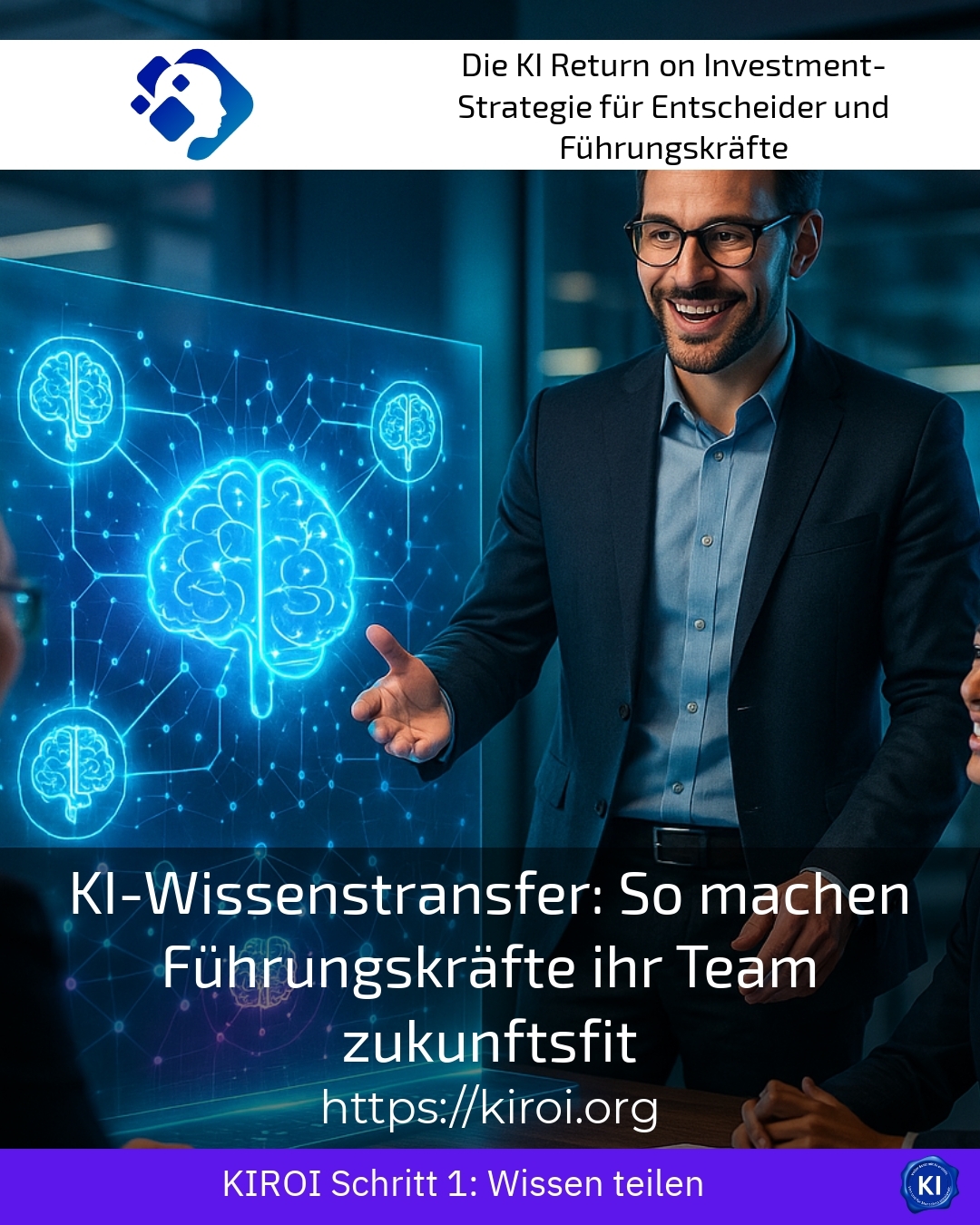
Digital transformation is changing companies at a breathless pace. Those who do not act today risk falling behind tomorrow. But how can leaders take their employees with them on this journey? The answer lies in AI knowledge transfer: How managers make their teams fit for the future. This process determines whether organisations thrive or stagnate. The following sections will outline specific strategies and methods that have proven successful in practice.
Why AI knowledge transfer is indispensable today
The world of work is undergoing a transformation. New technologies are permeating every area of business. Therefore, leaders must act proactively and empower their teams. Many organisations face the challenge that existing knowledge is not systematically passed on. This leads to inefficiencies and missed opportunities. Successful companies have recognised that the structured development of competencies is crucial [1]. They invest in the development of their workforce, thereby creating sustainable competitive advantages.
This shift is particularly evident in the financial sector. Banks are increasingly relying on automated customer advice. Insurance companies are using intelligent systems for claims processing. Investment firms are analysing market data in real time. All these developments require new competencies from employees. Therefore, managers must actively manage and support knowledge building.
AI Knowledge Transfer in Practice: Strategies for Leaders
The successful transfer of knowledge begins with a clear vision. Leaders must first analyse their teams' current level of knowledge. Building on this, they develop a structured development plan. This plan takes into account individual strengths as well as organisational requirements. The involvement of all hierarchical levels in the process is important.
In the logistics industry, various approaches have proven themselves. Freight forwarders train their dispatchers in the use of route optimisation systems. Warehouse operators qualify employees for collaboration with autonomous transport systems. Port operators re-skill crane drivers as monitoring specialists for automated facilities. These examples show how diverse the application possibilities are.
Best practice with a KIROI customer
A medium-sized logistics company with over three hundred employees faced the challenge of preparing their workforce for new technologies. The management decided to undergo transruptive coaching to structure the change process. In the first step, we jointly analysed the existing skills across all departments. This revealed that the older workforce, in particular, required support with digital topics. We developed a mentoring program where younger employees shared their technical knowledge with their more experienced colleagues. These more experienced employees, in turn, passed on their extensive process knowledge. After six months, the managers reported a significant improvement in collaboration between generations. Productivity increased measurably, and employee turnover decreased considerably. Particularly noteworthy was the increased motivation across the entire workforce. This project highlights the importance of systematic support during change processes.
Methods for sustainable AI knowledge transfer in a team
Various methods support successful knowledge transfer within organisations. Peer learning enables direct exchange between colleagues. Microlearning units impart knowledge in small, easily digestible portions. Practical workshops combine theoretical knowledge with practical application. Job rotation broadens understanding of company-wide interdependencies. Managers should deploy these methods situationally and according to the target audience [2].
These approaches can be particularly well observed in healthcare. Hospitals train medical staff in the use of diagnostic support systems. Care facilities qualify employees for the use of documentation software. Doctor's practices implement digital appointment management and patient communication. These developments require continuous further training and support for employees.
The role of the leader as a knowledge multiplier
Leaders bear a special responsibility in the knowledge transfer process. They act as role models and demonstrate the importance of continuous learning through their own actions. At the same time, they create the framework conditions that promote knowledge exchange. This includes both time resources and suitable learning environments. An open culture of error additionally supports the willingness to experiment.
Retail presents numerous application examples for this leadership role. Store managers train sales staff in the use of digital checkout systems. Category managers introduce teams to the use of sales forecasting tools. Those responsible for purchasing impart knowledge about automated ordering processes. These diverse tasks require strong didactic skills from managers.
Best practice with a KIROI customer
A retail chain with over fifty branches commissioned us to guide their digital transformation project. The biggest challenge was to bring along the very diverse workforce. Many long-serving employees initially expressed concerns about the planned changes. As part of the transruption coaching, we developed a multi-stage concept to involve all stakeholders. First, we identified so-called Change Champions in each branch, who were to act as multipliers. These received intensive training and became contact persons for their colleagues. In parallel, we conducted regular feedback sessions to address fears and concerns. Managers learned how to emotionally support their teams through change processes. After about nine months, the transformation had been successfully completed in most branches. Customer satisfaction improved noticeably through faster processes and more competent advice.
Overcoming obstacles and constructively using resistance
Change processes often encounter resistance from the workforce. This resistance is natural and should be taken seriously. Leaders who address concerns build trust and acceptance. Valuable insights into potential improvements are often hidden behind resistance. Constructively dealing with critical voices ultimately strengthens the entire transformation process [3].
In the manufacturing industry, typical patterns of resistance become particularly clear. Machine operators fear the loss of their jobs due to automation. Quality inspectors see their expertise devalued by sensor systems. Maintenance technicians doubt the reliability of new diagnostic tools. These concerns require sensitive handling and transparent communication from management.
Establish a sustainable learning culture
A sustainable learning culture doesn't happen overnight. It requires continuous commitment at all levels of the company. Leaders should view learning time as an investment, not a cost. Regular reflection phases help to embed what has been learned. Recognising learning progress provides additional motivation for further development.
The energy sector is a particularly striking example of the need for continuous learning. Grid operators are training employees in the management of decentralised energy generation. Municipal utilities are qualifying staff to manage smart meter infrastructure. Power plant operators are preparing workforces for the supervision of renewable energy systems. This transformation requires a long-term cultural shift within organisations.
How leaders make their teams future-proof through structured support
Professional support for change processes significantly increases their probability of success. External impulses bring new perspectives to entrenched structures. Experienced consultants help identify blind spots. Coaching supports leaders in reflecting on their own roles. This combination of internal commitment and external expertise often leads to better results.
In the service sector, the added value of professional support is particularly evident. Management consultancies are transforming their own working methods and consulting approaches. Auditing firms are automating routine audits and training staff accordingly. Law firms are implementing contract review systems and training lawyers in their use. These developments require a holistic approach to staff development.
Best practice with a KIROI customer
A service company in the consulting sector approached us for help with its internal transformation. The partners had recognised that they needed to better prepare their own employees for new ways of working. As part of the transruption coaching, we first developed a skills model for the company's future. This model formed the basis for individual development plans for all employees. We supported the managers in conducting regular development discussions and documenting learning progress. The establishment of a culture of failure, which enabled experimental learning, was particularly important. After one year, employees reported significantly increased job satisfaction and skill development. The company was able to significantly strengthen its market position through more innovative services. Employee turnover decreased measurably and attractiveness as an employer increased noticeably.
Measurable successes through systematic knowledge building
The success of knowledge transfer programmes should be regularly reviewed. Suitable performance indicators help to make progress visible. Measuring learning success motivates employees and justifies investments. Qualitative feedback methods complement quantitative measurements effectively. This combination enables a comprehensive assessment of effectiveness [4].
Such measurement approaches are already widely used in the education sector. Universities systematically evaluate the digital skills of their teaching staff. Schools measure progress in integrating new teaching technologies. Further education providers record the satisfaction and learning transfer of their participants. These experiences can be transferred to other industries.
My KIROI Analysis
The systematic development of competencies within organisations is no longer an optional measure; rather, it has become a strategic necessity for long-term business success. Leaders who actively guide their teams through this process create sustainable competitive advantages for their organisations. The examples presented from various industries illustrate the diverse applicability of structured knowledge development.
The combination of internal commitment and external support is particularly promising. Transruption coaching offers valuable impetus and structure for change processes in companies. The close integration of strategic planning and operational implementation significantly increases the probability of success. Managers should show the courage to break new ground and bring their teams along with them.
The documented best practices impressively show that systematic knowledge building delivers measurable results. Organisations that invest early in the development of their workforce are better prepared for future challenges. The AI knowledge transfer: How managers make their teams fit for the future This is not a one-off project. It is rather a continuous process that requires ongoing attention and resources. Those who shy away from this investment risk losing out on the dynamic development of the world of work in the long term.
Further links from the text above:
[1] McKinsey: Building workforce skills at scale
[2] Harvard Business Review: Where Companies Go Wrong with Learning and Development
[3] Gartner: Employee Experience Insights
[4] Deloitte: Global Human Capital Trends
For more information and if you have any questions, please contact Contact us or read more blog posts on the topic Artificial intelligence here.











 Deutsch
  English (UK)