
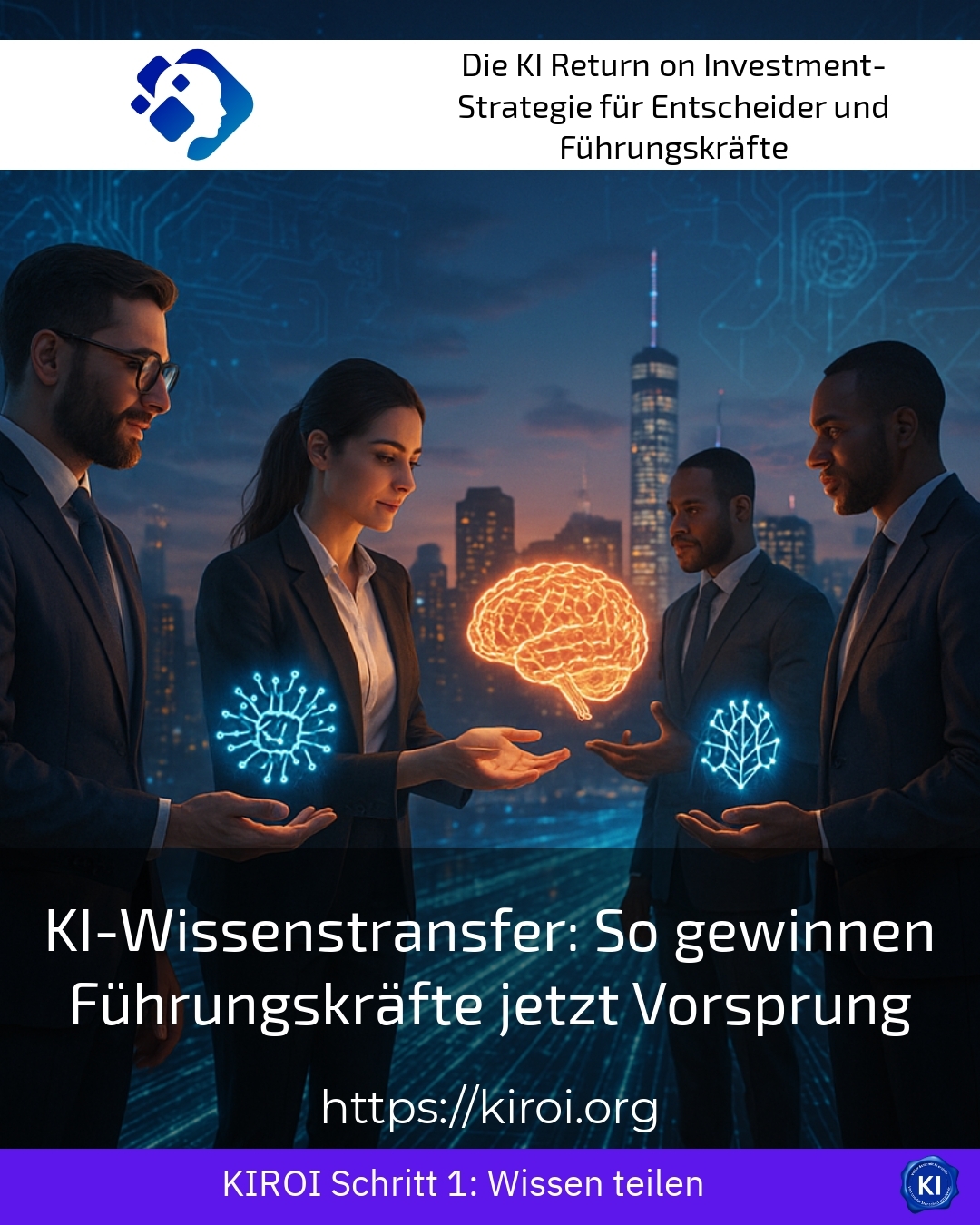
Imagine that you walk into your office tomorrow and your entire leadership team suddenly has the combined expertise of all departments. This vision is no longer a utopia today, but a tangible reality. AI knowledge transfer It is currently revolutionizing the way decision-makers in companies can act and react. Those who act now gain a significant advantage over their competitors. In this article, you will learn how modern technologies fundamentally change the flow of information in organizations and what concrete steps you can take.
Why AI knowledge transfer changes leadership work
The speed with which information is available today is increasingly overwhelming traditional management structures. Executives spend an average of several hours a day collecting and preparing relevant data. This time is missing for strategic decision-making and employee management. Intelligent systems can significantly accelerate and improve this process.
For example, a manufacturing company in the mechanical engineering sector implemented a system for automatic document analysis. The management level gained daily insights from production reports, customer complaints, and market analyses. Decision-making speed improved by about forty percent. Similar results are reported by companies in the logistics sector, which can now analyze complex supply chain data in real time.
A financial services provider used similar technologies to analyze customer portfolios. The advisors received personalized recommendations based on historical data and current market movements. Customer satisfaction increased measurably because conversations could be conducted in a more informed and targeted manner.
Best practice with a AIROI customer
A medium-sized company from the manufacturing industry faced the challenge of retaining the expertise of long-standing employees. Several key personnel were approaching retirement age and threatened to take valuable process knowledge with them. As part of a transruptive coaching program, we supported the management team in implementing an intelligent knowledge management system. The experienced professionals documented their expertise in structured interviews. The system analyzed these records and made them searchable and accessible for future generations. Within six months, a vibrant knowledge database with over two thousand documented process steps was created. New employees can now ask complex questions of the system and receive context-specific answers. The onboarding time was thereby significantly shortened. The management team reports that information availability in day-to-day operations has improved significantly.
Practical application areas for the transfer of AI knowledge in companies
The applications of intelligent knowledge systems extend to virtually all areas of the company. In sales, they support the preparation of customer conversations through automated summaries of past interactions. Sales managers gain a complete overview of customer relationships without having to spend hours searching through databases.
The human resources department of a large retail company uses such systems to analyze job applications and internal competency profiles. Executives can specifically search for employees with specific skills and receive appropriate proposals for project assignments. This significantly speeds up the team onboarding process and improves resource allocation.
A pharmaceutical company implemented a system for evaluating scientific publications. The research management now receives weekly summaries of relevant studies from their own field. This saves scientists many hours of manual research work and allows them to focus on the actual research.
Strategic advantages through systematic AI knowledge transfer
The strategic benefits go far beyond efficiency gains. Companies that systematically capture and make available their collective knowledge develop higher organizational resilience. They become more independent of individual knowledge sources and can react faster to changes.
A consulting company documented all project knowledge in an intelligent database [1]. New consultants can now access experience from hundreds of completed projects. The quality of the consulting services improved measurably as a result. At the same time, the dependence on individual senior consultants decreased.
In the insurance industry, executives use such systems for damage analysis and risk assessment. The aggregated findings from thousands of damage cases enable more precise forecasts and better product design. Customers benefit from more personalized offers and faster processing.
An energy provider uses comparable technology to analyze maintenance logs and incident reports. The technical department detects patterns and can initiate preventive measures before major outages occur. As a result, operating costs have decreased significantly.
The role of transruption coaching in implementation
The introduction of intelligent knowledge systems presents leaders with significant challenges. It is not just a matter of technical implementation, but above all of cultural changes. Employees must be willing to share their knowledge and adopt new working methods. This is where transruptive coaching comes in and supports organizations in this transformation.
Clients often report resistance within the workforce. Long-standing employees fear that they will be replaced by the documentation of their knowledge. Leaders are unsure how to deal with this fear. In such situations, transruptive coaching provides important impulses and supports the development of a positive change culture.
One automotive supplier faced exactly this challenge. The experienced toolmakers initially refused to document their expertise. Through accompanying workshops and individual discussions, it was possible to build trust and clearly demonstrate the benefits to all involved.
Best practice with a AIROI customer
An international logistics company wanted to systematically capture and make available the expertise of its dispatchers. The challenge was to translate implicit knowledge into explicit, searchable information. We accompanied the project from the initial concept phase to the full implementation. In joint workshops, the management team initially identified critical knowledge areas. Subsequently, we developed formats for structured knowledge capture. The dispatchers documented typical problem situations and their proven solution strategies. The intelligent system linked these individual cases to a comprehensive decision support system. New dispatchers can now enter complex situations and receive action recommendations based on the collective experience of the entire team. The error rate in routing decisions decreased by about thirty percent. At the same time, the satisfaction of the experienced employees increased, whose expertise was now visible and valued.
Success factors for sustainable knowledge transfer projects
The successful implementation of intelligent knowledge systems requires more than technical competence. Leaders must act as role models and actively participate in the exchange of knowledge. If management itself does not share information, employees will not either.
A construction company established weekly knowledge exchange rounds at the project manager level [2]. The findings were systematically documented and fed into the intelligent system. Within a year, a valuable wealth of experience was created that is regularly consulted on new projects.
The quality of the information submitted determines the usefulness of the overall system. Management should therefore establish clear standards for documentation. A technology company developed templates and checklists to standardize and simplify the recording process.
Regular review and updating of stored information is also crucial. A food company implemented a review process in which outdated content is identified and updated. This way, the knowledge base remains relevant and trustworthy at all times.
Challenges and how to overcome them
The implementation of intelligent knowledge systems also brings challenges. Data protection and information security require special attention. Sensitive company data must be protected from unauthorized access. A banking institution developed a multi-level authorization concept with different access levels for this purpose.
Integration into existing IT environments often presents a technical hurdle. Many companies operate with established system structures that are not easily compatible. A trading company therefore initially invested in unifying its data formats before the actual knowledge system was implemented.
User acceptance ultimately determines success or failure. One chemical company offered extensive training and established key users in every department [3]. These multipliers supported their colleagues in their daily use and collected feedback for continuous improvements.
Unrealistic expectations often lead to disappointment. Intelligent systems can support human expertise, but cannot completely replace it. From the outset, an engineering office communicated transparently about what tasks the system can handle and where human judgment is still required.
Future prospects for executives
Technological development is advancing rapidly. Executives who are laying the foundations now will benefit especially from future innovations. Systems will become increasingly capable of not only storing knowledge but also autonomously recognizing connections and generating recommendations for action.
A media company is already experimenting with systems that analyze market trends and provide creative impulses for new product ideas. The editorial team receives daily suggestions for relevant topics based on current developments and historical success data.
In medical technology, intelligent systems support the evaluation of clinical trials and the identification of promising research directions. Executives can use resources more purposefully and shorten development cycles. This significantly increases competitiveness.
A telecommunications company uses similar technologies to analyze customer requests and support tickets. The insights gained are directly incorporated into product development and continuously improve the customer experience. The churn rate has thus decreased measurably.
My AIROI Analysis
The systematic use of intelligent knowledge systems marks a turning point in corporate management. Executives who actively shape this development gain significant competitive advantages. The ability to access the collective knowledge of the entire organization fundamentally changes decision-making processes. This is not about replacing human intuition and experience. Rather, they are enhanced and expanded through technological support.
The examples from various industries show that the benefits can be realized regardless of the industry. The key is the right approach and a clear strategic vision. Transruptive coaching can provide valuable guidance and provide impulses for successful implementation. The cultural aspects of the transformation deserve at least as much attention as the technical issues.
The AI knowledge transfer is not a one-time project, but a continuous process. Companies need to create structures that promote and reward the continuous exchange of knowledge. The time and energy invested pay off through better decisions, faster responsiveness, and higher employee satisfaction. The right time to act is now, because the lead companies’ lead grows with every day.
Further links from the text above:
[1] McKinsey: The State of AI
[2] Harvard Business Review: Knowledge Management
[3] Gartner: Artificial Intelligence Insights
For more information and if you have any questions, please contact Contact us or read more blog posts on the topic Artificial intelligence here.











 Deutsch
 English (UK)