
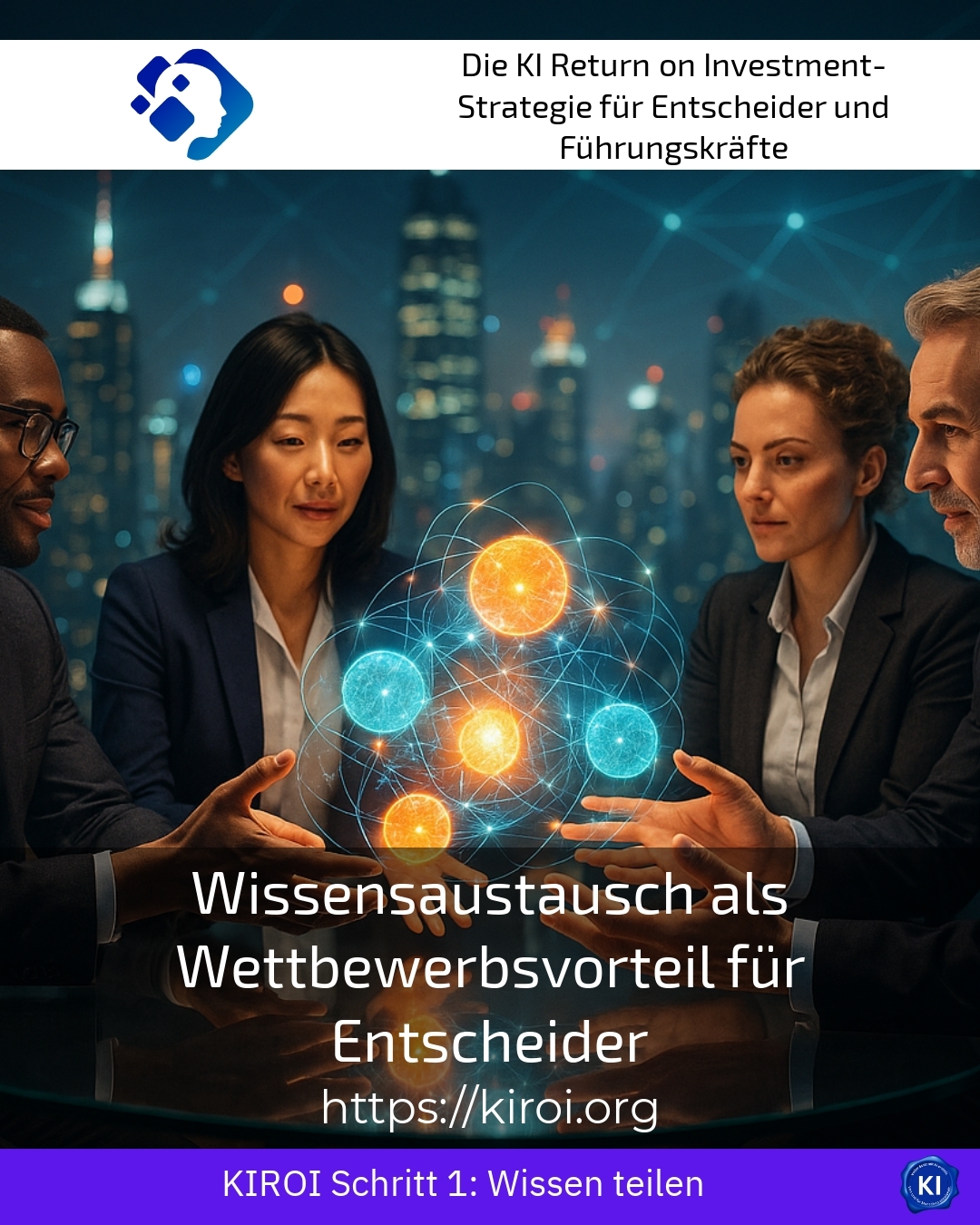
In a world where information has become the most valuable currency, the Knowledge sharing as a competitive advantage about the success or failure of entire organisations. Today, leaders face the challenge of uncovering hidden expertise within their teams and systematically utilising it. It repeatedly becomes clear that those companies prosper that deliberately promote and cultivate collective intelligence. The question is no longer whether you will undergo this change, but how quickly you can implement it.
Why collective learning is becoming a strategic imperative
The dynamics of modern markets demand a fundamental rethink from decision-makers regarding organisational learning processes. Traditional hierarchies, where knowledge flows from top to bottom, are increasingly proving to be an obstacle to agile action. Instead, we observe networked thinking in successful organisations, which integrates all levels. A medium-sized mechanical engineering company from southern Germany, for example, recognised that its service technicians possessed invaluable customer knowledge that was never systematically captured. These grassroots experts knew product weaknesses and unarticulated customer wishes better than any market research. It was only the establishment of regular knowledge-sharing sessions between technicians and product developers that led to an innovation rate which catapulted the company to the top of its niche.
Another example is provided by an internationally active logistics provider that fundamentally restructured its dispatching. Experienced dispatchers passed on their implicit knowledge of optimal route planning to younger colleagues. This mentoring programme significantly reduced empty runs and measurably increased customer satisfaction. A similar situation occurred at a pharmaceutical wholesale company that networked its field sales representatives. The sales reps shared successful sales strategies in an internal forum, thereby jointly improving their closing rates. These examples demonstrate that the Knowledge sharing as a competitive advantage does not represent an abstract theory, but delivers measurable results.
The Hidden Costs of Knowledge Silos
Clients often report frustration with double work and redundant processes in their organisations. Departments work in silos on similar problems, without knowing or benefiting from each other. For example, an insurance company invested considerable resources in developing a claims management tool, even though a subsidiary already possessed a working solution. This costly parallel development could have been prevented by a simple exchange of information. At an automotive supplier, a lack of communication between development and production led to recurring quality issues. The designers did not sufficiently understand the practical challenges of manufacturing, and production staff did not understand the technical background of design decisions. Only regular joint workshops untied this Gordian knot. A third example shows a software house whose support team repeatedly answered the same customer queries because a structured knowledge base did not exist. The introduction of a collaborative documentation system eased the workload of employees and significantly accelerated problem-solving.
Best practice with a AIROI customer
A family-run business steeped in tradition within the metalworking sector approached us because numerous experienced skilled workers were nearing retirement. Management feared a massive loss of knowledge, as these experts had accumulated unique expertise over decades. As part of our transruption-coaching support, we collaboratively developed a structured transfer programme that went far beyond traditional onboarding plans. The experienced employees documented their workflows and decision-making logic in short video sequences, commenting on their approach. Younger colleagues systematically shadowed the senior staff and asked targeted questions, which were also recorded. These recordings were integrated into an internal learning platform accessible to all employees. Furthermore, we established monthly experience exchange sessions where tricky manufacturing problems were discussed collectively. The results significantly exceeded expectations: the scrap rate decreased, the onboarding time for new employees was measurably reduced, and motivation across the entire team increased noticeably. The older employees felt valued, and the younger ones benefited from their wealth of experience. This project impressively demonstrates how transruption-coaching can support organisations in systematically safeguarding knowledge.
Embedding knowledge sharing as a competitive advantage in leadership culture
The willingness to share knowledge doesn't arise from instruction, but from a lived culture and appropriate frameworks. Leaders must understand that they themselves act as role models and, through their behaviour, shape the organisation's norms. For example, the CEO of a medium-sized technology company began reporting on personal mistakes and the lessons learned from them in weekly circular emails. This openness encouraged employees at all levels to share their experiences too, without fear of negative consequences. At a consulting firm, the introduction of so-called "lessons learned sessions" after each project completion led to a continuous improvement in project methodology. The consultants collectively reflected on what had worked well and what should be done differently next time. A retail company established a reverse mentoring programme where junior employees taught senior management digital skills. This reversal of traditional hierarchies created mutual respect and fostered intergenerational dialogue.
The creation of psychological safety proves to be a crucial success factor here [1]. Teams in which members can ask questions and admit mistakes without fear of shame demonstrably learn faster and innovate more often. An energy supplier fundamentally transformed its safety culture by no longer sanctioning near-misses, but by treating them as valuable learning opportunities. The reporting rate increased dramatically, and as a result, the actual number of accidents significantly decreased. A financial service provider set up anonymous feedback channels through which employees could submit suggestions for improvement without attribution. This low-threshold option encouraged the participation of more reserved team members as well.
Technological enablers for collective intelligence
Digital tools can significantly accelerate the flow of knowledge and overcome barriers between locations and departments. For example, a globally operating consumer goods manufacturer uses an internal social media platform where employees worldwide can share and discuss best practices [2]. An idea from the Brazilian plant thus improved production processes in Germany and China equally. A construction company digitised its site diaries and made them searchable across projects. Suddenly, site managers could benefit from the experiences of their colleagues from previous, similar projects and avoid typical pitfalls. A hospital established a wiki system where doctors and nurses documented and continuously updated medical expertise. This helped new employees find their way around more quickly, and rare diseases were recognised better because the knowledge about them was more easily accessible.
At the same time, we warn against viewing technology as a panacea, as even the best systems remain unused without cultural embedding. Clients often report on expensive knowledge management platforms that fall into disuse after their introduction. Implementation requires continuous support and clear incentives for use. Transruption coaching supports organisations in designing these change processes sustainably and addressing resistance constructively.
Best practice with a AIROI customer
A corporate group in the food sector was struggling with fragmented expert knowledge across its various subsidiaries. Each unit had developed its own procedures, and synergies within the group remained largely untapped. In our joint project, we initially identified key experts in each company through systematic interviews and network analyses. We then connected these knowledge carriers in thematic Communities of Practice, which met regularly both virtually and in person. Production specialists exchanged ideas on efficiency improvements, while quality managers worked together on uniform standards. The community of buyers proved particularly valuable, achieving significant cost savings through consolidated procurement. Management received regular input from these communities, enabling them to make more informed strategic decisions. Support from transruption coaching ensured that the communities did not fade away after the initial enthusiasm but continued to work sustainably. The group estimates annual savings from improved internal knowledge transfer to be in the seven-figure range. This project highlights the importance of professional moderation and continuous support in establishing knowledge structures.
The Human Factor: Designing Motivation and Incentives
The willingness to share knowledge is by no means a given, as in many organisations exclusive expert knowledge is considered a career guarantee and a power base. Breaking through this dynamic requires thoughtfully designed incentive systems and a redefinition of what is considered a valuable contribution. For example, a management consultancy explicitly integrated the quality of knowledge contributions into its promotion criteria. Employees who created helpful materials for colleagues or engaged as mentors received positive recognition in their performance reviews. A technology group awarded virtual accolades to particularly helpful experts who stood out through their contributions in internal forums. This symbolic recognition proved surprisingly motivating because it increased the visibility of knowledge holders and strengthened their reputation [3]. A service company introduced innovation bonuses, which were awarded not only for one's own ideas but also for the successful further development of others' approaches.
We must not forget that intrinsic motivation is more effective in the long term than external incentives. People are happy to share their knowledge when they feel their contributions are valued and make a difference. A care home introduced regular case conferences where nurses presented particularly successful care situations. The appreciation from colleagues and superiors motivated the entire team to learn from each other and improve together. An architectural firm set up internal competitions where teams presented their creative solutions. The competitive spirit fuelled their willingness to share innovative ideas for discussion rather than keeping them to themselves.
Making knowledge sharing a measurable competitive advantage
Decision-makers require reliable key figures to justify investments in knowledge management and track progress. Measuring knowledge flows is challenging, but by no means impossible. For example, an industrial company recorded the time to problem resolution before and after the introduction of a knowledge base. The reduction was impressive and justified the investment many times over. A sales team analysed the closing rates of employees who regularly participated in experience exchanges compared to those who did not. The difference was statistically significant and economically relevant. A research institute counted the number of cross-departmental collaborative projects as an indicator of successful knowledge transfer and recorded a continuous increase after targeted networking initiatives.
My AIROI Analysis
Examining numerous organisations and industries reveals a clear pattern that decision-makers should not ignore. Collective intelligence does not arise by chance, but requires deliberate design and continuous nurturing by committed leaders. The most successful companies understand that individual expertise only unfolds its full potential through networking and becomes organisational strength. It is not enough to provide technological platforms and hope for spontaneous use. The cultural dimension is at least as important as the technical infrastructure, and both must be developed in unison.
Transruptions-Coaching supports organisations on this path, providing impetus for sustainable change without imposing pre-packaged solutions. The examples demonstrate that similar challenges exist across industries and that similar principles lead to success. Psychological safety, well-considered incentives, and authentic leadership role-modelling form the foundation upon which technical solutions can only become effective. Investment in systematic knowledge transfer typically pays for itself quickly through avoided errors, accelerated innovation, and increased employee satisfaction. Decision-makers who recognise these connections and act consistently secure a sustainable advantage for their organisations in increasingly knowledge-intensive markets.
Further links from the text above:
[1] Harvard Business Review: Psychological Safety
[2] McKinsey: The Social Economy
[3] Gartner: Insights on Knowledge Management
For more information and if you have any questions, please contact Contact us or read more blog posts on the topic Artificial intelligence here.








 Deutsch
  English (UK)