
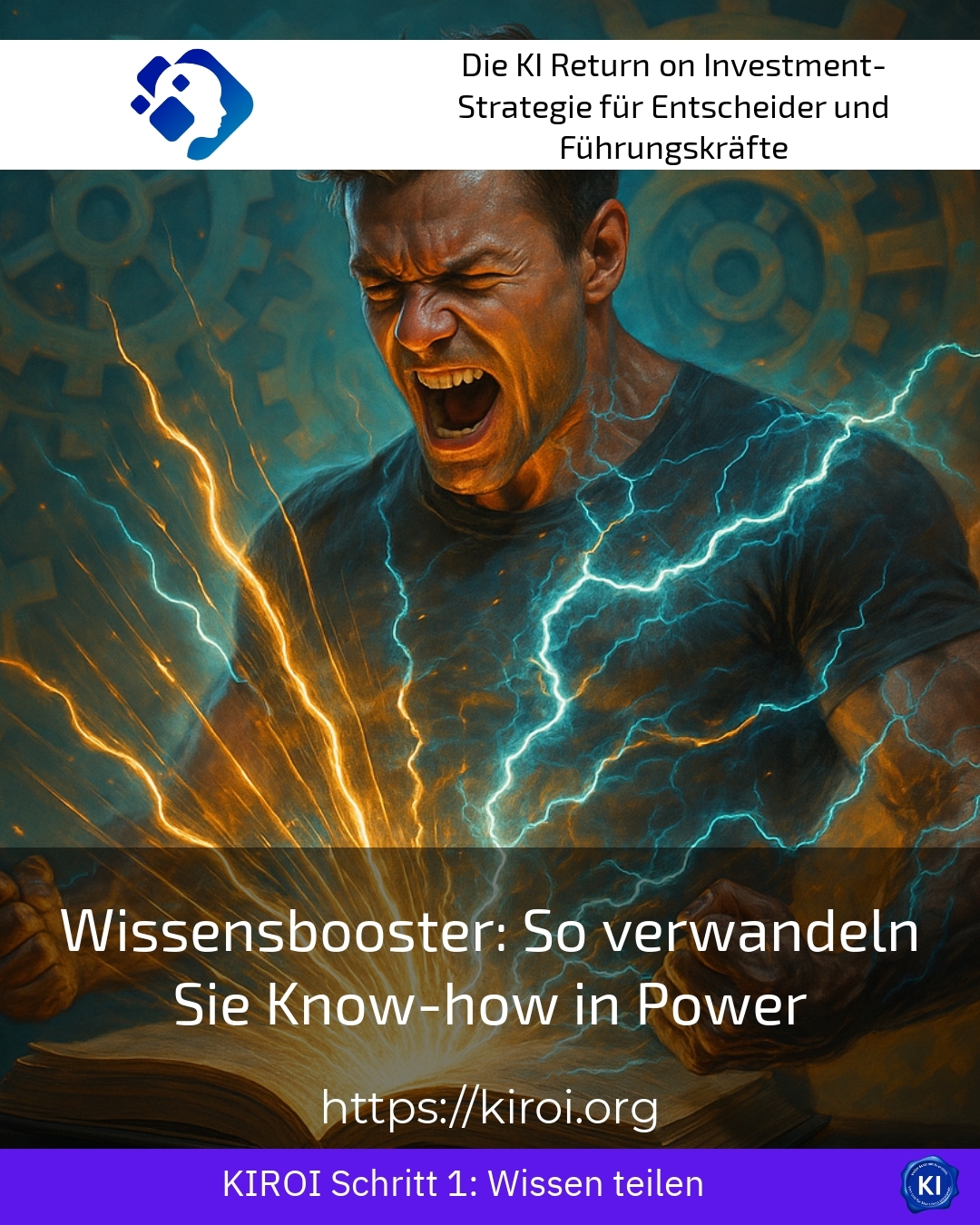
Imagine you own a treasure whose true value you haven't even recognised yet. It is precisely the same with the knowledge that slumbers within your company, waiting to be activated. The decisive Knowledge booster: How to turn know-how into power does not lie in the mere accumulation of information, but in its strategic transformation into a real competitive advantage. In a world that is changing more rapidly than ever before, the ability to systematically utilise and further develop existing knowledge is becoming the decisive success factor. This article shows you concrete ways in which you can unlock dormant potential.
The hidden power of organisational knowledge
Every company possesses a huge treasure trove of knowledge that has accumulated over the years. This treasure consists of the experience of long-standing employees, documented processes and countless lessons from past projects. Clients frequently report that this very knowledge remains trapped in silos. The individual departments communicate insufficiently with one another. Valuable insights are lost when experienced specialists leave the company.
For example, a medium-sized manufacturing company realised that its machine operators had decades of experience. However, this expertise had not been recorded anywhere. When several of these specialists retired at the same time, the company faced significant challenges. A financial sector consultancy experienced something similar because client relationships existed exclusively in the minds of individual consultants. A software developer also noticed that important architectural decisions went undocumented and new team members repeated the same mistakes.
Best practice with a AIROI customer
A long-established mechanical engineering company approached us because it was facing a particular challenge. The management had realised that about forty percent of its most experienced employees would retire within the next five years. These specialists held crucial knowledge regarding production processes, customer requirements and technical specificities. As part of our accompaniment, we jointly developed a structured knowledge-capture programme. We conducted detailed interviews with the experienced employees and documented their implicit knowledge in an understandable format. Furthermore, we established a mentoring system in which each experienced skilled worker intensively accompanied a younger colleague over several months. The transruptions coaching helped to break down resistance to this change. Many of the older employees initially feared that passing on their knowledge would make them replaceable. Through empathetic discussions and the appreciation of their expertise, it was possible to dispel these concerns. After about eighteen months, the company had a comprehensive knowledge database and a vibrant network for knowledge transfer.
The knowledge booster in practical application
The transformation of know-how into real agency requires a systematic approach. It is not enough merely to collect and store knowledge. Rather, this knowledge must remain dynamic and be continuously developed further. A Knowledge booster: How to turn know-how into power only works sustainably if all participants recognise the benefit and actively participate [1].
This is particularly evident in the healthcare sector. For instance, hospitals are developing internal knowledge platforms where doctors share complex case studies. Nursing staff document best practices for dealing with challenging patient situations. And administrative personnel exchange insights on efficient process workflows. A logistics company used a similar approach to make the route optimizations of experienced dispatchers accessible to everyone. An advertising agency established regular creative sessions in which teams analysed their most successful campaign concepts.
methods for systematic knowledge activation
The first step is to make existing knowledge visible in the first place. Many organisations underestimate the skills that are already present. A structured inventory therefore forms the indispensable basis for all further measures. Competency matrices, which show who has which specialist knowledge, are helpful here.
In retail, progressive companies use such tools to assess the product knowledge of their sales teams. In this way, a bookshop chain identified hidden experts for specific genres in its branches. An electronics store realised that some employees possessed a deep technical understanding. And a fashion retailer discovered style advisors with a special flair for colour combinations whose talent had previously gone unnoticed [2].
The second essential aspect concerns the creation of spaces for knowledge exchange. These spaces can be physical or virtual in nature. The crucial point is that they are designed to be inviting and encourage dialogue. Regular formats such as lunch-and-learn sessions or communities of practice have proven successful in many industries.
Knowledge boosters in the digital age: How to turn know-how into power
Digital transformation opens up completely new possibilities for knowledge management. Modern technologies make it possible to capture, structure and provide knowledge on demand. Artificial intelligence can assist in filtering relevant information from large amounts of data. At the same time, digital tools create new challenges that need to be mastered.
For example, an architectural practice implemented a digital system for recording project experience. Every completed construction project was systematically evaluated and the insights made available for future projects. A law firm developed a searchable database of legal argument patterns from won cases. And a pharmaceutical company connected its research teams worldwide via a collaborative platform [3].
Best practice with a AIROI customer
An international management consultancy approached us with a specific request. The management level had noticed that valuable project knowledge was regularly lost after an assignment was completed. Consultants moved on to new clients and took their insights with them. New project teams frequently started from scratch, even though similar challenges had already been solved. Together, we developed a structured process for so-called project harvesting. At the end of each consulting project, a moderated reflection session now took place. The team identified the most important lessons, both positive and negative. These insights were documented in a standardised format and stored in a central knowledge database. The transruptions coaching accompanied the cultural change that came with this initiative. Initially, many consultants perceived the documentation as an additional burden alongside their already high workload. Through continuous impetus and by highlighting concrete success stories, this perception shifted. After two years, project managers reported significantly shorter induction periods with new clients. The quality of the consulting services improved noticeably because proven approaches could be systematically reused.
The human component of knowledge transfer
Technology alone is not enough to successfully activate knowledge. The human factor plays a crucial role in all knowledge management initiatives. People will only willingly share their knowledge if they have trust in the organisation. They need to experience that the sharing of knowledge is valued and not exploited.
This dynamic is particularly clear in the trades. Master craft businesses thrive on the passing on of craft skills across generations. A carpentry workshop, for example, maintains the tradition of journeymen learning from different masters. A bakery preserves secret family recipes through ritualised initiation ceremonies. And a goldsmith documents their most intricate techniques in detailed video tutorials for the next generation.
The willingness to share is closely linked to the corporate culture. Leaders must lead by example and actively pass on knowledge themselves. Incentive systems can provide support, but they should not become the sole motivator. The intrinsic joy of sharing knowledge arises from positive experiences and genuine appreciation.
Overcoming obstacles and creating sustainable structures
On the path to becoming a knowledge-active organisation, companies encounter typical obstacles. Lack of time is frequently cited as the main reason why knowledge sharing does not take place. Employees feel so consumed by their operational tasks that no capacity remains for reflection and documentation. Here, clear signals from management are needed to show that knowledge work counts as legitimate working time [4].
A telecommunications company granted its technical experts two hours of dedicated time per week for knowledge activities. An insurance company integrated the documentation of case knowledge into regular workflows. And an automotive supplier rewarded teams that shared particularly valuable process improvements with additional development budgets.
Another common obstacle is the fear of losing power. Some employees worry that by passing on their knowledge they will become replaceable. This concern is understandable and deserves to be handled respectfully. However, experience shows that knowledge sharers are usually particularly valued within organisations. Their competence lies not only in the knowledge itself, but also in the ability to communicate it in an understandable way.
My AIROI Analysis
Following intensive support for numerous organisations in activating their knowledge potential, a few key insights are emerging. The importance of well-conceived knowledge management will continue to grow in the coming years. Demographic changes, increasing complexity and accelerated innovation cycles are intensifying the pressure to systematically utilise existing know-how.
The integration of knowledge activities into the working day appears particularly significant to me. Isolated initiatives or sporadic campaigns only have a limited impact. Lasting success is achieved when knowledge sharing becomes a natural part of daily work. This requires both structural frameworks and cultural changes.
The role of leaders cannot be overestimated in this process. Through their own behaviour, they shape the culture of knowledge sharing. When leaders themselves ask questions, admit what they do not know and actively learn, this signals to the entire organisation that intellectual curiosity is encouraged.
The Knowledge booster: How to turn know-how into power only achieves its full effect through consistent action. It is not enough to develop theoretical concepts. True transformation happens in daily practice, in every conversation and every piece of documentation. Organisations that consistently follow this path develop a sustainable competitive advantage that can hardly be copied.
Further links from the text above:
[1] Harvard Business Review: Knowledge Management
[2] McKinsey Insights: People and Organisational Performance
[3] Gartner: Knowledge Management Research
[4] Deloitte: Global Human Capital Trends
For more information and if you have any questions, please contact Contact us or read more blog posts on the topic Artificial intelligence here.








 Deutsch
  English (UK)