
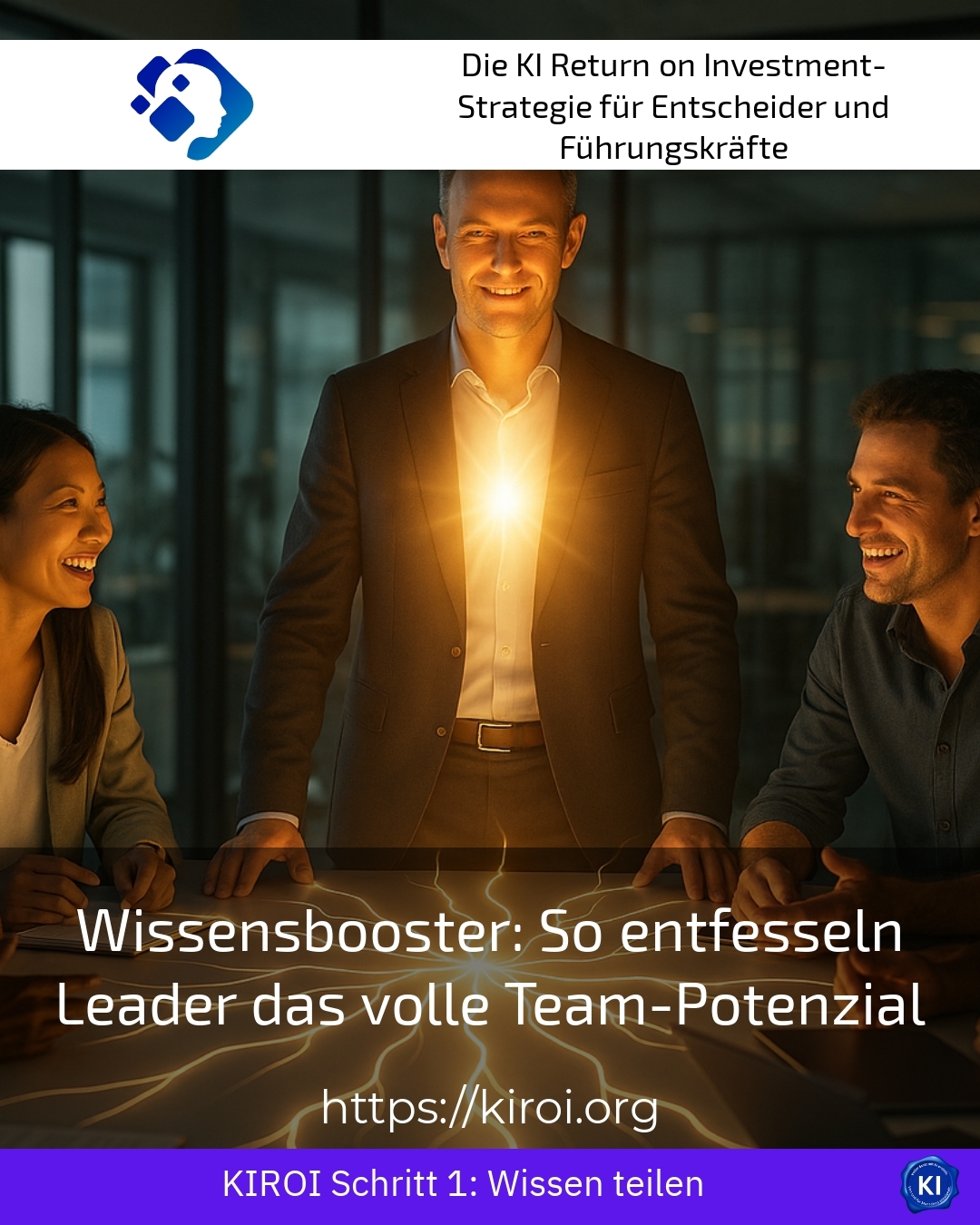
Imagine being able to make your team's hidden talents visible and nurture them specifically within a few weeks. This very knowledge booster, which unleashes the full team potential, is what leaders worldwide are concerned with today. But why do so many leaders fail at this, even with the best intentions? The answer lies deeper than most suspect. It's not just about training courses or workshops. Rather, it requires a fundamental rethink in how we share knowledge and grow together.
The invisible treasure: Why hidden knowledge slows teams down
Vast potential often lies dormant in the minds of employees in numerous companies. Experienced colleagues possess expert knowledge that they rarely actively share. New team members struggle through the same challenges that others have long since overcome. This cycle costs time, energy, and not least, money.
For example, a manufacturing company in mechanical engineering recognised that its service technicians were repeatedly analysing the same errors. An insurance group noticed that complex claims were researched individually by each case handler. A logistics company discovered that proven route optimisation methods were only known to individual drivers. These examples illustrate how valuable systematic knowledge transfer can be. Managers who wish to tap into this treasure need new approaches and methods.
The knowledge booster as a management tool for sustainable success
Modern leaders increasingly understand that their most important asset does not lie in machines or software. The collective knowledge of their teams makes the crucial difference in competition. Clients often report that they initially don't even know where the knowledge in their organisation is located. This is precisely where professional support comes in, as structured processes can help to activate this potential.
A medium-sized software company introduced so-called knowledge circles, where developers exchanged their findings weekly. A retail chain established digital testimonials, which store managers shared among themselves. A hospital implemented structured handover protocols, which preserved the accumulated knowledge of the nursing staff. These three different sectors show how diverse the implementation can be.
Best practice with a AIROI customer
An internationally active consulting firm approached transruptions-Coaching because high staff turnover meant that valuable project knowledge was regularly being lost. Executives noticed that new consultants were making the same beginner mistakes that experienced colleagues had long since avoided. As part of the support process, we jointly developed a multi-stage mentoring system that systematically transferred knowledge from senior to junior consultants. This resulted not only in formal training formats but also in informal exchange platforms where experiential knowledge was organically passed on. After six months, the company reported a significant reduction in the onboarding time for new employees. Additionally, the satisfaction of experienced consultants increased because they saw their expertise valued. The project impressively demonstrated that structured knowledge transfer processes can enrich both sides and sustainably strengthen the entire organisation.
Psychological Safety: The Foundation for Open Knowledge Sharing
Before teams can share their knowledge, they need to feel safe. Psychological safety describes a climate in which people are not afraid of negative consequences [1]. Leaders can actively shape and promote this climate. They start by admitting their own mistakes and learning from them.
For example, a technology start-up introduced so-called "Failure Fridays" where teams presented their failed experiments. A financial services provider introduced anonymous feedback rounds, which enabled honest responses. An architecture firm created open critique rooms where designs could be constructively questioned. These measures signal that learning is more important than perfection.
Research shows that teams with high psychological safety are more innovative and productive [2]. Leaders who communicate openly lay the foundation for genuine knowledge sharing. This is not about weakness, but about authentic strength.
Knowledge boost through targeted learning formats and modern methods
Traditional training courses often don't achieve the desired effect. Modern learning formats, on the other hand, focus on active participation and practical application. Leaders can combine various methods and adapt them to their specific needs.
A pharmaceutical company used micro-learning units, completed by employees in just five minutes daily. An automotive supplier implemented peer-to-peer coaching, where experienced workers shared their knowledge directly at the workplace. A media company established internal podcasts, in which experts shared their specialist knowledge. These examples demonstrate how creatively knowledge transfer can be designed.
The crucial factor lies in regularity and integration into the daily work routine. Knowledge that people can apply immediately is better retained. Leaders should therefore create learning opportunities that are seamlessly embedded into existing processes.
Best practice with a AIROI customer
A long-established trading company approached us with the challenge that digitalisation required new skills that were only sporadically available within the company. The few digitally savvy employees were overworked because all their colleagues were constantly asking them for help. As part of transruptive coaching, we jointly developed an internal expert network that distributed the knowledge burden across multiple shoulders. We first identified the various areas of expertise and assigned several contact persons to each. Subsequently, we established short, weekly knowledge-sharing sessions in which the experts systematically passed on their know-how. After the introduction, the company reported a noticeable reduction in the workload for the original knowledge carriers and an overall higher level of digital competence throughout the workforce. It was particularly pleasing that even reserved employees increasingly asked questions and actively participated in the learning process.
The role of the leader as a knowledge enabler
Leaders who wish to unlock the full potential of their teams need to redefine their roles. They are no longer the all-knowing decision-makers, but rather enablers of learning processes. This transformation requires courage and a willingness to let go of control.
A construction company benefited because the managing director regularly visited construction sites and listened to the workers. An advertising agency experienced a creative surge after the executive stopped judging every idea. An IT service provider increased its innovative capacity because the team leaders began asking more questions than giving answers. These examples illustrate the shift in leadership culture.
Clients often report difficulty transitioning from an expert role to a coaching role. Professional guidance can provide valuable insights precisely at this transition. The aim is to empower teams to develop their own solutions.
Enhance knowledge boosters with digital tools
Technology can significantly accelerate and simplify knowledge transfer. Digital platforms make it possible to document knowledge and make it accessible at any time. However, technology never replaces human interaction [3].
An energy provider implemented an internal wiki that was continuously maintained by employees. A catering group used video tutorials in which top chefs demonstrated their techniques. A care home introduced an app that allowed nursing staff to quickly document their observations. These digital solutions meaningfully supplement personal exchange.
The challenge lies in selecting the right tools and establishing their use. Many organisations have digital platforms that are barely used. Leaders must therefore not only introduce the technology, but also create the culture that promotes its use.
Breaking down knowledge silos: promoting cross-departmental learning
There is often enormous knowledge within individual departments that remains hidden from other teams. These knowledge silos prevent synergies and slow down the entire organisation. Leaders can actively build bridges between departments.
A chemical company established job rotation programmes where employees worked in different departments for a few weeks. A telecommunications provider introduced interdisciplinary project teams that jointly solved complex customer problems. A publishing house organised regular networking meetings where editors, designers and marketing experts came together. These measures promote mutual understanding and knowledge sharing.
Overcoming silo thinking often requires a cultural shift that takes time and patience. Transruption coaching can offer support and valuable insights for projects surrounding this transformation.
My AIROI Analysis
Unlocking the full potential of a team through targeted knowledge transfer is one of the most important leadership tasks of our time. My analysis clearly shows that successful organisations must combine several factors to achieve sustainable success. Firstly, a culture of psychological safety is needed, where people are willing to openly share their knowledge and admit mistakes. This culture does not emerge on its own but must be actively modelled and fostered by leaders.
Furthermore, suitable formats and structures play a crucial role in successful implementation. Spontaneous knowledge sharing is valuable, but without systematic approaches, much potential remains untapped. The combination of formal learning programmes and informal exchange opportunities proves to be particularly effective in practice. Digital tools can offer support, but they can never replace personal dialogue.
The role of the leader as an enabler of learning processes seems particularly relevant to me. The shift from the all-knowing expert to the questioning coach is difficult for many leaders. It is precisely here that professional support can provide valuable impulses and support the transformation process. The examples from various industries show that the fundamental principles are universally applicable, while the specific implementation must always be adapted to the specific context. Those who heed and consistently implement these insights will gradually unlock the hidden potential of their team and benefit from a learning organisation in the long term.
Further links from the text above:
[1] High-Performing Teams Need Psychological Safety – Harvard Business Review
[2] Guide: Understanding Team Effectiveness – Google re:Work
[3] Technology Alone Won’t Transform Your Organisation – McKinsey
For more information and if you have any questions, please contact Contact us or read more blog posts on the topic Artificial intelligence here.










 Deutsch
  English (UK)