
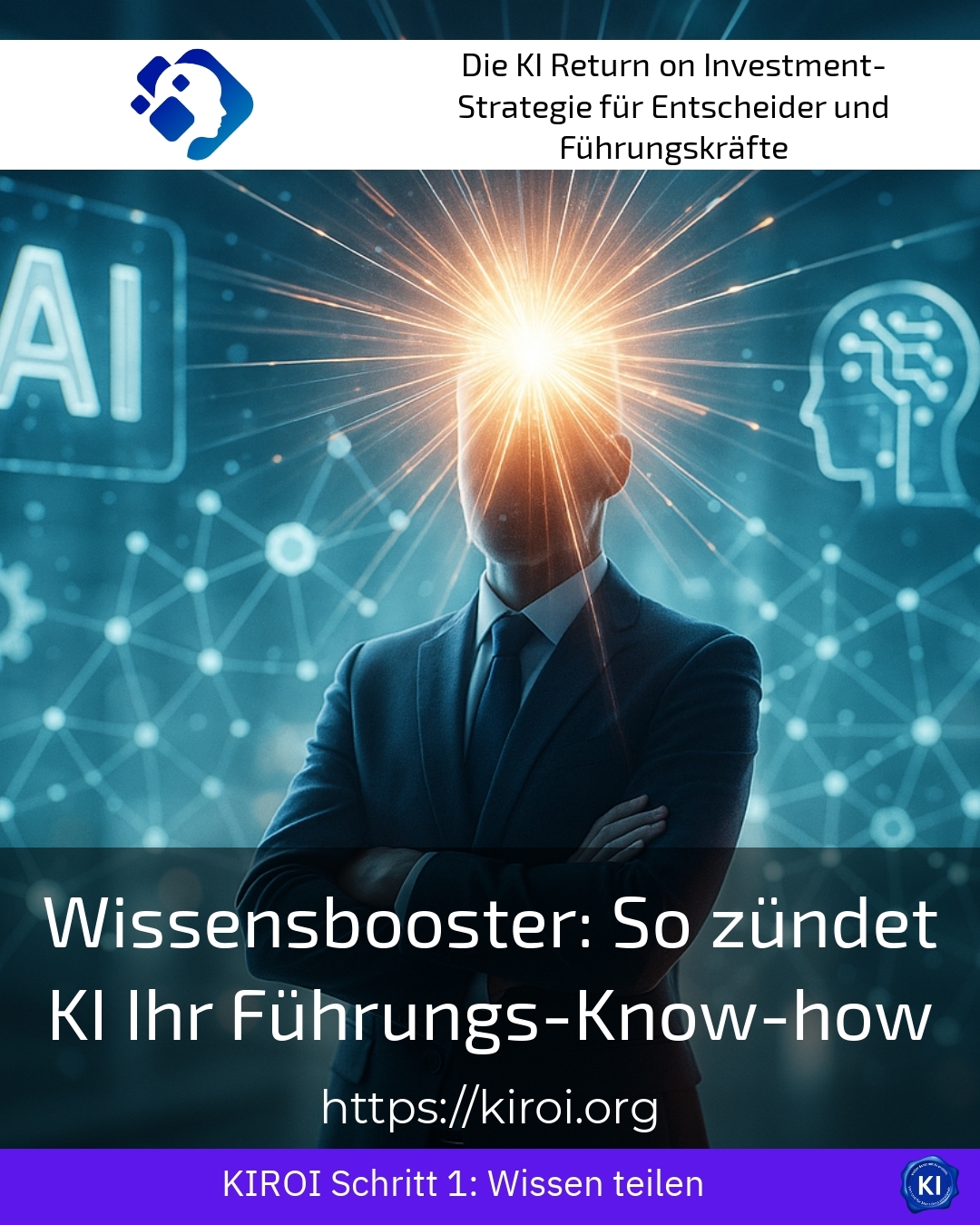
Imagine being able to elevate all your leadership knowledge to a completely new level in the shortest possible time. This is precisely what intelligent systems, which act as Knowledge Booster: How AI Ignites Your Leadership Expertise Initiate revolutionary learning processes. Today, leaders face the challenge of having to make complex decisions faster than ever before. The good news is that modern technologies support you in filtering and strategically applying relevant information. In this article, you will learn how to use these possibilities for your personal development.
The new era of leadership learning
The classic management seminar has had its day, as the business world has fundamentally changed. Today, leaders need continuous knowledge impulses rather than one-off training sessions. Intelligent learning assistants analyse individual knowledge gaps and suggest suitable content. They recognise patterns in your learning behaviour and optimise information delivery accordingly.
In healthcare, clinic directors are already successfully using such systems for their strategic development. For example, a hospital CEO receives a personalised summary of relevant industry developments in the morning. The chief physician of an emergency department uses adaptive learning platforms for continuous leadership impulses. Heads of nursing services also frequently report significantly more efficient training processes through intelligent support.
Knowledge Booster: How AI Ignites Your Leadership Expertise in Clinical Practice
Everyday life in hospitals and care facilities leaves little room for extensive further training. This is why microlearning offers are gaining increasing importance for busy leaders. Intelligent systems recognise free time slots and then offer compact learning units. This form of adaptive learning optimally adapts to the rhythm of the healthcare sector.
For example, an administrative director at a rehabilitation centre makes productive use of downtime between meetings. The head of a care home systematically expands her change management knowledge during quiet night shifts. Outpatient care service managers make use of mobile learning formats available on the go.
Best practice with a KIROI customer
A large hospital group with over twenty locations faced the challenge of developing its managers in a consistent manner. The geographical distribution of the facilities made traditional in-person training significantly more difficult and incurred high travel costs. As part of a transruptive coaching project, we jointly developed an intelligent learning architecture for all management levels. The system now analyses individual competencies and suggests tailored development paths that match the respective experience background. Senior physicians receive different stimuli than commercial managers or nursing managers, because their challenges are different. The platform also identifies knowledge gaps in the area of staff management and proactively offers relevant content. After six months of support, the managers reported significantly increased confidence in acting in critical situations. Fluctuations in middle management decreased noticeably, pointing to improved leadership quality. The ability to automatically share best practices between locations proved particularly valuable. This project impressively demonstrates how intelligent systems can meaningfully complement traditional personnel development.
Personalised development paths for leaders
Every leader brings unique strengths and areas for development that should be taken into account. Standardised leadership programmes can hardly do justice to this individuality and often miss their mark. Intelligent analysis systems, in contrast, create precise competency profiles and derive learning recommendations from them. This personalisation significantly increases learning motivation and accelerates the transfer of knowledge into practice.
The Medical Director of a university hospital uses such systems to prepare for supervisory board meetings [1]. The director of a hospice receives inspiration for empathetic leadership in emotionally challenging situations. The CEO of a medical device company uses adaptive learning tools for regulatory updates. All these use cases demonstrate how diverse the applications in the healthcare sector already are.
Systematically build strategic decision-making competence
Leadership decisions in healthcare often have far-reaching consequences for both patient safety and economic viability. Therefore, the systematic development of decision-making competence deserves special attention. Intelligent simulation environments enable risk-free practice of complex leadership situations in a protected setting. You receive direct feedback and can play through various options for action.
For example, a clinic buyer virtually rehearses negotiation strategies with medical device manufacturers in advance. The nursing management of an intensive care unit systematically practices crisis communication in the event of unexpected staff shortages. Quality managers simulate conversations with critical inspectors before they actually take place. These practice formats enhance self-confidence and improve responsiveness in stressful situations.
Knowledge Booster: How AI ignites your leadership know-how through collective intelligence
Individual learning gains additional power when linked to the knowledge of other leaders. Intelligent systems can consolidate and make accessible anonymised insights from successful leadership practices. This collective intelligence significantly accelerates knowledge transfer between organisations and industries. At the same time, the confidentiality of sensitive information is maintained.
Hospital groups use such systems to systematically identify and share best leadership practices. Regional nursing networks exchange insights on staff retention in this way. Medical care centres learn from each other without strengthening direct competitors [2]. This form of structured knowledge exchange was not previously possible on this scale.
Best practice with a KIROI customer
A medium-sized provider of care facilities was looking for ways to better network its facility managers and enable them to learn from each other. The different homes largely worked in isolation, even though they had to deal with similar leadership challenges. As part of our transruption coaching support, we implemented an intelligent knowledge platform with learning analytics functions. The system now automatically detects when a facility performs particularly well in certain key figures and facilitates contact with those responsible. Managers receive personalised pointers to colleagues with relevant expertise for current challenges. The platform also suggests suitable learning partnerships between experienced and newer managers. The function for anonymously collecting successful conflict resolution strategies, which is made accessible to everyone, proved particularly valuable. After one year, the facility managers reported significantly improved networking and shorter problem-solving times. Employee satisfaction in the participating homes demonstrably increased, underscoring the effectiveness of the measure. This project impressively demonstrates the value of intelligent knowledge networks for leadership development in the care sector.
Strengthening Emotional Intelligence through Technological Support
Leadership in healthcare requires particularly strong emotional competencies in view of stressful situations for all involved. Intelligent systems can also provide valuable impetus for development in this sensitive area. They analyse communication patterns and provide guidance on improving empathetic communication skills [3]. Of course, they do not replace direct human contact, but they do support reflection.
A palliative care unit manager uses such tools to structure their preparation for difficult family conversations. The chief physician of a psychiatric clinic regularly reflects on their team communication using intelligent analyses. CEOs also use these systems to better assess their impact on employees.
Developing future-oriented leadership competence
The healthcare sector is facing profound transformations that will require new leadership skills. Demographic change, a shortage of skilled workers, and digitalisation fundamentally challenge established leadership concepts. Intelligent learning systems help to anticipate these future requirements early on and to build up corresponding competencies. They identify emerging trends and proactively suggest relevant learning topics.
Clinic management is already dealing with leading age-mixed teams in new work models. Nursing service managers are preparing for the integration of technical assistance systems into their areas of work. Administrative directors are systematically developing competencies for data-based decision-making processes in hospital operations.
Knowledge Booster: How AI ignites your leadership expertise sustainably
The sustainable integration of intelligent learning tools requires a well-thought-out rollout strategy within each organisation. It is not enough to simply provide new technologies without considering the cultural aspects. Leaders must understand the added value of these systems and actively want to utilise them. That's why transruptions-coaching supports organisations with the gradual implementation of such solutions.
A large hospital successfully launched with a small pilot group of interested managers. A chain of care homes initially intensively trained their technically savvy managers as multipliers. A medical supply centre meaningfully integrated the new learning tools into existing quality circles.
My KIROI Analysis
The integration of intelligent systems into healthcare leadership development holds enormous potential, but also presents considerable challenges. In my assessment, the greatest benefit lies in the personalisation of learning pathways, which can cater to the individual needs of busy leaders. The traditional seminar landscape will not disappear, but it will be usefully supplemented and expanded by adaptive learning formats.
What seems particularly relevant to me is the possibility of networking and making collective leadership knowledge accessible across organisational boundaries. The healthcare sector could benefit significantly from this structured knowledge exchange, as many institutions face similar challenges. At the same time, I urge caution regarding inflated expectations: technology can support human leadership quality, but can never completely replace it.
Successful implementation requires careful support that considers both technical and cultural aspects. Leaders need time and space to try out new forms of learning and integrate them into their daily routines. Organisations should formulate realistic expectations and understand the introduction process as a learning journey.
I advise healthcare decision-makers to carefully observe current developments and gradually gain their own experience. The technology will continue to improve, and early adopters will be able to achieve competitive advantages in leadership development. Those who start today will be significantly better positioned for tomorrow's challenges.
Further links from the text above:
[1] McKinsey Healthcare Insights – Healthcare Leadership
[2] Harvard Business Review – Leadership Development
[3] WHO – Health Leadership and Governance
For more information and if you have any questions, please contact Contact us or read more blog posts on the topic Artificial intelligence here.











 Deutsch
  English (UK)