
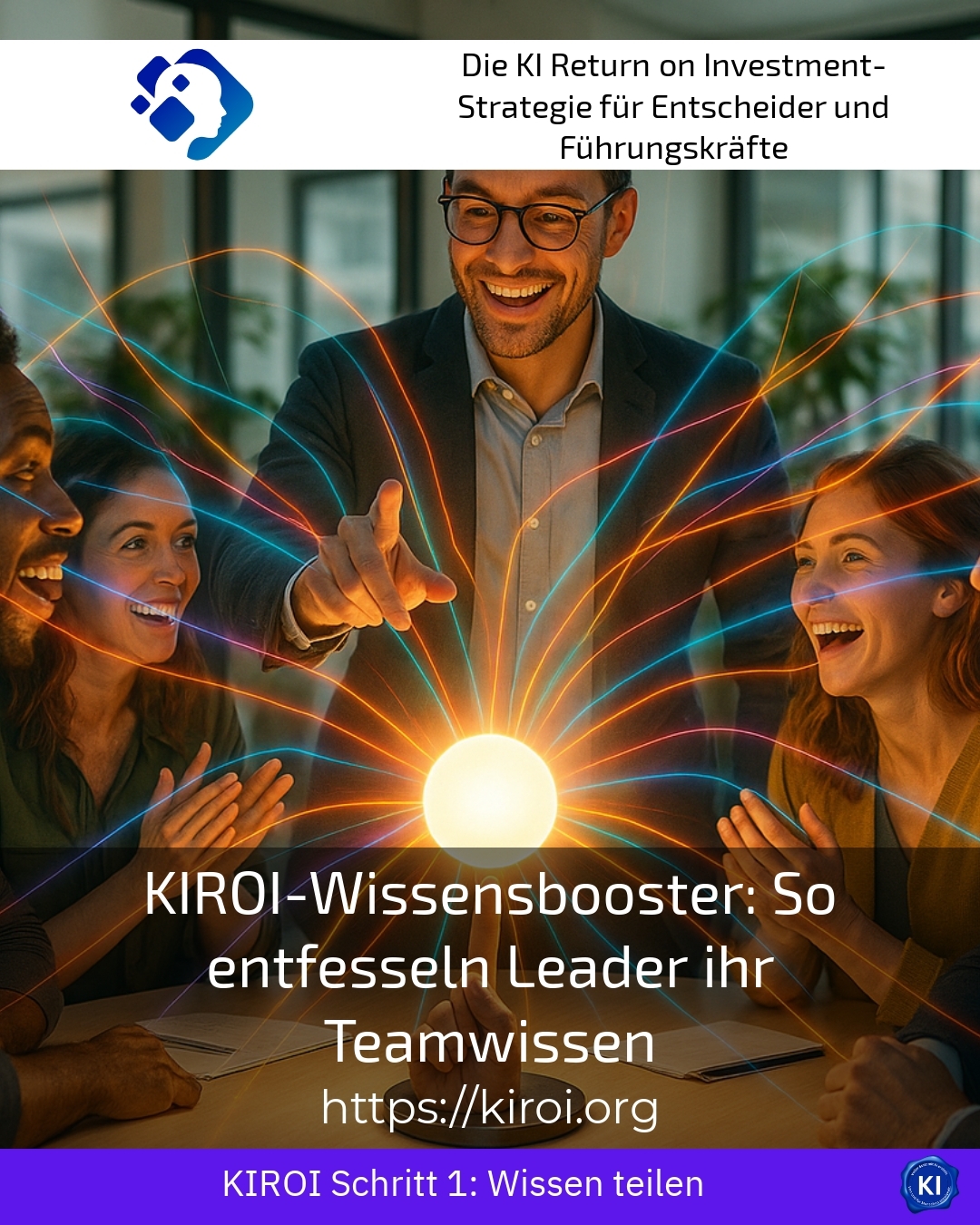
Have you ever wondered why some leaders seem to effortlessly unlock the full potential of their teams, while others barely make progress despite enormous efforts? The answer often lies not in a lack of willpower or resources, but rather in the way knowledge is structured, shared and utilised within an organisation. The AIROI Knowledge Booster offers a systematic approach that helps leaders unlock and strategically deploy the collective intelligence of their teams. In an era where knowledge has become the most valuable currency, the ability to manage knowledge effectively determines the success or failure of entire organisations.
The hidden treasures in your team: Why knowledge transfer is so crucial
Every team possesses an enormous reservoir of experience, insights and tacit knowledge that frequently remains untapped. This hidden capital slumbers in the minds of individual employees. It is waiting to be systematically unlocked. In the automotive industry, for example, experienced engineers possess decades of know-how regarding vehicle development. This knowledge is often lost when these experts retire. A mechanical engineering company loses critical process knowledge when long-standing skilled workers leave the firm. In the chemical industry too, laboratory specialists accumulate valuable insights that are documented nowhere.
The challenge is to make this implicit knowledge explicit. Leaders must create structures that encourage the exchange of knowledge. The AIROI Knowledge Booster supports leaders in building precisely these structures and establishing them sustainably. In pharmaceutical research, clients frequently report communication barriers between different research departments. Similar silos exist between development and production at electronics manufacturers. Even in the food industry, quality assurance and product development often work at cross-purposes.
Best practice with a AIROI customer A medium-sized automotive supplier faced the challenge that important manufacturing knowledge existed only in the heads of a few specialists. The management recognised that the impending retirement of several key employees would pose significant risks to production quality. As part of a transruption coaching programme, a systematic knowledge transfer process was established. Experienced employees were deployed as internal mentors and documented their expertise in structured formats. Younger colleagues learned not only technical procedures, but also came to understand the background and context. Within eight months, a dynamic knowledge database was created containing over two hundred documented processes and decision-making logics. The error rate in production fell by twelve percent because critical know-how was now accessible to all employees. In addition, employee satisfaction rose significantly as both the experienced and younger team members felt valued.
AIROI knowledge boosters as a catalyst for collective intelligence
The systematic deployment of team knowledge requires more than good intentions. It demands a well-thought-out methodology and consistent implementation. This becomes particularly clear in the steel industry. Shift teams accumulate valuable experience in process optimisation over the years. However, without suitable transfer mechanisms, this knowledge remains limited to individual shifts. Similar patterns can be found in paper manufacturing, where experienced machine operators intuitively know when adjustments are necessary. In the glass industry, furnace specialists have a feel for optimal temperatures that is difficult to capture in numbers.
The AIROI Knowledge Booster provides ideas on how managers can systematically capture such experiential knowledge. This is not about rigid documentation requirements. Rather, flexible formats are developed that fit the respective work context. In the textile industry, for example, short video tutorials in which experienced weavers demonstrate their techniques have proven effective. Plastics processors, on the other hand, often use illustrated checklists for complex setup procedures. In furniture production, master carpenters document their techniques in commented photo series.
Breaking down knowledge silos: Practical approaches for industry
Knowledge silos do not arise from malicious intent, but from evolved organisational structures. In metal processing, design and manufacturing often work physically separated from each other. Communication is limited to formal handovers and technical drawings. In the process, valuable information regarding manufacturing experience is lost that would be relevant for future designs. The situation is similar in the semiconductor industry, where research and production represent different worlds. Communication barriers also exist between electrode manufacturing and cell assembly in battery cell production.
Leaders who come to us with such issues frequently report frustration on all sides. The developers do not understand why production is having difficulties with their designs. The manufacturing staff feel unheard by the designers. Transruption Coaching assists here with the development of cross-functional communication formats. Regular feedback loops between departments are established. In the machine tool industry, for example, monthly cross-functional meetings have proven successful.
Best practice with a AIROI customer An industrial valve manufacturer had been struggling for years with recurring quality issues in new products. The root cause was not a lack of employee competence, but a lack of communication between the R&D and quality assurance departments. Experience from previous product launches was not being systematically utilised for new projects. As part of the consultancy support, a lessons-learned process was implemented that takes effect at the end of every project. All relevant insights are captured in a structured manner and made accessible for subsequent projects. Development teams now receive a summary of relevant learnings from comparable projects at the start of each project. In addition, quarterly knowledge-sharing workshops are held where employees from various departments share their experiences. As a result, the time required to reach stable serial production for new products was reduced by an average of six weeks. At the same time, the number of complaints during the start-up phase fell by more than thirty per cent.
AIROI Knowledge Booster: Leadership culture as the foundation of knowledge sharing
No knowledge management system works without the appropriate leadership culture. Through their behaviour, leaders shape whether knowledge sharing is perceived as a valuable contribution or a waste of time. In the chemical industry, we frequently experience experts viewing their knowledge as personal job security. They share it only reluctantly because they fear for their position. Similar patterns are evident in medical technology, where specialists guard their expertise as a unique selling proposition. In the aerospace industry, too, a culture of withholding knowledge occasionally exists.
Leaders must actively counteract this and reward knowledge sharing. They should act as role models themselves and share their own knowledge generously. In railway technology, some companies have already recognised that knowledge sharing should be anchored in target agreements. Mechanical engineering companies integrate contributions to knowledge exchange into performance reviews. Plant engineers acknowledge particularly committed knowledge sharers through internal communication channels.
Using digital tools effectively
Technology alone does not solve knowledge problems, but it can make sharing significantly easier. In the process industry, digital shift handover systems support the structured flow of information [1]. Pharmaceutical companies use knowledge bases to make research results accessible across departments. In the food industry, digital recipe management systems help to standardise and disseminate production knowledge.
The AIROI Knowledge Booster supports the selection and implementation of suitable digital tools. The focus is not on the technology itself, but on the benefit to the users. In the printing industry, for example, simple wiki systems have proven effective for machine documentation. Packaging manufacturers rely on mobile apps that allow employees to quickly access instructions. In the ceramics industry, kiln operators document their experiences in digital diaries.
Best practice with a AIROI customer A packaging machine manufacturer wanted to make better use of the service knowledge of its field service technicians. These experts solved complex problems for customers on site every day, but their experiences largely remained undocumented. As part of the project support, a digital knowledge portal was developed, specifically tailored to the needs of mobile service staff. Technicians can now document problem solutions with just a few clicks and supplement them with photos or short videos. At the same time, an intelligent search system helps them draw on the experience of their colleagues when facing new challenges. Within six months, the average repair time fell by eighteen percent. The system had a particularly positive effect on the training of new service technicians, who can now work independently much faster. Customer satisfaction increased measurably because problems could be resolved more frequently on the first visit.
Establishing sustainable knowledge structures
One-off knowledge transfer initiatives often fizzle out ineffectively. Sustainable structures require continuous maintenance and further development. In energy engineering, this is particularly evident in the maintenance of power plant facilities. Knowledge about decades-old systems must be actively maintained because original documentation is often incomplete. In water treatment, experienced plant operators gather knowledge about local quirks over years. Valuable empirical knowledge for the optimisation of sorting facilities also exists in waste management.
Managers should view knowledge management as an ongoing task. Regular reviews of the knowledge base are just as much a part of this as updating outdated content. In the construction machinery industry, knowledge officers who coordinate these tasks have proven successful. Agricultural machinery manufacturers establish knowledge circles in which experts from various fields regularly come together. In mining technology, some companies organise annual knowledge conferences for their specialists.
My AIROI Analysis
The systematic development of team knowledge represents one of the most important leadership tasks of our time. My experience from numerous accompaniments shows that successful organisations do not leave knowledge transfer to chance. They invest purposefully in structures, processes and, above all, an open knowledge culture. The AIROI Knowledge Booster offers a proven framework that can be adapted to individual company contexts.
What remains particularly impressive is the potential that lies dormant within teams. When the right conditions are created, employees willingly and enthusiastically share their knowledge. They experience that their expertise is valued and makes a real difference. This positive dynamic is self-reinforcing and leads to continuous improvement across the entire organisation.
At the same time, the challenges must not be underestimated. Established structures and ingrained behaviours do not change overnight. Leaders require patience and persistence to bring about sustainable change. Transruptions coaching can offer valuable guidance here by providing direction and professionally supporting the change process. However, the time and energy invested pay off manifold, as a learning organisation is more resilient and adaptable to the challenges of an ever-changing world.
Further links from the text above:
[1] Fraunhofer Institute: Industrial digitisation
For more information and if you have any questions, please contact Contact us or read more blog posts on the topic Artificial intelligence here.










 Deutsch
  English (UK)