
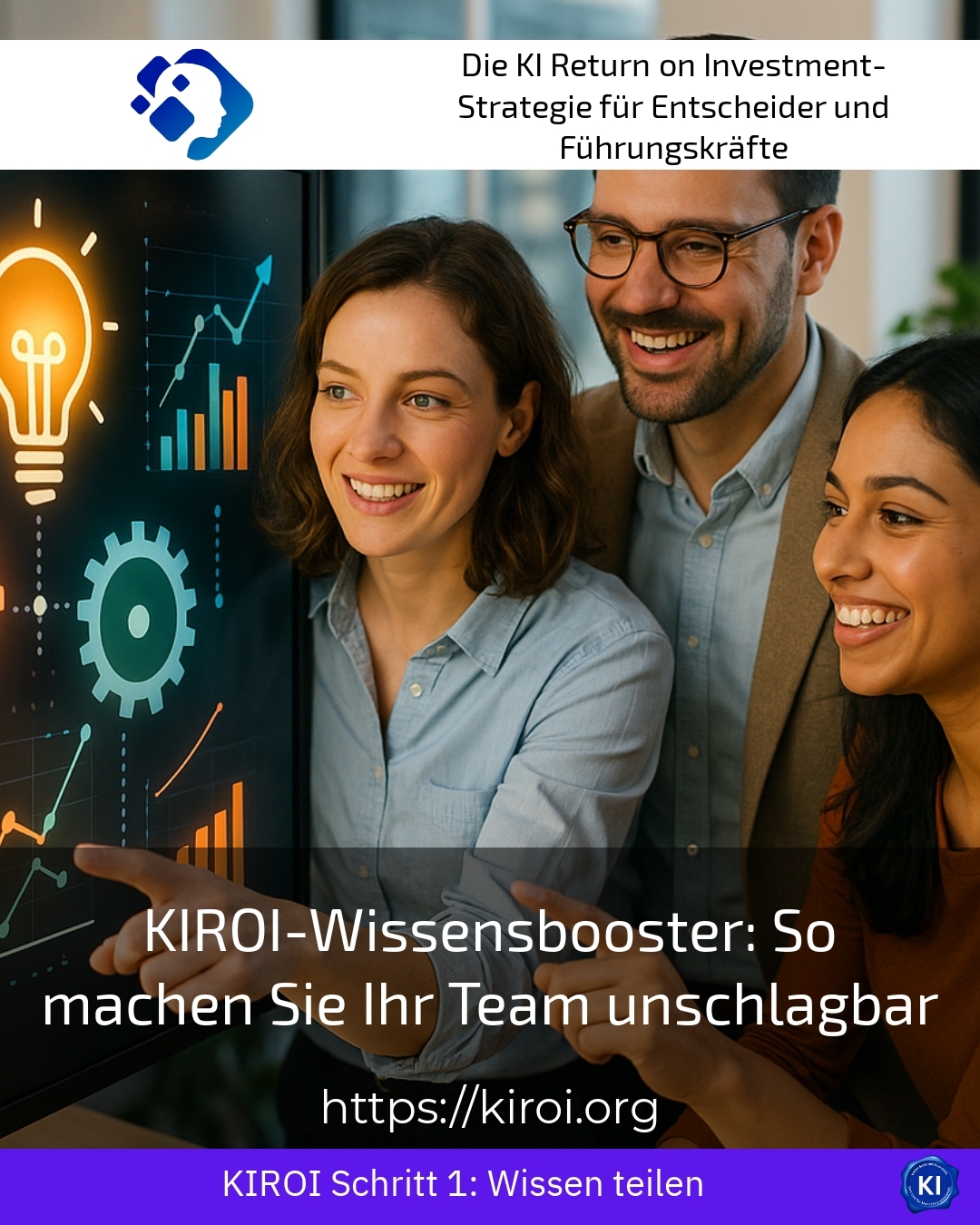
Imagine your employees coming to work every single day with a palpable enthusiasm for new technologies, because they finally understand how they can use these tools specifically for their own tasks. This is precisely the transformation that companies experience when they systematically focus on KIROI Knowledge Booster and thereby enable their teams to see technological change not as a threat, but as a genuine opportunity. In a working world that is changing at breakneck speed, the competence of your workforce determines the success or failure of entire business models. This is no longer just about technical expertise, but about a fundamental change in mindset and work culture.
Why systematic competence development has become indispensable today
The demands on skilled professionals have fundamentally changed in recent years, and this development continues to accelerate. Whereas previously knowledge acquired once held validity for decades, today skills become obsolete within a few months. Companies wishing to maintain their competitiveness therefore invest specifically in continuous further training programmes. KIROI Knowledge Booster provides a structured framework for this, going far beyond traditional training formats [1].
In the automotive industry, for example, engineers today must not only understand mechanical systems but also master software architectures and data analysis. A production manager at a major supplier recently reported that his employees, through targeted skills development, were able to implement entirely new manufacturing processes within weeks. The situation is similar in the financial sector, where bank advisors today must understand complex algorithmic systems to competently advise their clients. This trend is also clearly evident in healthcare, as nursing staff increasingly use digital documentation systems and telemedicine applications.
The challenge lies in preparing learning content in such a way that it can be directly integrated into everyday work. Traditional seminars, which last several days and take place away from the workplace, often do not achieve this goal. Instead, many managers report that short, practical learning units are much more effective.
Best practice with a KIROI customer
A medium-sized mechanical engineering company with around three hundred employees faced the challenge of qualifying its service technicians to handle networked systems. Previous training measures had not been successful because the content was conveyed too abstractly and had no direct relevance to the technicians' daily tasks. As part of transruption coaching, a modular learning concept was jointly developed that combined theoretical basics with practical exercises on real machines. The technicians first learned fundamental concepts of data transmission and network technology before they could immediately apply this knowledge to their customers' systems. Within six months, the first-time fix rate for service calls increased by more than twenty percent because the technicians could now identify and resolve sources of error more quickly. Furthermore, customer satisfaction improved measurably because waiting times for spare parts were significantly reduced through better remote diagnostics. The management reported that the investment in skills development had already fully paid for itself after nine months.
The KIROI Knowledge Booster as a catalyst for sustainable change
What differentiates successful competency development programmes from those which only achieve short-term effects and are then forgotten? The answer lies in the systematic embedding of learning within the company culture. KIROI Knowledge Booster pursues exactly this approach, by not only imparting knowledge but also creating the framework for continuous learning [2].
In retail, this is particularly impressively demonstrated with the introduction of new checkout systems and merchandise management programmes. Employees who were initially sceptical of the changes developed a genuine understanding of the benefits of the new technologies through targeted support. A branch manager of a large drugstore chain described how, after their training, her team members independently developed suggestions for improving system use. In the logistics sector, a similar approach enabled warehouse workers not only to learn how to use automated picking systems but also to actively contribute to their optimisation. Craft businesses also benefit from this approach, for example, when electricians want to add new smart-home technologies to their range of services.
The support for disruption in such projects encompasses far more than simply imparting knowledge. It assists companies in identifying and constructively addressing resistance. Managers often report that older employees, in particular, become the most dedicated advocates of the new ways of working after initial scepticism. However, this is only successful if their concerns are taken seriously and their experience is valued.
Practical implementation strategies for the KIROI Knowledge Booster
The successful implementation of a competency development programme requires careful planning and clear communication of objectives. Initially, a thorough assessment of existing skills and identified development needs is recommended. This analysis should not only include technical competencies but also take into account methodological and social skills.
In the media industry, for example, editors today not only need to master journalistic skills but also possess basic knowledge of search engine optimisation and social media marketing. One publishing house therefore opted for a tiered qualification programme that began with fundamental digital competencies and successively imparted specialised knowledge. In the insurance industry, meanwhile, a company focused on its clerks' ability to process complex claims more quickly and accurately with the support of digital assistance systems. The pharmaceutical industry implemented similar programmes to prepare field sales representatives for the use of digital presentation and documentation tools.
Crucial to this success is the involvement of employees from the outset. Programmes that are imposed from above and leave no room for questions or suggestions regularly meet with resistance. Successful companies instead rely on participative formats where learners can contribute their own experiences [3].
Best practice with a KIROI customer
A municipal administration with around five hundred employees wanted to digitise its services for citizens while simultaneously increasing employee satisfaction. Initial scepticism among the workforce was considerable, as many employees feared for their jobs and felt overwhelmed by the technology. As part of the "transruption" support, intensive discussions were first held with employees at all hierarchical levels to record their specific concerns and wishes. On this basis, a tailor-made training programme was developed that combined technical training with reflection workshops. Employees were able to ask questions and address uncertainties in a safe environment without fear of negative consequences. The formation of learning partnerships between younger and older employees, where both sides could benefit from each other, proved particularly valuable. The younger employees contributed technical expertise, while the experienced colleagues shared their process knowledge. After the programme concluded, an employee survey showed that job satisfaction had significantly increased and the acceptance of the new digital services exceeded all expectations.
Long-term effects and measurable successes through structured skills development
Investing in employee training doesn't just pay off in the short term, but only unfolds its full effect over a longer period. Companies that consistently focus on competence development report increased innovation capacity and higher employee retention. The KIROI Knowledge Booster supports organisations in systematically capturing and further developing these long-term effects.
In the hospitality industry, a well-thought-out qualification programme enabled hotel staff not only to operate new booking and guest management systems but also to actively use them to improve guest satisfaction. A restaurant operator reported that training their service staff in the use of digital ordering systems allowed them to gain more time for personal guest care. In the construction industry, systematic further training of site managers in the field of Building Information Modelling led to a noticeable reduction in planning errors and rework. Tax advisory firms also benefit from structured competence programmes when preparing their employees for dealing with automated accounting systems.
An often underestimated aspect of this is the role-modelling function of managers. If supervisors actively participate in further training themselves and make their own learning processes transparent, the willingness of employees to engage with new topics also increases. This insight has been confirmed in numerous projects and forms an important component of successful implementation strategies [4].
Ideas for the KIROI knowledge booster in various company contexts
The areas where structured competence development can be applied are diverse and range from small craft businesses to international corporations. The key is to adapt it to the specific needs and conditions of the respective company. A one-size-fits-all approach that treats all industries and company sizes the same cannot be successful.
For startups, an agile learning format is recommended, for instance, which allows for rapid adjustments and is closely integrated with product development. Established industrial companies, on the other hand, often require more comprehensive programmes that also take long-serving employees on board and integrate their experience and knowledge. Non-profit organisations benefit from formats that take into account the specific motivational drivers of their employees. Family businesses, in turn, can use skills development to prepare for generational change in leadership and combine traditional knowledge with new competencies.
The transruption support provides valuable impetus by bringing in external perspectives and adapting proven methods from other industries. At the same time, it respects the unique characteristics of each company and avoids standardised solutions that do not meet specific needs.
My KIROI Analysis
The systematic development of employee competencies is proving to be one of the crucial success factors for companies in a rapidly changing economic landscape. Numerous examples from a wide variety of industries impressively show that investments in training are not costs, but rather lead to measurable competitive advantages in the long term. It is less about individual training measures and more about establishing a sustainable learning culture that involves all employees and takes their individual starting points into account.
Particularly noteworthy is the observation that successful competency development always benefits both sides. Employees gain self-confidence and agency, while companies benefit from increased productivity and innovation. The fear that qualified employees might leave the company usually proves to be unfounded in practice. On the contrary, many organisations report increased employee loyalty because employees perceive the investment in their personal development as a sign of appreciation.
In the future, I expect the importance of structured skills development to continue to grow. The pace of technological change makes lifelong learning a necessity, and companies that invest early will gain a sustainable advantage over hesitant competitors.
Further links from the text above:
[1] KIROI Framework and Competency Development
[2] Business Transruption Coaching
[3] Staff training workshops
[4] Strategic consulting for digital transformation
For more information and if you have any questions, please contact Contact us or read more blog posts on the topic Artificial intelligence here.











 Deutsch
  English (UK)