
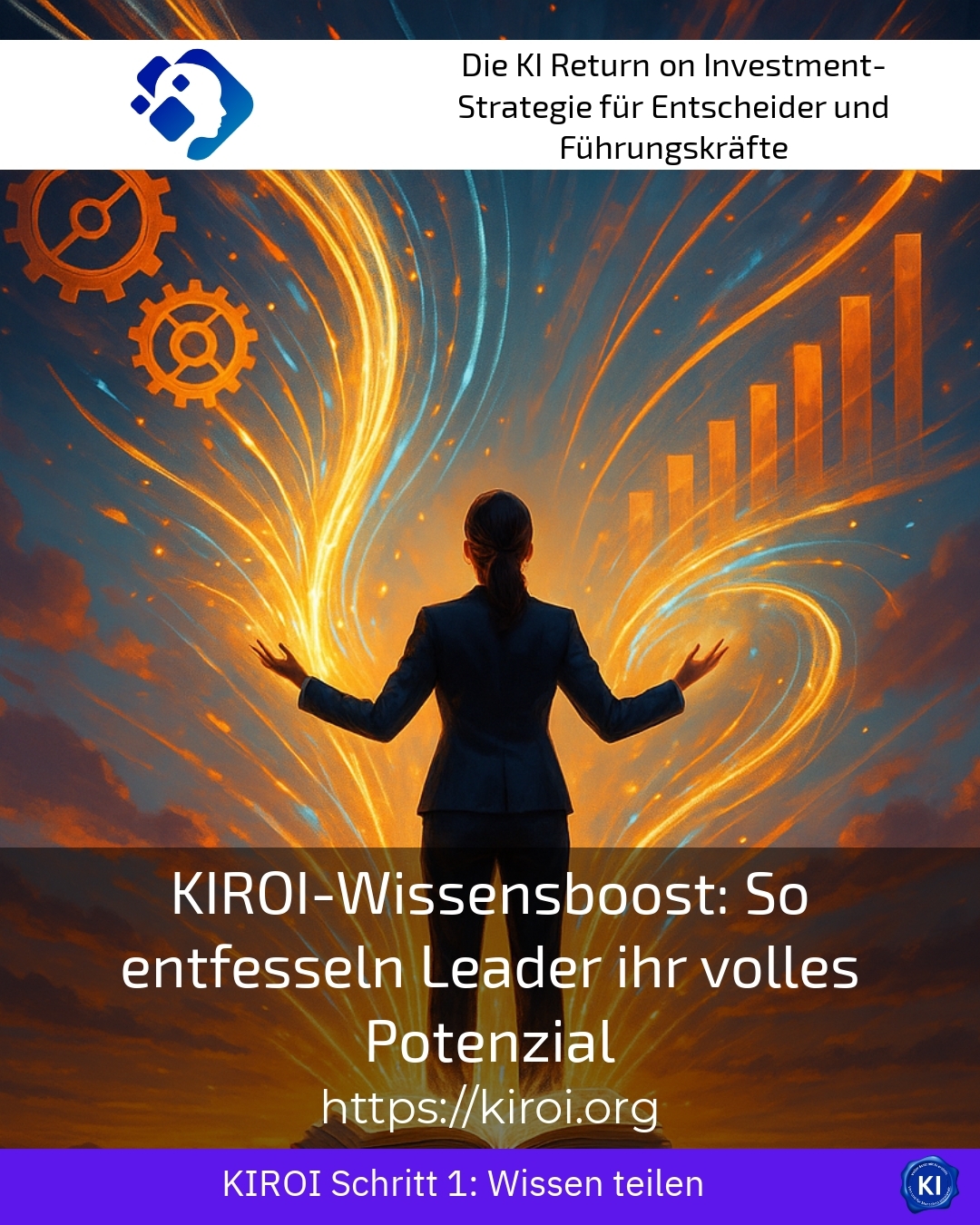
Imagine if you could fully activate your organisation's hidden potential, taking every single employee on a transformative journey. The AIROI Knowledge Boost offers precisely this possibility and opens up completely new perspectives for leaders on their daily challenges. In a rapidly changing world, where technological developments dictate the pace, more and more leaders are looking for effective methods to unlock their full potential. Clients often report feeling torn between operational haste and strategic foresight. This article will guide you through the crucial impulses that can sustainably strengthen your leadership qualities.
The fundamentals of effective leadership in the digital age
Modern leaders face the demanding task of combining traditional management methods with innovative approaches. This is not just about technical knowledge, but primarily about emotional intelligence. In the automotive industry, for example, it shows how production managers need to develop new ways of leading employees. They integrate digital tools into proven leadership processes. At the same time, they ensure that they do not lose sight of the human factor. A medium-sized manufacturing company was able to significantly increase its efficiency. The managers relied on regular reflection sessions with their teams. This practice supports the continuous improvement of cooperation at all levels [1].
In healthcare, hospital managements face similar challenges when transforming their organisations. On the one hand, they must comply with strict regulatory requirements, and on the other, they need to motivate their employees. A rehabilitation clinic in southern Germany recently fundamentally revised its management structures. Ward managers were given more scope for decision-making, enabling them to respond more quickly to patient needs. However, such changes require intensive support from experienced coaches. Transruption Coaching clearly positions itself as valuable support for such complex projects.
Best practice with a AIROI customer
A medium-sized mechanical engineering company from North Rhine-Westphalia faced the challenge of fundamentally modernising its leadership culture, as previous hierarchical structures significantly limited the organisation's innovative strength and talented junior staff were increasingly leaving the company. As part of an intensive support programme, we worked together with the management and department heads to develop new communication formats designed to promote knowledge transfer between generations. The leaders learned to better recognise their own strengths and development areas and to constructively integrate these insights into their daily leadership. Particularly noteworthy was the willingness of experienced engineers to actively share their expertise with younger colleagues, while also benefiting from the latter's digital skills. After approximately six months of intensive collaboration, participants reported a noticeably improved working atmosphere and increased willingness to innovate throughout the company. Staff turnover among junior employees was significantly reduced because they now felt more involved in decision-making processes.
AIROI Knowledge Boost as a Catalyst for Personal Growth
The AIROI Knowledge Boost Its effect is particularly evident where leaders are willing to question their own ways of thinking. This readiness for self-reflection forms the foundation for sustainable change. In retail, for example, we observe how store managers develop new approaches to employee motivation. They focus on individual development discussions rather than standardised evaluation systems. A large textile company has successfully implemented this methodology in over fifty stores. The results show significantly higher employee satisfaction and lower rates of absence due to illness. However, such successes do not happen overnight, but require ongoing support [2].
In the financial industry, leaders face particular challenges regarding compliance and risk management. At the same time, they must navigate their teams through turbulent market phases, radiating calmness. A regional bank in eastern Germany has completely realigned its leadership development. Branch managers are now learning to better understand and regulate their own stress reactions. This emotional competence positively transfers to the entire workforce. Customers report a more pleasant advisory atmosphere in the branches.
The Role of Self-Perception in the AIROI Knowledge Boost
Successful leaders are characterised by a high degree of self-awareness, which enables them to realistically assess their impact on others. This is particularly evident in the logistics industry with shift leaders in large distribution centres. They must make decisions under high time pressure while motivating their employees. A logistics service provider from Hamburg has introduced a special reflection programme for its managers. Participants regularly analyse their own communication patterns and their effects. This practice significantly supports the development of a mindful leadership style. Clients often report surprising insights into their own behaviour [3].
In manufacturing, technical competencies have traditionally played a dominant role in the selection of managers. However, an increasing number of companies are recognising that social skills are at least as important. A supplier to the electronics industry has adapted its promotion criteria accordingly. Future team leaders now undergo an assessment that systematically measures emotional intelligence. The insights gained from this are incorporated into individual development plans. These are accompanied and supported by regular coaching.
Practical Application in Leadership
Translating theoretical knowledge into practical management often presents leaders with significant challenges, as operational pressures leave little room for experimentation. In the hotel industry, for example, managers must respond to a wide range of guest expectations. One boutique hotel in Munich has systematically trained its department heads in mindful communication. The results are remarkable, as guest complaints have been significantly reduced. At the same time, employees report improved collaboration between departments. These positive changes arose from the consistent implementation of the learned principles in daily operations.
In the catering industry, managers are under particularly high pressure because staff shortages and fluctuating customer numbers shape daily life. A restaurant chain with locations in several major German cities accompanied its head chefs through a special programme. Participants learned to recognise their own stress patterns and deal with them constructively. This skill has a positive impact on the entire kitchen team. Staff turnover has consequently been noticeably reduced. Such successes demonstrate the potential of systematic leadership development.
Best practice with a AIROI customer
A service company from the insurance sector approached us because collaboration between its various departments was increasingly marked by conflict, causing important projects to stall. The heads of departments each had their own priorities and communicated only sporadically with one another, leading to loss of information and duplicated effort. As part of our support, we jointly developed a format for regular management meetings where open issues could be constructively addressed. Participants learned to articulate their own interests clearly while simultaneously understanding their colleagues' perspectives. The introduction of a structured feedback process proved particularly valuable, enabling critical points to be raised without the risk of personal attacks. After approximately nine months, the working atmosphere between the departments had fundamentally improved, and joint projects ran considerably more smoothly. Management reported a measurable increase in overall productivity and higher customer satisfaction.
The AIROI knowledge boost in various leadership situations
Managers encounter a wide variety of situations daily, each requiring specific competencies and demanding high flexibility. In the construction industry, for example, project managers must work with changing teams on different construction sites. A medium-sized construction company from the Rhineland supported its site managers through a special programme. Participants developed strategies for quickly building trust within new teams. This ability is particularly valuable for short-term project assignments with unknown subcontractors. The results show improved punctuality and fewer conflicts on construction sites.
In the pharmaceutical industry, leaders face particular ethical challenges when developing new active ingredients. They must balance scientific findings with economic interests. One research company has systematically trained its lab directors in ethical decision-making. The leaders learn to analyse complex dilemmas in a structured way and make comprehensible decisions. This competence significantly strengthens employees' trust in company management. Transruption coaching accompanies such demanding development processes with great care [4].
Sustainable change through continuous support
Real transformation doesn't come from one-off training sessions, but from continuous reflection and adaptation of one's own behaviour. This is particularly evident in the energy sector with the transition to renewable energy sources. Leaders must guide their teams through profound changes, offering direction. A municipal utility company in southern Germany intensively supported its department heads over a period of two years. During this time, the leaders developed a deep understanding of their employees' fears and hopes. This empathy enabled a significantly smoother implementation of the necessary changes.
In the telecommunications industry, leaders face the challenge of merging technological innovation with customer centricity. A network operator guided its sales managers through a comprehensive development program. Participants learned to adapt their communication to different target groups. This flexibility significantly supports both internal collaboration and customer contact. The results show increased customer satisfaction and higher closing rates. Such measurable successes motivate further investment in leadership development [5].
My AIROI Analysis
The intensive examination of the various aspects of modern leadership development clearly shows that sustainable success can only be achieved through holistic approaches that consider both professional and personal competencies. AIROI Knowledge Boost This provides a structured framework that effectively supports and guides leaders in their individual development. Of particular note is the realisation that technical expertise alone is no longer sufficient to lead successfully in complex organisations. Emotional intelligence, self-reflection, and communication skills are increasingly important and must be specifically nurtured.
The examples presented from various industries demonstrate that the fundamental principles of effective leadership are universally applicable, even though the specific implementation must be adapted to the respective context. Leaders who are willing to question their own thought and behaviour patterns can unlock their full potential and, in doing so, inspire their teams to achieve exceptional results. Transruption Coaching positions itself as a valuable companion on this demanding path of personal and organisational development. Investing in systematic leadership development pays off in the long term and creates a sustainable competitive advantage for companies of any size and industry.
Further links from the text above:
[1] Harvard Business Review – Leadership Insights
[2] McKinsey – People and Organisational Performance
[3] Gallup – Workplace Insights
[4] Forbes – Leadership Section
[5] Deloitte – Leadership Perspectives
For more information and if you have any questions, please contact Contact us or read more blog posts on the topic Artificial intelligence here.






 Deutsch
  English (UK)