
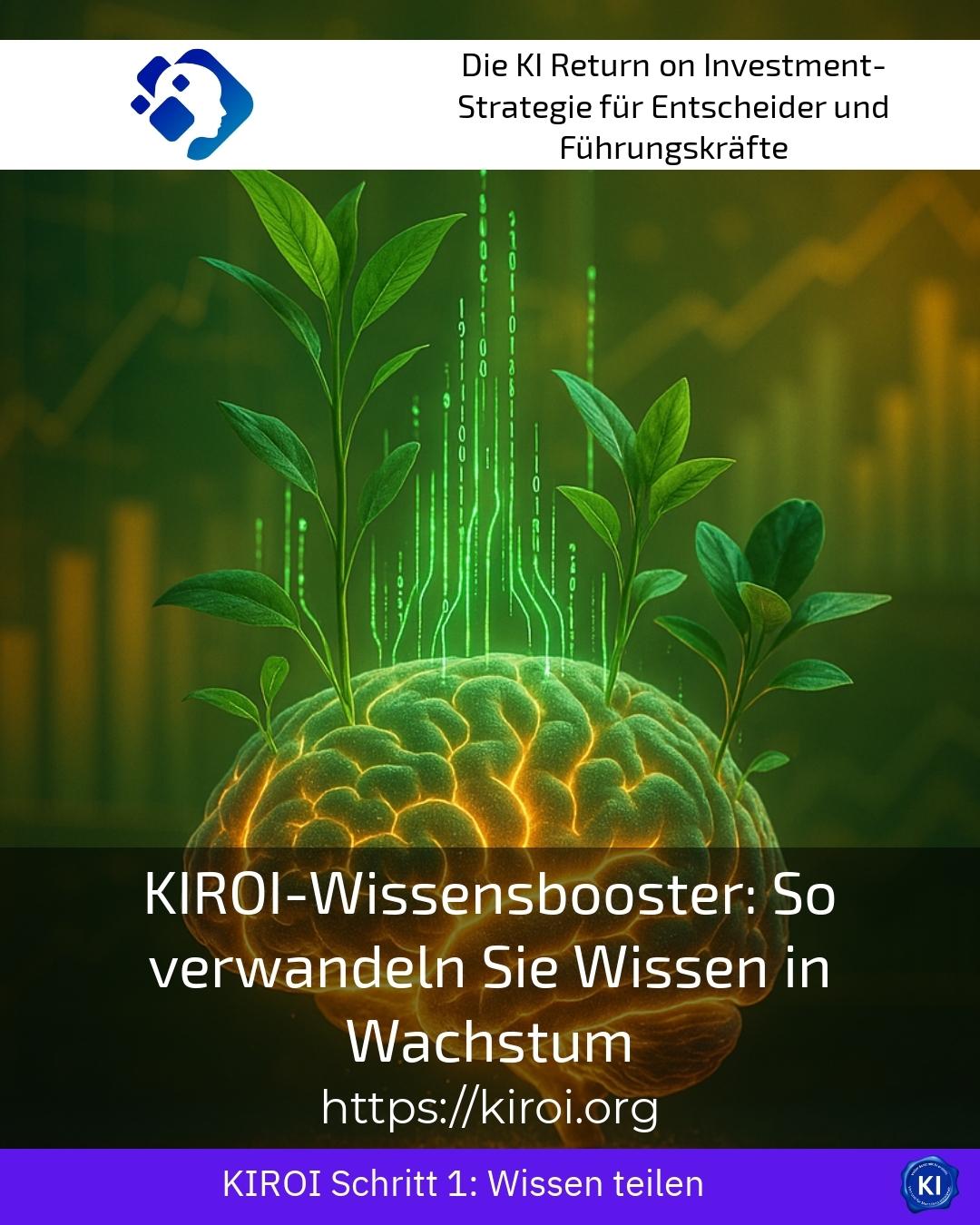
Imagine you own a treasure that you carry with you daily, without recognising its true value. This treasure is your accumulated knowledge, your experiences, and your expertise. AIROI Knowledge Booster opens up entirely new perspectives on how you can systematically unlock this hidden potential. In a rapidly changing world, simply collecting and storing information is no longer sufficient. It's more about strategically utilising existing know-how and transforming it into measurable growth. Particularly in the area of Management and strategic management consultancy shows the enormous opportunities that remain untapped on a daily basis. Clients often report dormant resources within their organisations. This article will accompany you on a journey of discovery through tried-and-tested methods and inspiring practical examples.
Understanding the Basics of AIROI Knowledge Booster
Before we delve deeper, we first need to understand what makes this approach so special. At its core, it's about systematically linking implicit and explicit knowledge within an organisation. Many consulting firms struggle with the problem of valuable insights from completed projects being lost. An experienced consultant leaves the company, and suddenly crucial know-how for similar assignments is missing. Large auditing firms, which must apply complex auditing standards, are also familiar with this phenomenon. The solution lies in a well-thought-out system for knowledge capture and transfer. The structured approach of transruptions coaching, which supports organisations with precisely these kinds of transformation projects, helps with this.
A medium-sized restructuring consultancy faced the challenge of consolidating industry expertise. Over the years, the partners had accumulated specialised knowledge in various industrial sectors. However, this knowledge was tied to individuals and was not systematically documented. Through the introduction of structured knowledge transfer workshops, critical success factors were identified. A strategy consultancy in the renewable energy sector used similar methods for its market analyses. A management consultancy specialising in digitalisation also benefited from this approach in client projects.
Best practice with a AIROI customer
An international management consultancy specialising in post-merger integration approached us with a specific concern. The partners had realised that their team was starting from scratch with each new integration project. Although dozens of successful merger support projects had already been completed, there was no systematic access to the collective experience gained. As part of the transruption coaching, we jointly developed a multi-stage knowledge strategy. First, we conducted structured interviews with all project managers from the past five years. In doing so, we identified recurring success patterns and typical pitfalls in integration projects. These findings were consolidated and categorised in a dynamic knowledge portal. The development of decision trees for critical project phases proved particularly valuable. Consultants can now access proven approaches to solutions without having to reinvent the wheel. The average onboarding time for new project members was reduced by almost forty percent. At the same time, customer satisfaction increased measurably because projects delivered results more quickly. AIROI Knowledge Booster partly uncovering and making use of hidden competence treasures.
Transforming knowledge into growth with the AIROI Knowledge Booster
The real art lies in actually generating growth impulses from existing knowledge. Various factors play a crucial role in this, which must be carefully coordinated. For example, personnel consultancies can significantly enhance their candidate database through intelligent connections. Instead of just storing CVs, competence patterns and career paths are analysed. This creates predictive models for successful placements in specific positions. IT consultancies use similar approaches to identify project risks early on.
The key lies in the combination of human expertise and technological support. A logistics consultancy was able to identify new patterns by systematically analysing past optimisation projects. These patterns made it possible to identify savings potential for new clients more quickly. A consultancy specialising in sustainability consistently documents all CO2 reduction measures at clients' premises [1]. This creates a valuable wealth of experience for future projects in similar industries. A financial consultancy also benefits from the systematic processing of past transactions and valuations.
Practical implementation steps for sustainable results
The implementation of an effective knowledge management system requires a structured approach with clear milestones. First, it is crucial to take stock of existing knowledge and identify gaps. A strategy consultancy for the retail sector began by analysing all client presentations from recent years. This revealed that certain market analyses were repeatedly recreated. By centralising these analyses, the consultants saved valuable time for more creative tasks. A consultancy specialising in healthcare went a step further and linked internal data with external market research findings [2].
The second step involves identifying knowledge carriers and systematically documenting their expertise. A process consultancy for the automotive industry introduced regular expert rounds. In these rounds, senior consultants exchange ideas on current challenges and solution approaches. The insights are recorded, transcribed, and fed into searchable knowledge databases. A consultancy for public sector clients makes particularly intensive use of this approach due to complex procurement guidelines. A consultancy specialising in family businesses also benefits from this systematic exchange of experience.
Best practice with a AIROI customer
An organisational development consultancy approached us with a specific growth problem. Despite an excellent reputation and satisfied clients, their revenue had stagnated for several years. During a joint analysis as part of our transruption coaching, we identified a surprising pattern. The consultants possessed enormous knowledge of change management processes across various industries. However, this knowledge was not being actively leveraged for acquiring new mandates. We subsequently developed a system for creating industry-specific thought leadership content. The accumulated project experience was transformed into practical white papers and specialist articles. These publications positioned the company as an expert in specific niche markets. Potential clients became aware of the consultancy without needing to engage in traditional cold calling. Within eighteen months, the number of qualified enquiries increased by over sixty percent. Particularly noteworthy was that the fee rates for new mandates were, on average, fifteen percent higher. The systematic utilisation of existing knowledge had a direct and measurable impact on the company's financial results.
Cultural aspects of knowledge transformation
Technical solutions alone are not enough to successfully transform knowledge into growth. Corporate culture plays an at least equally important role in implementing such initiatives. Many consulting firms suffer from a culture of individual expertise, which hinders knowledge sharing. Partners often see their specialised know-how as a personal competitive advantage over colleagues. However, this attitude can slow down the growth of the entire organisation. A management consultancy for medium-sized businesses recognised this problem and introduced new incentive systems.
The willingness to share knowledge has been included as an assessment criterion in the annual performance review. One technology consultancy went even further and linked bonus payments to the quality of submitted best-practice documentation. A consultancy specialising in compliance also introduced regular knowledge transfer sessions as a mandatory event. The results of these cultural changes were impressive and were evident after only a few months. One brand consultancy reported significantly improved collaboration between different locations. Furthermore, staff turnover decreased because junior consultants received better development opportunities through mentoring.
The AIROI Knowledge Booster in the context of digital transformation
The ongoing digitalisation opens up completely new possibilities for knowledge management in consulting firms. Modern technologies make it possible to automatically categorise and link unstructured information. A tax consulting firm uses intelligent systems to automatically record and classify changes in case law [3]. This allows consultants to proactively inform their clients about relevant developments. An auditing firm uses similar technologies to evaluate audit documents more efficiently. A regulatory consultancy also benefits from automated analyses of complex regulations.
However, integrating modern tools into existing workflows requires careful planning and support. An innovation consultancy initially encountered resistance to new digital knowledge systems from experienced partners. Broad acceptance was only achieved through patient change management and compelling pilot projects. Transruption coaching supported the appropriate involvement of the various stakeholder groups. A sales optimisation consultancy now successfully combines classic experience values with data-driven insights. A consultancy specialising in production uses similar approaches for analysing manufacturing processes at customer sites.
Best practice with a AIROI customer
A consultancy specialising in turnaround management was looking for ways to further increase its success rate. Analysis of past restructuring projects revealed that certain early warning indicators had regularly been overlooked. As part of our collaboration, we developed a systematic screening tool for new mandates. This tool is based on the aggregated experience from over two hundred completed restructuring projects. Consultants enter various parameters into the system at the start of a project and receive immediate risk alerts. Additionally, the system displays similar past cases, the documentation of which offers valuable guidance. The automatic linking to proven catalogues of measures for typical problem scenarios proved to be particularly helpful. The average time to stabilising critical company situations measurably shortened. At the same time, the quality of decision proposals for creditors' committees improved significantly. The AIROI Knowledge Booster enabled decades of experience to be transformed into a systematic tool. The consultancy was able to significantly strengthen its market position and win new mandates as a result.
Long-term perspectives and strategic considerations
The sustainable transformation of knowledge into growth requires a long-term perspective and continuous investment. Many consulting firms underestimate the effort required to maintain and update knowledge bases. A strategy consultancy for the energy sector has therefore set up its own knowledge management department. This department ensures that project findings are processed and fed in promptly. A consultancy for digital business models also invests significant resources in knowledge maintenance. A consultancy specializing in supply chains updates its databases after every significant market change.
The return on investment of such measures can certainly be quantified and is often impressive. One HR consultancy was able to increase its project margins by several percentage points through systematic knowledge management. An internationalisation consultancy reduced the onboarding time for new country markets by more than half. A consultancy specialising in communication also reports measurable efficiency gains through knowledge transfer [4]. The investment in corresponding systems and processes generally pays for itself within a few years. Transruption coaching supports organisations in developing realistic expectations and defining suitable metrics.
My AIROI Analysis
Following intensive consideration of the topic of knowledge transformation in consulting firms, some key findings are emerging. The AIROI Knowledge Booster provides a structured framework that supports organisations in unlocking their hidden potential. Particularly impressive is the combination of methodological rigour and practical applicability that characterises this approach. The case studies presented clearly show that measurable results are achievable when companies are willing to invest.
At the same time, it is clear that technical solutions alone are not sufficient to bring about sustainable change. The cultural dimension of knowledge management deserves at least as much attention as the systemic aspects. Leaders in consulting firms should lead by example and establish knowledge sharing as a strategic priority. The integration of transruption coaching can help to overcome resistance and bring everyone involved along.
For the future, I expect data-driven approaches in knowledge management to become increasingly important. Consulting firms that invest in relevant capabilities early on will be able to gain a competitive advantage. However, it is important to maintain a balance between technological innovation and human expertise. Ultimately, a deep understanding of customer needs and industry dynamics remains the decisive success factor. AIROI Knowledge Booster While this cannot replace understanding, it can make it systematically available and usable. Organisations that consistently pursue this path will be able to strengthen their market position in the long term and achieve sustainable growth.
Further links from the text above:
[1] McKinsey Sustainability Insights
[2] BCG Healthcare Expertise
[3] PwC Tax Consulting Germany
[4] Harvard Business Review Knowledge Management
For more information and if you have any questions, please contact Contact us or read more blog posts on the topic Artificial intelligence here.








 Deutsch
  English (UK)