
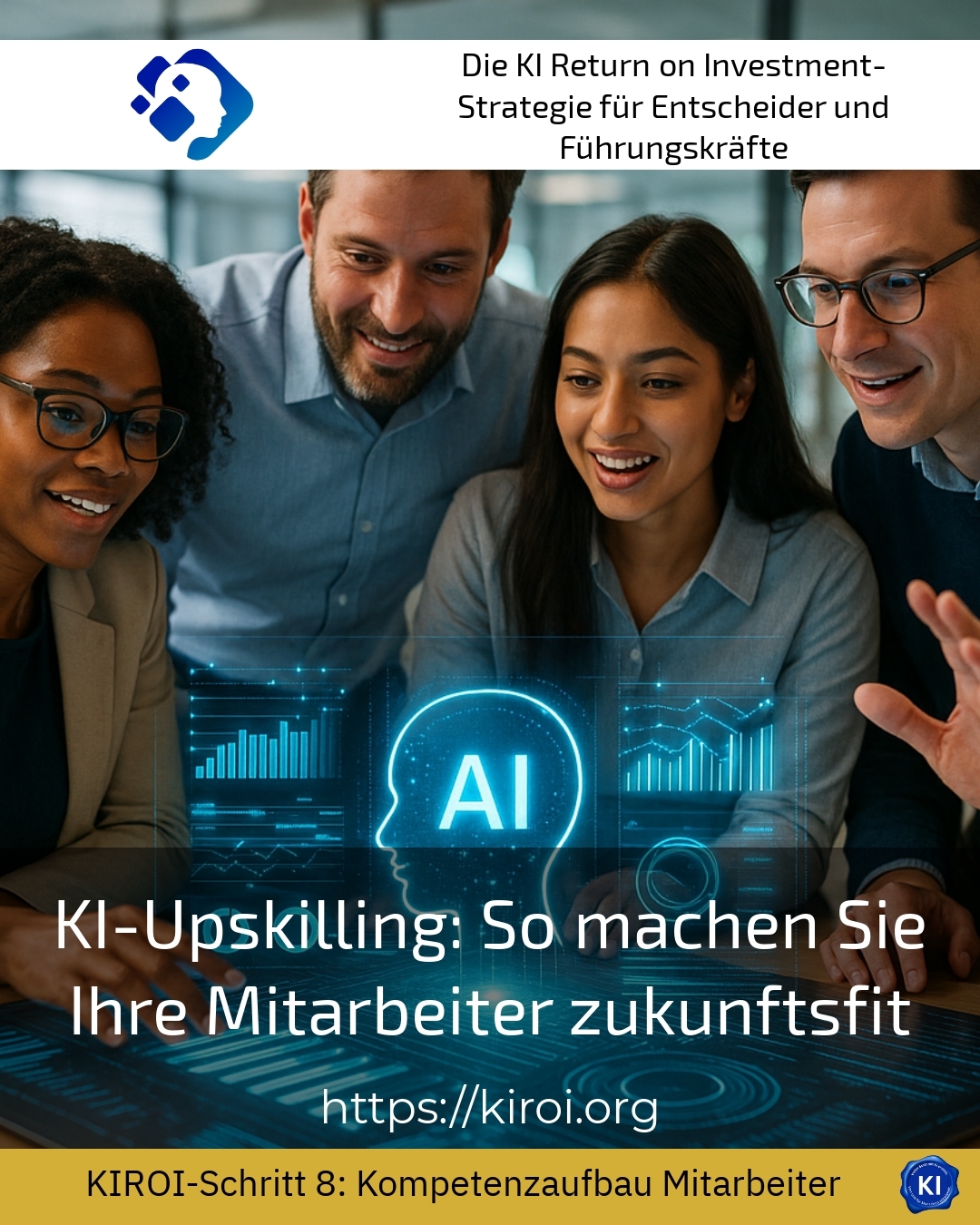
The digital transformation is radically changing work environments. Companies face a crucial question: how can they prepare their workforce for a future that has already begun? AI Upskilling: How to Make Your Employees Future-Ready This is not an empty promise; it is, rather, a strategic necessity for every organization. Anyone who does not invest in competence development today risks losing the ability to keep up tomorrow.
Why AI Upskilling is Becoming a Strategic Priority
The world of work is undergoing a fundamental transformation. Automation and intelligent systems are increasingly taking on repetitive tasks. This affects almost all industries and professional fields alike. Employees therefore need new skills and an expanded understanding. They must learn to work effectively with intelligent tools.
Many executives report similar challenges in their organizations. The workforce often feels overwhelmed by the speed of change. At the same time, there is a lack of clear learning paths and structured continuing education opportunities [1]. Professional coaching is needed here because it provides guidance and structure.
In the financial sector, banks use intelligent algorithms for credit checks. Business analysts must be able to understand the decision logic of these systems. In healthcare, diagnostic assistance systems support doctors in making diagnoses. Nursing staff works with automated documentation solutions. In logistics, self-learning programs optimize supply chains in real time. These examples show the breadth of changes.
Creating the foundations for successful AI upskilling
Before companies begin training programs, they need to conduct a baseline assessment. What competencies already exist within the organization? Where are the biggest gaps between the current state and the desired state? This analysis forms the foundation for all subsequent steps.
Transruptions coaching supports organizations in these very transformation projects. The methodology helps to systematically identify individual learning needs. This results in tailor-made development programs for different employee groups. The support provides impulses for sustainable change processes.
Best practice with a AIROI customer
A medium-sized manufacturing company faced a particular challenge. The workforce, with an average of twenty years of employment, showed considerable reservations towards new technologies. The management decided on a guided transformation process using the AIROI-approach. In the first step, we conducted a comprehensive competency analysis of all departments. In doing so, we identified different learning styles and individual strengths of the employees. Subsequently, we developed a tiered training concept with practical application examples. The experienced production workers initially received simple digital tools for quality control. They were able to intelligently combine their expertise with the new possibilities. After six months, eighty percent of the participants reported an increase in job satisfaction. The error rate in production decreased by fifteen percent through better data usage. What was particularly valuable was the insight that older employees often acted as mentors for younger colleagues.
Designing learning formats for different target audiences
Not every employee learns in the same way effectively. Some prefer traditional in-person training with direct interaction. Others benefit more from self-directed online courses. Still others need practical application projects for learning [2].
For example, a business has developed different learning paths for different roles. Sales representatives learned how to use recommendation systems for customers. The purchasing team received training on interpreting demand forecasts. The marketing department worked on automated customer segmentation. Each group thus received relevant and applicable knowledge.
In the insurance sector, claims adjusters use automated review systems for routine cases. They must learn when human assessment remains necessary. Customer advisors work with intelligent assistants for product recommendations. These examples illustrate the diversity of application scenarios.
Overcoming resistance and building motivation
Clients often report fears within their workforce. Employees fear being replaced by intelligent systems. These concerns are understandable and must be taken seriously. Open communication about opportunities and changes builds trust.
One pharmaceutical company took this approach in a very transparent and successful way. The management explained which tasks should be automated. At the same time, it highlighted new career opportunities through expanded competencies. The laboratory staff learned to interpret analysis results using intelligent systems. Instead of losing their jobs, they experienced an enhancement of their expertise.
In the media industry, editors use automated research tools for background research. Creative writing remains a human domain. Graphic designers work with generative design tools for initial drafts. The final responsibility for quality lies with the human being.
Embed AI upskilling in corporate culture
Sustainable competence development requires a learning-promoting corporate culture. Leaders must lead by example and learn themselves. Mistakes should be seen as learning opportunities rather than failures. Many organizations underestimate these cultural aspects significantly.
An energy provider has established so-called learning circles in all departments. Every week, employees exchange new insights and applications. This creates collective knowledge that goes beyond individual training. The technical teams share experiences with intelligent maintenance systems. Customer center employees report improved chatbot interactions [3].
Best practice with a AIROI customer
An internationally operating logistics company wanted to equip its entire workforce for the future. The challenge lay in the enormous heterogeneity of the employee groups. From the warehouse worker to the strategic planner, everyone had to be reached. We jointly developed a three-stage program with different entry levels. The basic level conveyed general understanding of intelligent systems. The advanced level focused on departmental-specific applications and tools. The expert level prepared selected employees for multiplier roles. Particularly successful was the integration into the workday through microlearning units. Employees could learn fifteen minutes daily during working hours. The managers received separate workshops on change management aspects. After twelve months, half of the workforce had completed at least one level. The route planning now used intelligent optimization systems with high acceptance. The warehouse management benefited significantly from predictive inventory forecasts.
Practical steps for implementation in the company
The path to becoming a sustainable company starts with small steps. Pilot projects in selected areas provide valuable insights for the rollout. These experiences help to better plan larger initiatives.
One construction company started with the estimating department as a pilot area. The employees learned to use and refine automated cost estimates. Their expertise significantly refined the accuracy of the system forecasts. Subsequently, the program was expanded to include project management.
In the education sector, teachers use adaptive learning systems for individualized support. Administrative staff work with automated document processing systems. Training managers in corporate continuing education use intelligent learning path recommendations. These applications demonstrate the wide range of possibilities.
Measuring the Return on Investment in AI Upskilling
Investments in competence development must be economically justifiable. Therefore, companies need suitable metrics for success measurement. This involves more than just the number of participants and the number of training hours.
A telecommunications provider systematically measures the increase in productivity following training courses. Customer satisfaction improved through more competent advice with intelligent systems. The processing time for standard inquiries decreased by thirty percent. At the same time, the resolution rate for initial contact increased significantly [4].
In the automotive industry, engineers use generative design tools for component optimization. Production workers monitor self-learning quality control systems in real time. Sales teams work with intelligent configuration wizards for customer consultations. These applications demonstrate measurable efficiency gains.
The role of leaders in the transformation process
Executives play a crucial role in the success of upskilling initiatives. They must actively lead and support the change. Without their commitment, training measures often remain ineffective.
A chemical company trained and sensitized all management personnel in advance. They learned to professionally guide their teams through the change. Regular reflection rounds helped to identify resistance early on. This created trust and openness to new working methods.
In the hospitality industry, hotel managers use intelligent yield management systems for pricing. Restaurant managers work with automated order forecasts for the warehouse management system. Event managers use intelligent planning assistants for capacity optimization. The management level must understand and promote these tools.
My AIROI Analysis
The systematic examination of numerous transformation projects reveals recurring success patterns and stumbling blocks. Organizations that AI Upskilling: How to Make Your Employees Future-Ready When treating it as a strategic priority, companies achieve significantly better results. In this case, it is less about the training formats used; what is crucial is embedding it within a holistic transformation strategy.
Companies that actively involve their employees are particularly successful. They ask about concerns and wishes before implementing programs. This participatory approach creates acceptance and engagement. Moreover, valuable ideas often emerge from within the workforce itself.
The biggest obstacles often lie not in technical aspects. Rather, initiatives fail due to a lack of communication and leadership support. The AIROI-approach therefore deliberately addresses these soft factors. It combines technical competence development with cultural transformation.
For the future, I recommend an iterative approach with regular adjustments. Technological development is advancing rapidly and requires continuous learning. Companies should view upskilling as a continuous process, not a one-time project. Those who internalize this attitude will remain competitive in the long run and be able to guide their employees along the way.
Further links from the text above:
[1] McKinsey – Future of Work Research
[2] World Economic Forum – Future of Jobs Report
[3] Harvard Business Review – Organisational Learning
[4] Gartner – Future of Work Insights
For more information and if you have any questions, please contact Contact us or read more blog posts on the topic Artificial intelligence here.






 Deutsch
 English (UK)