
Have you ever wondered why some leaders seemingly effortlessly find the right digital tools, while others get lost in a jungle of options and waste valuable time that they should actually be using to make strategic decisions?
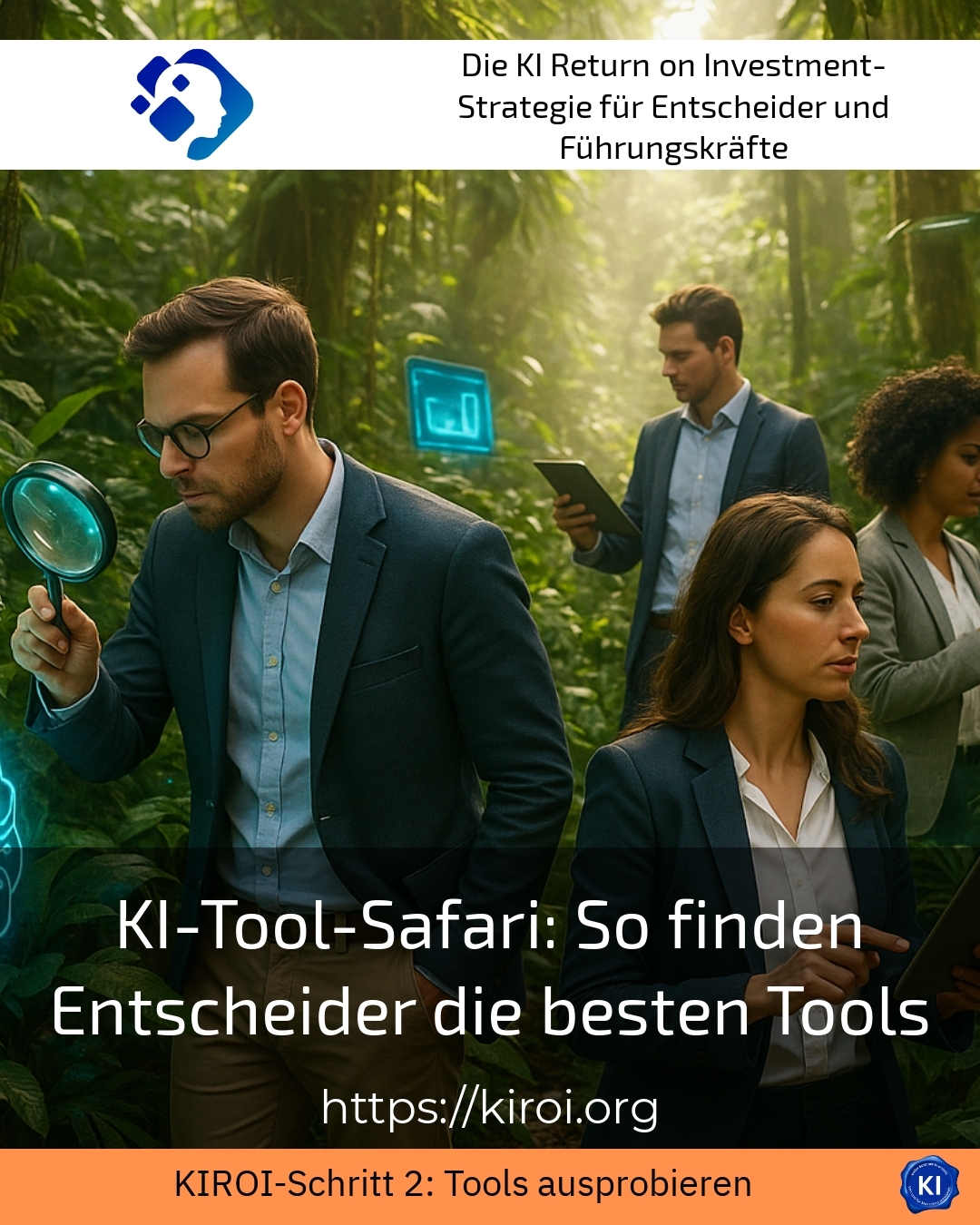
Today, the search for suitable intelligent solutions is comparable to a real one. AI Tool Safari, In which decision-makers have to navigate through an unclear terrain. Many report feeling overwhelmed and uncertain. The market is growing rapidly, and new applications are appearing daily. Without a systematic approach, even experienced managers lose their overview. Therefore, in transruptions coaching we accompany executives precisely in this challenge. We provide guidance and structure the selection process together with our clients.
Why the AI tool safari is becoming a strategic necessity for decision-makers
The digital transformation has developed a momentum in recent years that poses significant challenges for even technology-savvy executives. Specialized applications are emerging in almost every industry. These promise efficiency gains and competitive advantages. Yet which of these solutions actually deliver on their promises? This question is deeply on the minds of many of our clients.
For example, a medium-sized company in the manufacturing sector faced the decision between three different predictive maintenance systems. Each system offered different strengths and weaknesses. The management felt overwhelmed. A logistics company, on the other hand, was looking for a solution to route optimization and found over fifty potential providers. Financial service providers also often report similar experiences when selecting analysis tools. The variety can be paralyzing when there is no clear methodology [1].
Decision-makers must understand that choosing intelligent tools is not a purely technical issue. Rather, it is a strategic decision. The chosen solutions shape work processes, influence corporate culture, and determine long-term development opportunities. Therefore, in transruptive coaching, we support clients in making these decisions in a thorough way.
Best practice with a AIROI customer
An international machinery manufacturer approached us because its management wanted to systematically evaluate various intelligent assistance systems for customer service. The company had previously experienced two failed implementations and had become cautious accordingly. Together, we initially developed a requirement profile that took into account both technical and cultural aspects. It turned out that the previous failures were not due to the tools themselves, but to insufficient preparation of the employees. We accompanied the entire selection process over several months, integrating the future users early in the decision-making process. The result was a solution that not only fit technically but was also accepted by the teams. The implementation went much more smoothly than in previous attempts, and the company was able to significantly shorten response times in customer service. This experience illustrates the importance of a holistic approach when selecting tools.
The five stages of a successful AI tool journey
Successful decision-makers follow a structured process when evaluating new digital solutions. This process can be divided into five essential phases. Each phase requires specific competencies and resources. Often, clients report that they lacked this structure at first.
Phase 1: Needs analysis and goal setting
Before the actual search begins, companies must precisely define their actual needs. For example, a trading company only realized through intensive workshops that inventory management was not the primary problem; rather, it was demand forecasting. A insurance company, in turn, found that the desired automation of claims processing initially required a standardization of internal processes [2]. An energy provider also had to revise its original assumptions after a thorough analysis revealed the true bottlenecks.
Many leaders greatly underestimate this phase. They jump straight to product search, thereby losing valuable time. In transruptions coaching, we place special emphasis on this groundwork. Without clear goals, no meaningful evaluation can take place.
Phase 2: Market overview and preliminary selection
The market for intelligent applications is fragmented and dynamic. Decision-makers therefore need efficient methods for gathering information. Industry associations regularly publish market overviews and comparative studies. Professional conferences also provide valuable insights into current developments. For example, a pharmaceutical company specifically used industry networks to gather testimonials. A telecommunications provider, on the other hand, relied on structured tenders. Both approaches can be useful, depending on the specific situation [3].
Phase 3: Depth survey and pilot projects
After the preliminary selection, the intensive testing of the remaining candidates follows. Pilot projects play a crucial role in this process. A automotive supplier tested three different quality control systems in parallel in different plants. A media company conducted a multi-week hands-on test with two content analysis tools. A healthcare provider also relied on controlled pilot phases before making a final decision.
This phase requires patience and resources. However, it protects against costly misjudgments. We assist our clients in developing suitable test scenarios and establishing meaningful evaluation criteria.
Best practice with a AIROI customer
A leading company in the consumer goods industry had already invested significant sums in a marketing analytics solution that did not deliver the expected results. The senior management was frustrated and skeptical about further investments in this area. In our collaboration, we initially developed a transparent evaluation matrix that took into account both quantitative and qualitative factors. Subsequently, we jointly identified three alternative solutions that better suited the company’s specific business model. Particularly important was the involvement of the specialist departments that would later use the tools. Their practical requirements differed significantly from the original specifications of the IT department. After a structured pilot project, the company decided on a solution that was technically less sophisticated but could be more easily integrated into existing workflows. This experience shows that not always the most powerful tool is the most appropriate one. The context determines the success of an implementation.
Avoid Typical Pitfalls in the AI Tool Safari
The search for suitable intelligent solutions presents numerous stumbling blocks. However, many of these can be overcome with the right preparation. One of the most common mistakes is to be overwhelmed by impressive presentations. For example, a financial services provider experienced how a demo version worked excellently, while the productive implementation caused significant problems.
Neglecting integration issues also regularly leads to difficulties. One retail company had to realize that the chosen forecasting tool was not compatible with the existing ERP system [4]. An industrial company, in turn, significantly underestimated the training costs for its employees. These examples illustrate the importance of a holistic approach.
In transruptional coaching, we sensitize leaders to these risks. We help them ask critical questions and develop realistic expectations. After all, exaggerated promises almost always lead to disappointment.
The human factor in tool selection
Technology alone does not create added value. What matters is how people use the new tools. One chemical company initially failed to implement its new systems because the workforce perceived the new systems as a threat. Only after extensive communication measures was the successful implementation achieved. A construction company, on the other hand, involved its employees from the very beginning in the selection process and thereby achieved significantly higher acceptance. A service company from the consulting sector also had similar experiences [5].
These observations underline the importance of change management. The best solution is of little use if it is rejected by the users. Therefore, when providing our support, we always integrate aspects of organizational development as well.
Criteria for a sustainable choice of tools
Successful decision-makers develop systematic evaluation criteria for their decisions. AI Tool Safari. These criteria should cover various dimensions. Functional requirements are only one aspect. Equally important are questions of scalability, data security, and long-term development.
One utility company placed particular emphasis on compliance with regulatory requirements when selecting its analysis tools. A technology company, on the other hand, prioritized integration with existing development environments. A transportation company also had specific requirements that resulted from the specificities of its industry.
The weighting of these criteria varies significantly depending on the company’s situation. There is no universal formula for the right decision. Rather, leaders must clearly define their individual priorities. We develop this clarity together in the coaching process.
Best practice with a AIROI customer
A medium-sized company in the machinery and plant engineering sector was looking for a solution to optimize its quote calculations. The previous processes were time-consuming and prone to errors, leading to margin losses. Together, we developed a comprehensive requirement profile that not only considered the technical features but also the working habits of the sales team. Particularly challenging was the balance between automation and the necessary flexibility for custom solutions. As part of our collaboration, we evaluated five different providers using a structured criteria catalog. The final decision was made in favor of a solution that did not offer all the desired features, but enabled particularly intuitive operation. After six months of productive use, the company reported significantly shorter quote times and improved success rates in tenders. This case illustrates vividly how important it is to consider practical usability when choosing tools.
My AIROI Analysis
The systematic search for suitable intelligent tools presents a significant challenge for many executives. This challenge will continue to increase in the coming years. The market is evolving rapidly, and the complexity of decisions is growing accordingly.
From my experience in assisting numerous companies, several key insights can be drawn. First, it is crucial to note that successful implementations almost always rely on thorough groundwork. Companies that take sufficient time to conduct a needs analysis make better decisions and avoid costly corrections. Furthermore, the importance of the human factor is always evident; even excellent technical solutions can fail if user acceptance is lacking.
The AI Tool Safari It requires perseverance and a methodical approach. Quick decisions under pressure rarely lead to optimal results. Instead, I recommend a structured process with clear milestones. Involving various stakeholders from the outset significantly increases the probability of success.
For decision-makers facing this challenge, transruptional coaching offers valuable support. We guide the entire selection process and provide insights for informed decisions. Our clients benefit from the experience gained from numerous comparable projects. The future belongs to those companies that specifically use intelligent tools to strengthen their competitiveness.
Further links from the text above:
[1] Gartner – IT Research and Advisory
[2] McKinsey Digital – AI Insights
[3] Bitkom – Artificial Intelligence in Business
[4] Forbes Technology Council – Enterprise Solutions
[5] Harvard Business Review – Technology and Strategy
For more information and if you have any questions, please contact Contact us or read more blog posts on the topic Artificial intelligence here.











 Deutsch
  English (UK)