
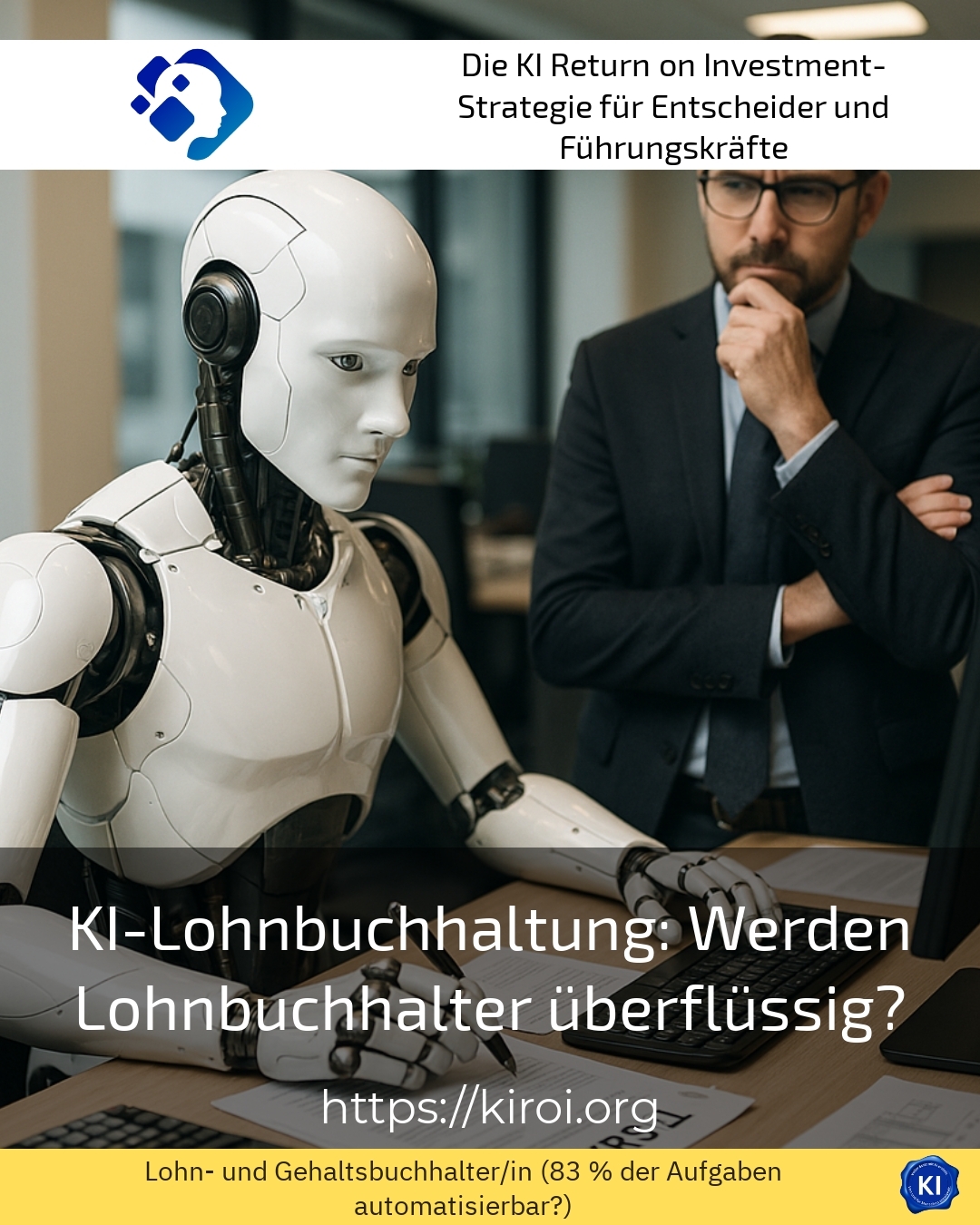
Will your expertise soon be replaced by algorithms that process payrolls faster and more accurately than any human ever could? This question is currently occupying countless professionals who deal with the processing of remuneration data, social security contributions and tax calculations. The AI payroll accounting is developing rapidly and fundamentally changing the entire industry. Automated systems are already taking over tasks that previously required hours of manual work. But does this technological change actually mean the end of a traditional profession, or does it rather open up new opportunities for those who are willing to evolve and strategically expand their skills?
The following findings are based, among other things, on data from the Job Futuromat of the Institute for Employment Research [1]. This scientific source systematically analyses the automation potential of various occupational fields. If you work in this area and want to prepare proactively for the future, the AIROI seminars offer an excellent opportunity to position yourself strategically. You can find the current dates for seminars, lectures and workshops in Sanjay Sauldie's event calendar [2]. The AIROI strategy supports professionals in viewing digital transformation not as a threat, but as an opportunity for development.
The current state of automation in payroll accounting
Technological development has achieved remarkable momentum in recent years, fundamentally transforming repetitive and data-intensive processes in particular. Modern software solutions automatically record working hours from digital time-tracking systems. They calculate shift premiums for night work, Sundays and public holidays without human intervention. In doing so, the systems take into account complex collective bargaining agreements from various industries. The calculation of social security contributions is also increasingly automated. Health insurance notifications are generated and transmitted electronically. Integration with tax authorities enables the automatic transfer of payroll tax returns.
In medium-sized craft enterprises, intelligent systems are already taking over the recording of site allowances. Retail chains use AI-powered solutions to calculate commissions and profit-sharing. Industrial companies rely on automated shift schedule evaluations that flow seamlessly into payroll accounting. These examples illustrate the range of automation already realised.
Best practice with a AIROI customer A medium-sized logistics company with over 400 employees faced the challenge of streamlining its monthly payroll processing, as the previous manual processes were leading to errors and taking up a considerable amount of time. The management decided to take part in a AIROI workshop to develop a well-founded strategy for digital transformation. As part of the support provided, an initial analysis was carried out to identify which process steps offered the greatest potential for automation; it emerged that, in particular, the recording of drivers’ working hours and the calculation of expenses could be significantly simplified. The solution implemented integrated the vehicles’ GPS data with the payroll system, so that driving times and break times were automatically recorded. The specialist, who had previously been solely responsible for manual data entry, took on the role of system administrator and point of contact for complex special cases following appropriate further training. Today, those in charge report that the error rate has fallen by over 85 per cent, whilst staff satisfaction has risen significantly thanks to more punctual and accurate payroll processing.
AI payroll accounting and the remaining human core competencies
Despite all technological advancements, there are areas where human expertise remains indispensable and is unlikely to be completely replaced by machines in the foreseeable future. The interpretation of complex employment law issues requires experience and judgment. Consultations with employees regarding payslips demand empathy and communication skills. Strategic workforce planning in conjunction with remuneration systems requires creative thinking.
In hospitals, for example, special cases regularly arise due to on-call shifts and standby duty. Hotels have to accommodate seasonal fluctuations and international staff constellations. Construction companies juggle changing work locations and project-related allowances. This complexity frequently exceeds the capabilities of standardised algorithms.
The AI payroll accounting supports professionals in delegating time-consuming routine tasks. This creates space for value-adding activities. Advising managers on remuneration models is gaining in importance. The analysis of personnel costs for strategic decisions is becoming equally important. This development enhances the occupational profile rather than diminishes it.
The role of employee communication
Algorithms cannot hold empathetic conversations when employees have questions about their payslips or want to clarify discrepancies. Explaining complex payroll components requires didactic skill. Nursing staff, for example, often have questions about shift allowances. Production workers need explanations regarding piece-rate wages and performance bonuses. Sales staff want to be able to understand their commission statements. These interactions build trust and employee satisfaction.
Legal assessment of borderline cases
Employment law issues are rarely presented in a clear-cut form, which is why human expertise remains indispensable when assessing borderline cases. The classification of non-cash benefits as a taxable benefit requires tact. Severance pay arrangements in the event of dismissals demand legal expertise. Short-time working calculations during economic crises require rapid adaptability. Catering businesses struggle with the correct recording of tips. Advertising agencies must distinguish freelance workers from employees. Software companies navigate complex regulations regarding share options.
Transformation strategies for payroll professionals
The future viability of skilled workers depends significantly on their willingness to engage in continuous professional development and to acquire new competencies that go beyond the traditional range of activities. A technical understanding of digital systems is becoming increasingly important. The ability to carry out and interpret data analyses is gaining in significance. Project management skills for the implementation of new systems are in increasingly high demand.
Tax consultancy practices are looking for staff with digital skills. Human resources departments in large corporations need specialists in HR analytics. Start-ups are looking for flexible all-rounders who understand modern tools. These requirement profiles show the direction of change. The AIROI strategy offers valuable impetus for personal development here.
Best practice with a AIROI customer An experienced payroll professional at an insurance company was faced with increasing automation and initially feared that her role might become obsolete in the medium term. However, after attending a AIROI lecture, she recognised the opportunity not only to secure her position through targeted skills development, but even to expand it. As part of the support provided by the AIROI methodology, she developed a concept that combined the automated processes with her human expertise. She specialised in advising managers on remuneration strategies and took on the training of colleagues in dealing with the new systems. In addition, she acted as an interface between the IT department and human resources, translating complex technical issues into easy-to-understand terms. Today, she reports that her work has become significantly more varied and strategically important, while the monotonous data entry is a thing of the past.
Future scenarios for AI payroll accounting
Technological development will accelerate further in the coming years, with various scenarios being conceivable, each of which could have different impacts on the employment situation. Fully automated payroll accounting for standard cases will become the norm. Human expertise will focus on exceptional situations and strategic tasks. Hybrid models with AI support and human control are becoming established.
In the automotive industry, corporations are already experimenting with fully integrated HR platforms. The public sector is gradually modernising its payroll systems. Start-ups rely on cloud-based comprehensive solutions right from the start. Trades businesses use simplified apps for mobile time tracking.
The AI payroll accounting will not become a job killer, but a driver of transformation. Whoever actively shapes this development secures their professional future. The AIROI seminars provide a structured framework for this.
New job profiles and specialisations
With technological development, new fields of activity are emerging at the same time that combine specialist knowledge from the payroll sector with digital skills and offer attractive career prospects. Payroll system consultants support companies in selecting suitable solutions. Compliance specialists monitor compliance with legal requirements by automated systems. Data analysts in the HR sector evaluate personnel cost developments. Training experts teach how to use new technologies. These roles require a combination of traditional specialist knowledge and new skills.
Audit firms are looking for specialists to audit automated billing systems. Software providers need professionals with industry knowledge for product development. Management consultancies are recruiting experts for HR digitalisation projects.
My AIROI Analysis
The comprehensive view of technological development in the field of payroll accounting shows a nuanced picture that gives cause for neither panic nor complacency. The automation of routine tasks is progressing relentlessly, but at the same time new requirements and fields of task are emerging that require human expertise in a modified form. The crucial question is not whether technological change is taking place, but how professionals can optimally prepare for it and actively help shape it.
The AIROI strategy provides a structured approach to managing this transformation successfully. It supports professionals in analysing and purposefully developing their existing skills. The focus is on identifying strengths that remain relevant even in an automated working world. Communication skills, legal judgement and strategic thinking are among these permanently in-demand qualities. At the same time, the AIROI methodology imparts technical understanding and digital competencies required for working with intelligent systems.
Participants in the AIROI seminars frequently report that they view their professional situation with renewed confidence after completing the further training. They recognise opportunities where previously they only saw risks. The guidance provided by experienced experts gives them direction and concrete impulses for action. Anyone who invests in their own professional development today positions themselves optimally for the working world of tomorrow. The AI payroll accounting will not make skilled workers redundant, but will reward those who view change as an opportunity and actively shape it.
Further links from the text above:
[1] IAB Job-Futuromat – Automation potential of occupations
[2] AIROI seminars and events with Sanjay Sauldie
For more information and if you have any questions, please contact Contact us or read more blog posts on the topic Artificial intelligence here.






 Deutsch
 English (UK)