
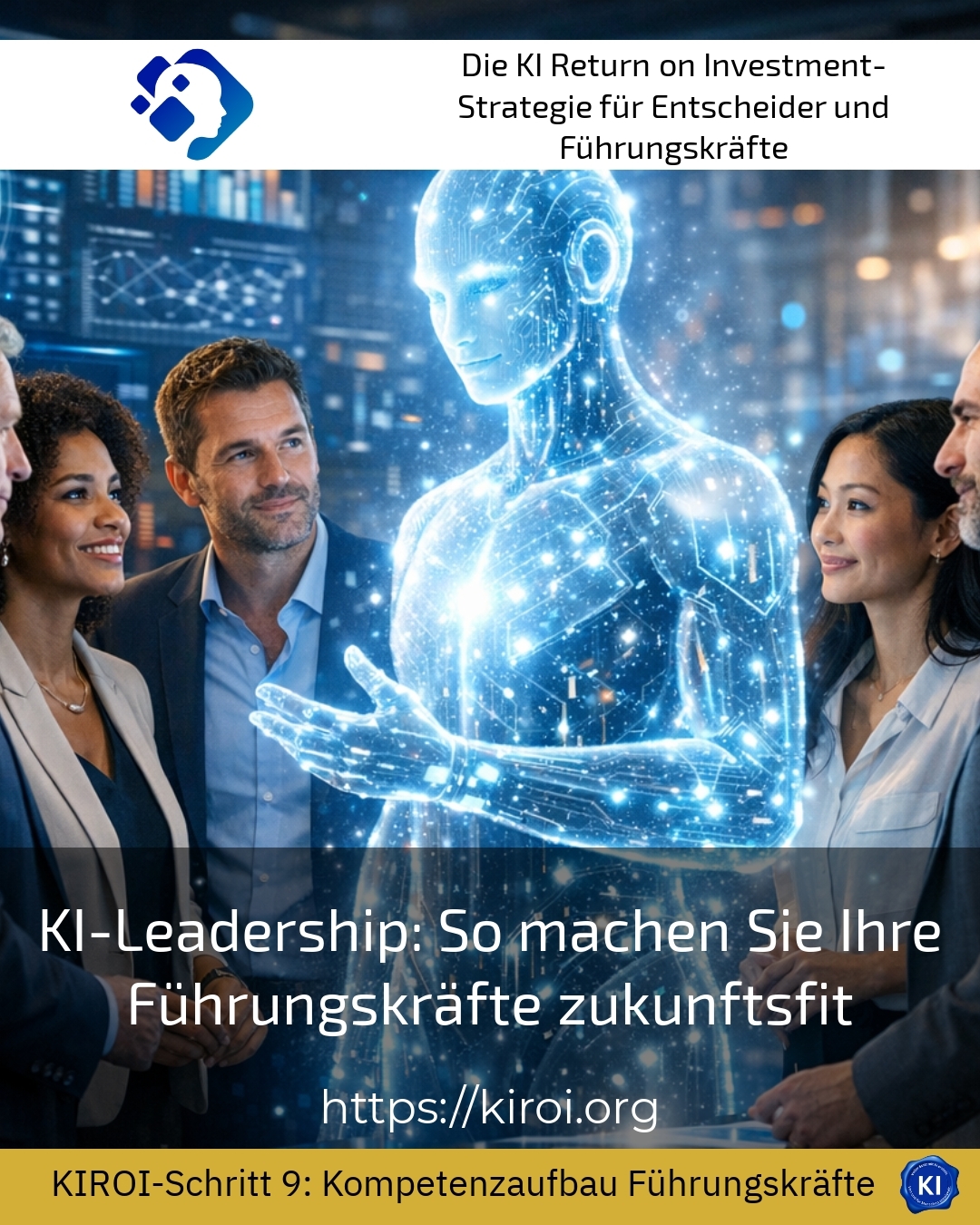
Are your leaders ready for the biggest transformation since the Industrial Revolution, or is your company at risk of losing its edge because crucial competencies are lacking that are essential in an increasingly automated business world? This question is currently occupying the minds of executives, managers, and human resources managers alike, because the integration of intelligent systems into business processes is fundamentally changing how we need to think about leadership. The concept of AI Leadership This is becoming increasingly important because it is no longer enough to simply employ technological tools. Instead, the goal is to establish an entirely new leadership culture that synergizes human intuition with machine intelligence. In this article, you will learn how transruptive coaching helps leaders successfully master this challenge.
The new reality: Why traditional leadership models are no longer sufficient
The working world is changing at a speed that poses unprecedented challenges for many executives. Decision-making processes that used to take weeks now have to be completed in hours. At the same time, the complexity of the available data is increasing exponentially. Intelligent analysis tools can now detect patterns that remain hidden from the human eye. A financial services provider from the Rhine-Main region recently reported that its executives initially struggled to incorporate recommendations from algorithmic systems into their strategic thinking because the classic understanding of leadership was based on other foundations.
In the automotive industry, this transformation is particularly evident. Production managers must now not only lead teams but also interact with predictive maintenance systems that predict machine failures. A medium-sized supplier in southern Germany implemented intelligent quality control systems. The shift managers initially felt left behind because algorithms made decisions that were previously reserved for their experience. Only through targeted guidance was it possible to establish productive collaboration between humans and machines.
Similar developments are also occurring in the healthcare sector. Chief physicians and nursing service managers face the challenge of integrating diagnostic assistance systems meaningfully into clinical workflows. The challenge lies in combining technological precision with human empathy. A network of clinics in northern Germany reported that the acceptance of new technologies depended significantly on the attitude of the senior management. Where department heads perceived the change as a threat, implementation projects often failed.
AI leadership as a key competence of the future
The concept of AI Leadership Describes a leadership philosophy that goes far beyond technical understanding. It encompasses the ability to navigate with confidence in a hybrid work environment where human and machine intelligence work together. Leaders with this competence understand when to rely on algorithmic recommendations and when human judgment remains indispensable. They create conditions where their teams perceive technological tools as support rather than a threat.
In retail, we are observing how store managers are learning to navigate with personalized recommendation systems. One leading retail company reported that its district managers were initially skeptical when intelligent systems suggested assortment decisions. Through a structured development program, they learned to use data analysis as a valuable addition to their understanding of the market. Sales in the pilot regions subsequently developed at a significantly positive rate.
In the logistics industry, the importance of AI leadership is particularly striking. Dispatchers now work with route optimization systems that take into account thousands of variables simultaneously. The leaders in this sector must understand how to orchestrate these systems while simultaneously valuing the experience of their teams. A freight forwarder from the Ruhr region developed a hybrid decision model in which algorithms generate suggestions and experienced dispatchers refine them with their practical knowledge.
Best practice with a AIROI customer A traditional machine engineering company with over 800 employees faced the challenge of preparing its senior management for the integration of intelligent production systems. The management leadership recognized early on that technical training alone would not be sufficient to manage the necessary transformation. Within the framework of a six-month follow-up process, we worked with the department managers on their personal attitude towards technological change. The executives developed a deep understanding of how they could redefine their role. They learned to view algorithms as tools that support their decision-making, rather than replacing them. Particularly valuable was the realization that their human competencies, such as empathy, creativity, and ethical judgment, were gaining importance precisely through technological development. After completing the program, the participants reported a significantly more confident handling of the new systems. The acceptance within the teams increased measurably, because the leaders acted as positive role models.
The emotional dimension of technological transformation
Clients in transruptive coaching often report deep-seated fears and uncertainties that accompany technological transformation. These emotional reactions are completely understandable and deserve serious attention. Executives who have been valued for decades for their expertise and experience suddenly wonder if their competencies are still relevant. They experience that younger employees seem to handle new technologies effortlessly while they themselves are seeking guidance.
In the insurance industry, we are observing this dynamic particularly closely. Experienced claims officers and team leaders are seeing intelligent systems analyze claims and make recommendations. A regional manager of a large insurance company described how he initially felt superfluous. Through mentoring, he realized that his ability to emotionally grasp complex customer situations is irreplaceable by any technology. He learned to combine his expertise with algorithmic analysis and thus became a valuable bridge builder between technology and humanity.
Similar patterns are also evident in the banking sector. Branch managers are seeing how advisory algorithms generate investment recommendations. The challenge lies in integrating these recommendations into personal consultations. One private client advisor reported that transruptive coaching helped him redefine his added value. Today, he sees himself as a translator between technological possibilities and individual customer needs.
Practical impulses for the development of AI leadership
The development of AI Leadership-Competencies require a holistic approach that combines technical understanding with personal development. In transruptive coaching, we work with leaders on several dimensions simultaneously. First, it is about developing a fundamental understanding of the functioning of intelligent systems. This does not mean that leaders need to learn to program. Rather, it is about a conceptual understanding that enables informed decisions.
In the media industry, one can see how important this conceptual understanding is. Editors today must decide which tasks they can delegate to automated systems. A chief editor of a regional news portal reported that he learned to distinguish between routine tasks and creative processes through mentoring. He implemented intelligent tools for data research, but consistently retained editorial decision-making authority over his journalists.
The pharmaceutical sector offers further insightful examples. Research leaders face the challenge of integrating intelligent systems into drug development. The challenge lies in combining scientific expertise with machine learning. One laboratory director reported that his greatest discovery was to view algorithms as hypothesis generators. Scientific validation remains firmly in human hands.
Cultural change as a leadership task in the age of intelligent systems
The successful integration of intelligent systems depends largely on the company culture. Leaders shape this culture through their own behavior and communication. When they view technology as a threat, their teams will react accordingly. However, when they emphasize the opportunities and demonstrate a willingness to experiment, a positive climate for change emerges.
In the construction industry, we are witnessing how this cultural change can be achieved. Project managers are increasingly using Building Information Modeling and predictive analysis tools. A contractor from southern Germany reported that the introduction of these technologies initially faced massive resistance. Experienced polishers felt their expertise was under attack. Through targeted communication and involvement, it was possible to establish a culture of openness. Today, even skeptical employees are using the new tools productively.
The energy sector is also facing fundamental changes. Grid operators must work with intelligent control systems that optimize the flow of electricity in real time. A team leader at a municipal utility described that the biggest challenge was developing trust in the algorithmic decisions. The mentoring helped him establish a model of shared responsibility where humans and machines bring complementary strengths.
Best practice with a AIROI customer An international logistics service provider with several thousand employees implemented a comprehensive strategy to develop future-proof leadership skills. The company recognized that technological transformation would fail without corresponding leadership development. In a two-year program, we supported over 120 leaders from various levels in their personal development. The participants learned to redefine their role in an increasingly automated environment and to specifically leverage their human strengths. Particularly valuable was the work on concrete practical cases from the leaders’ daily work lives. They developed action strategies for typical conflict situations that arise when introducing new technologies. The evaluation after the program concluded with significantly higher willingness to change and strengthened self-confidence among the participants. The company was able to significantly accelerate its digital transformation because the executives acted as positive multipliers.
The role of transruptions coaching in the development of future-ready leaders
Transruptions Coaching positions itself as a support for projects around the technological transformation of leaders. Unlike pure technology training, this approach addresses the personal development dimension that is essential for sustainable success. The coaching supports leaders in reflecting on and developing their own attitude towards change. It provides impulses for new ways of thinking and acting that are necessary in a hybrid working environment.
In the telecommunications sector, the effectiveness of this approach is evident. Customer service managers face the challenge of integrating chatbots and intelligent assistants into their service concepts. A call center manager reported that coaching helped him take the concerns of his employees seriously and address them constructively. He developed a concept in which algorithms handle routine requests while his team focuses on complex customer issues.
The tourism industry offers further insights into the importance of professional guidance. Hotel managers today work with revenue management systems that dynamically adjust prices. One hotel director described how he learned through coaching to view these systems as strategic partners. He uses the algorithmic recommendations as a starting point for his pricing decisions and supplements them with his knowledge of local peculiarities.
My AIROI Analysis
The development of AI leadership competencies is not an optional additional qualification but an existential necessity for companies that want to remain competitive in an increasingly technology-driven economy. My analysis shows that successful transformations are only achieved when technological implementation is accompanied by targeted leadership development. Companies that invest early in the future-readiness of their leadership level gain crucial competitive advantages because they can implement change processes more quickly and sustainably.
What is particularly noteworthy is the realization that technological competence alone is not enough. Leaders must instead develop a new attitude that understands human and machine intelligence as complementary forces. This change in attitude cannot be taught through classroom instruction but requires reflective practical experience and individual guidance. The examples from various industries impressively show that while the challenges may have different manifestations, the fundamental success factors apply across industries.
For the future, I expect that the demands on leaders will continue to increase. The speed of technological developments is accelerating, and the half-life of knowledge is continuously shortening. Leaders who invest in their personal development today create the foundation for long-term success. They will be able to master future changes with confidence because they have learned to deal with uncertainty productively. The AIROI[1] model provides a structured framework that systematically supports these complex development processes.
Further links from the text above:
[1] AIROI-Master plan for AI implementation in companies
For more information and if you have any questions, please contact Contact us or read more blog posts on the topic Artificial intelligence here.








 Deutsch
 English (UK)