
Why do so many transformation projects fail despite the latest technology and ambitious strategies?
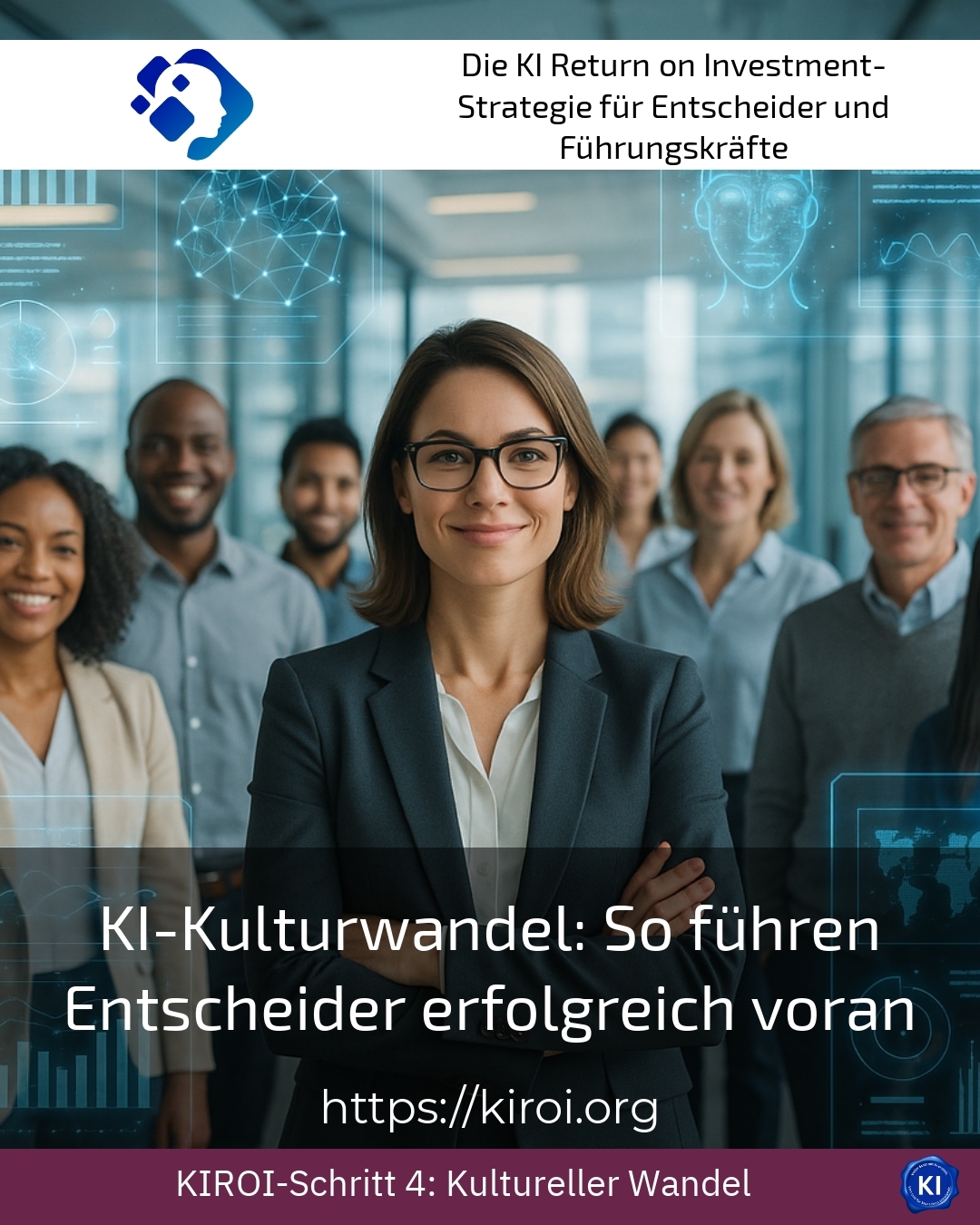
The answer often lies not in the technology itself, but in the way organizations handle change. AI cultural change It presents leaders with entirely new challenges that go far beyond simply implementing software. Decision-makers repeatedly report that while they are introducing impressive systems, the expected results are not being achieved. The cause is almost always found in the lack of willingness of people to adopt new ways of working and let go of old habits. This is where professional guidance comes into play, which not only considers technical aspects but also places the human dimension at the center.
Recognize the hidden obstacles to AI culture change
Many organizations underestimate the emotional reactions of their employees to profound changes. Fear of job loss, uncertainty about new competencies, and skepticism towards unfamiliar processes characterize the work day. These feelings are completely normal and deserve recognition. Leaders must understand that resistance is often a sign of commitment. Those who are excited are still important to the matter. Indifference would be significantly more problematic.
In manufacturing companies, this phenomenon is particularly evident. Experienced professionals who have been working with proven methods for decades feel threatened by new systems. Their expertise suddenly seems less valuable. However, the opposite is true. Human experience remains indispensable for quality assurance and problem solving. The combination of traditional know-how and modern tools creates real added value.
We also face similar challenges in healthcare. Caregivers and medical staff fear that human interaction will be replaced by automated processes. This concern is understandable, but unfounded. Intelligent systems can take on administrative tasks, thereby freeing up more time for real patient care. However, what matters most is how this message is communicated.
Best practice with a AIROI customer A medium-sized company in the mechanical engineering sector faced the challenge of fundamentally modernizing its production planning. The experienced craftsmen initially showed clear resistance to the new analysis tools. They felt that their expertise was not being valued and feared being replaced by algorithms. As part of the transruptive support process, we jointly developed an approach that explicitly included the expertise of the employees. The craftsmen became knowledge-bearers whose expertise was incorporated into the system development. After six months, they reported enthusiastically about the new possibilities. Production efficiency increased by about fifteen percent, while at the same time employee satisfaction measurably increased. This success was not based on technical superiority, but on the consistent involvement of all parties involved.
Redefining leadership competencies in the cultural transformation of AI
The role of decision-makers is fundamentally changing in times of technological upheaval. Traditional leadership styles are reaching their limits. Hierarchical implementation of change generates resistance instead of acceptance. Modern leadership instead means creating spaces for dialogue and shared learning. Decision-makers become facilitators and moderators of complex transformation processes.
In retail, we are experiencing this development particularly intensively [1]. Store managers suddenly have to deal with data-driven recommendations that contradict their own experience. The trick is to appreciate both perspectives. Sometimes the algorithms are correct, sometimes the human intuition is right. Leaders need the ability to use these conflicting perspectives productively. They must not blindly trust the numbers or ignore technological insights.
Financial service providers are also facing similar challenges [2]. Advisors who relied on personal relationships for years are now expected to incorporate automated analyses into their conversations. This requires a new approach to their role. Human advice-giving skills are not being replaced but rather complemented. Leaders must convey and demonstrate this message in a credible manner.
Changes are also evident in the education sector. Teachers are wondering what role they will play in the future. Their role is shifting from a mere disseminator of knowledge to a learning companion and mentor. This transformation requires time, support, and respectful communication.
Communication strategies for successful transformation
The way changes are communicated is crucial to their success. One-time announcements are far from enough. Continuous dialogue is required. Leaders should regularly feel the pulse of the organization and address concerns. Open questions deserve honest answers, even if they are sometimes uncomfortable.
In the logistics industry, it has proven effective to make pilot projects transparent [3]. Warehouse workers who were initially skeptical became ambassadors of change. They themselves experienced how new systems facilitated their work. These authentic testimonials are more convincing than any management presentation. People believe people, not slides.
In the insurance industry, a similar approach works. Agents who initially had reservations later trained their colleagues. This peer-to-peer mentoring creates trust and credibility. Leaders create the framework for such organic learning processes.
Best practice with a AIROI customer A service company with several hundred employees wanted to fundamentally modernize its internal processes. The management had already experienced several failed attempts and was looking for a new approach. As part of the transruptive support, we first analyzed the previous stumbling blocks and identified a lack of communication as the main cause. Together, we developed a dialogue format that established regular feedback loops. The employees were able to express their concerns and received concrete answers. In addition, change ambassadors from various departments were appointed to act as intermediaries. After about nine months, the acceptance of the new processes was significantly higher than with previous initiatives. The employees reported a sense of involvement and appreciation. This cultural change enabled the technological progress to take place in the first place.
Practical steps for AI culture change in the organization
Successful transformation begins with an honest assessment of the current corporate culture. What values are actually lived, not just proclaimed? How does the organization handle mistakes? Are new ideas encouraged or blocked? These questions often reveal uncomfortable truths. Yet they form the foundation for any sustainable change.
In the trades, there is often a strong sense of tradition. Businesses that have been operating successfully for generations rarely question their established processes. Introducing digital tools requires particularly much sensitivity here. What has been proven must be acknowledged before new things can be accepted.
Specific challenges also confront us in public administration. Complex hierarchies and formalized processes make agile approaches difficult. Nevertheless, successful transformations are also achieved here. The key lies in the gradual change that respects existing structures.
In healthcare, regulatory requirements also play a major role. Any change must be carefully reviewed for compliance. This slows down processes, but also provides security. Leaders must communicate this balance and show patience.
Learning to use resistance constructively
Resistance to change is not the enemy, but a valuable source of information. It shows where fears and uncertainties lie. It reveals which aspects have not yet been sufficiently explained. Wise leaders listen carefully and adapt their strategy accordingly.
In the automotive industry, we are currently experiencing massive disruptions. Professionals whose entire careers are based on specific technologies must retrain. This understandably creates uncertainty. Companies that take these emotions seriously and offer further training opportunities are better able to manage the change.
The uncertainty is also high in the media sector. Journalists are wondering what added value they can offer in the future. However, their ability to critically assess and conduct investigative research remains indispensable. Leaders must convey this message credibly.
In the tourism sector, similar patterns are evident. Travel consultants who rely on personal expertise compete with automated booking platforms. Their strength lies in individual advice and the building of long-term customer relationships. These qualities cannot be automated.
The role of external support in transformation projects
Internal change processes often encounter systemic limitations. Organizational inertia prevents the recognition of patterns. Internal power dynamics block honest communication. Here, external support can provide valuable impulses. It brings an unbiased perspective and methodological expertise.
Transruptions Coaching positions itself clearly as a support for complex projects. It is not about delivering ready-made solutions. Rather, it helps organizations find their own answers. This approach promotes sustainable change because it strengthens self-responsibility.
In the energy sector, the added value of external support is particularly evident [4]. The transition away from fossil fuels requires fundamental rethinking. External perspectives help to question established ways of thinking. They enable new perspectives on seemingly unsolvable problems.
Best practice with a AIROI customer A retail chain with several branches planned the introduction of new cash register systems and warehouse management solutions. Previous projects had failed due to a lack of employee acceptance. The management approached us because they were looking for a different approach. As part of the transruptive support, we first conducted detailed discussions with employees at all levels. Specific fears emerged that had never been discussed before. Many employees feared not being able to master the new technology and thus acting incompetently. We developed a tiered training concept that took individual learning speeds into account. Additionally, we established a mentoring system in which technically-savvy employees supported their colleagues. The implementation proceeded much more smoothly than in previous projects. Employees reported a strengthened sense of confidence in using the new tools.
My AIROI Analysis
The experience from numerous accompanying projects clearly shows that the AI cultural change Primarily, it is a human challenge. Technology alone does not bring about transformation. It takes leadership that understands that change requires time and patience. Successful decision-makers invest at least as much energy in the cultural dimension as in the technical implementation.
Clients often report initial overwhelm in the face of the complexity of such projects. These feelings are completely understandable and should be openly discussed. As part of the support process, we work together to develop realistic expectations and manageable steps. Small successes create momentum for greater changes.
The analysis of AIROI the methodology illustrates that sustainable transformation must be implemented simultaneously at multiple levels. Strategy, structure, and culture must be aligned with each other. Isolated measures are ineffective. Only a holistic approach leads to lasting results.
What seems particularly important to me is the realization that resistance is a normal part of any change process. Fighting it is a waste of energy. Understanding and using it constructively accelerates transformation. Leaders who internalize this attitude lead more successfully through turbulent times.
The coming years will show which organizations will master cultural change. Those that invest early in their people will emerge stronger. Technology is advancing rapidly. Human adaptability remains the decisive factor of success. It is precisely here that professional guidance can make the difference.
Further links from the text above:
[1] Handelsblatt: Digital transformation in retail
[2] McKinsey: Transformation in the financial sector
[3] BVL: Digitization in logistics
[4] BDEW: Transformation of the energy sector
For more information and if you have any questions, please contact Contact us or read more blog posts on the topic Artificial intelligence here.








 Deutsch
 English (UK)