
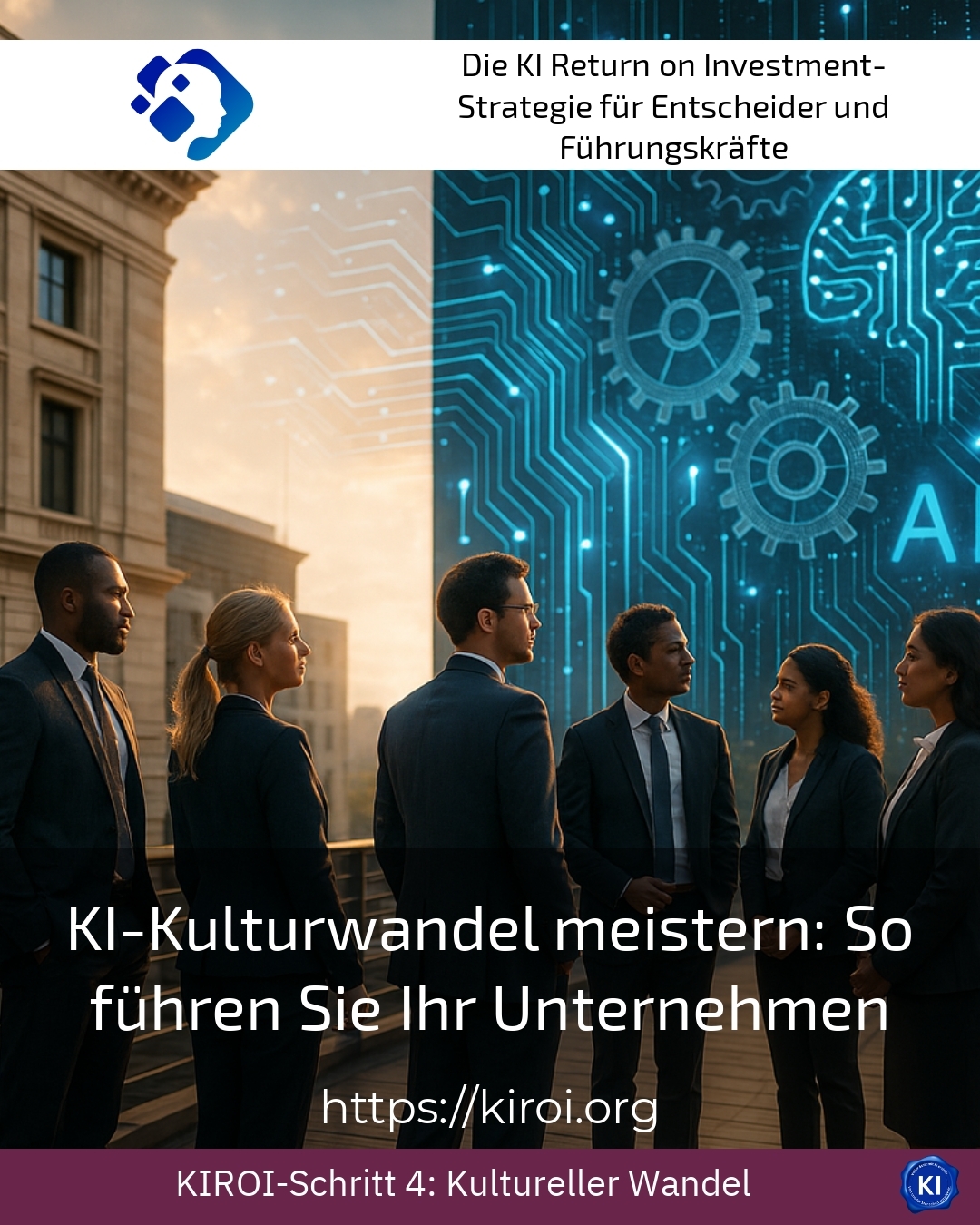
The world of work is changing rapidly. Technologies are permeating every business area. However, many managers face an enormous challenge. Their employees react skeptically to new systems. Processes falter despite state-of-the-art tools. The Mastering AI cultural change This makes it the central leadership task of our time. Why do so many transformation projects fail? The answer rarely lies in the technology itself. Instead, there is often a lack of thoughtful support for the human factor. I want to highlight this crucial difference in this article. I will explore concrete paths for sustainable change. You will learn how successful companies involve their teams while remaining authentic.
Why technological progress alone is not enough
Many organisations invest considerable sums in new systems. They implement automated processes and intelligent analysis tools. Nevertheless, the hoped-for results often fail to materialise. The reason for this lies in a fundamental misunderstanding. Technology only unfolds its effect through people. These people must understand and want to support the change. Without this internal willingness, friction losses occur at all levels. Employees bypass new systems or only use them superficially. Leaders often report silent resistance within their teams. This resistance is not maliciousness. Rather, it stems from deep-seated fears and uncertainties.
This phenomenon is particularly evident in the automotive industry. Traditional manufacturing experts see their specialist knowledge under threat. Decades of acquired knowledge suddenly seem obsolete. A production manager with thirty years of experience feels uncertain. Their expertise in mechanical manufacturing is being supplemented by data-driven approaches. They may perceive this supplementation as replacement. We observe similar dynamics in the chemical industry. Laboratory managers with profound material knowledge encounter algorithmic forecasting models. In mechanical engineering, experienced designers are grappling with generative design tools. These tools propose solutions in seconds that previously took weeks.
Best practice with a KIROI customer
A medium-sized supplier to the automotive industry was facing a difficult situation. The management had decided to introduce intelligent quality control systems. These systems were intended to recognise and report errors in production at an early stage. The technical implementation initially proceeded without any major problems. However, the employees in production showed clear reservations. They perceived the systems as instruments for monitoring their work. The error rate hardly fell because reports were ignored or bypassed. As part of a transruption coaching programme, we worked intensively with all those involved. We held dialogue sessions in which fears could be openly expressed. The managers learnt to take concerns seriously instead of dismissing them. Together, we developed a new communication strategy for the project. After six months, the working atmosphere had improved noticeably. The employees began to perceive the systems as helpful support. The error rate ultimately fell by more than forty per cent compared to the initial figure.
Mastering the AI culture shift through conscious leadership decisions
Leaders play a key role in any transformation. Their attitude significantly shapes their teams' reactions. This isn't about technical expertise. Instead, authentic communication and genuine interest are crucial. Employees can clearly sense whether changes are imposed from above. They also notice when leaders themselves are unsure. This uncertainty is human and can be shown. However, it needs a constructive framework. This is precisely where accompanying coaching processes come in.
In the pharmaceutical industry, we are experiencing particularly complex transformation processes. Regulatory requirements meet technological innovation. Research departments must question their established ways of working. One example: drug discovery increasingly uses predictive models. These models can predict molecular structures and their efficacy. Experienced pharmacists sometimes feel devalued by this. Their years of laboratory experience seem to be becoming less important. In reality, both skill sets complement each other excellently. However, this understanding must be actively communicated and experienced. We observe similar patterns in the logistics sector. Dispatchers with an intuitive feel for route planning are meeting optimisation algorithms. In retail, experienced buyers are struggling with data-driven demand forecasts.
Practical Approaches to Successful Cultural Change
Successful transformation begins with listening and understanding. Leaders need to know what motivates their employees. What worries concern them? What hopes do they associate with change? These questions require safe spaces for honest conversations. Many clients report surprising insights from such dialogues. Long-serving employees suddenly express constructive improvement ideas. Skeptics become valuable critics who highlight blind spots.
The financial sector offers clear examples of successful cultural support. Banks are increasingly introducing automated advisory systems. Customer advisors fear becoming redundant. In reality, their roles are undergoing fundamental change. Instead of conveying standard information, they can concentrate on complex consultation. However, this repositioning does not happen by itself. It requires intensive support and qualification. In the insurance industry, claims adjusters are experiencing similar shifts. Intelligent systems are taking over routine cases completely. The remaining tasks require higher expertise and empathy.
Best practice with a KIROI customer
A regional insurance company wanted to modernise its claims processing. The management planned to introduce an intelligent assistance system. This system would automatically categorise and prioritise claims. Simple cases would be processed completely automatically. The employees in the claims department reacted with clear disapproval. They saw their jobs under acute threat and refused to co-operate. The project team contacted us for transruption coaching support. We began with a comprehensive assessment of the concerns and fears. It turned out that many employees wanted to redefine their role. They wanted more time for demanding customer contacts. Together, we developed a concept for expanded competences. The clerks were trained to become case managers with greater decision-making authority. The assistance system took over repetitive tasks such as data entry and standard correspondence. After one year, remarkable results were seen in several areas. Employee satisfaction increased significantly, while staff turnover decreased. Processing times were significantly reduced without any loss of quality.
Understanding and constructively using resistance
Resistance to change is not a disruption. It is a valuable signal for unresolved issues. Clients often report frustrating situations with critical employees. Upon closer examination, valid objections often emerge. These employees see risks that management misses. Their experience from operational practice is invaluable. Smart leadership leverages this potential instead of suppressing it.
In the manufacturing industry, we often encounter experienced specialists. These individuals know their machines and processes in intricate detail. They sense deviations before sensors register them. An experienced machine operator in the textile industry intuitively recognises quality issues. Their perception is based on years of attentive observation. Algorithmic systems can supplement this intuition, but not replace it. In the food industry, production managers possess similar implicit knowledge. They understand how temperature and humidity affect dough quality. In the skilled trades, experienced master craftsmen preserve skills that are scarcely documented.
Mastering AI cultural change also means slowing down
Speed is not always an advantage. Sometimes, real change needs time to mature. Many transformation projects fail due to unrealistic timelines. Employees feel overwhelmed and react by withdrawing. Sustainable development requires phases of reflection and integration. These phases are often underestimated in project management. However, they are crucial for long-term success.
The construction industry is showing interesting developments in this regard. Digital planning tools are fundamentally changing collaboration. Architects, engineers and site managers have to develop new forms of communication. Building Information Modelling requires changed ways of thinking for all parties involved. Successful implementation often takes longer than is technically necessary. However, this additional time is well invested. We are observing similar dynamics in the healthcare sector. Doctors and nurses need to develop trust in support systems. This trust grows through positive experiences, not through directives. In the energy sector, employees are undergoing fundamental restructuring of their working world.
Best practice with a KIROI customer
An energy supplier was planning to transform its grid control system. Intelligent systems were to optimise load distribution and predict faults. The technical requirements were complex and demanding. However, the human factor proved to be even more challenging. The employees in the control room had decades of combined experience. They had mastered critical situations that are not in any manual. Their scepticism towards automated decisions was understandably justified. As part of a transruption coaching programme, we developed a cautious approach. Initially, the new systems worked in parallel with the existing processes. The employees were able to observe and evaluate predictions and recommendations. In doing so, they documented cases in which their assessment differed. This documentation became the basis for system improvements. The employees experienced themselves as active creators rather than passive stakeholders. After eighteen months, trust had grown to such an extent that more automation gradually became possible. The transformation succeeded because time and space were given for real integration.
The role of external support in change processes
Internal managers are often too close to the action. They overlook dynamics that are obvious to outsiders. External support offers a neutral perspective on entrenched situations. This isn't about ready-made solutions from the outside. Rather, professional support assists in developing one's own approaches. External input can break down rigid ways of thinking. New perspectives emerge through the dialogue between internal knowledge and external experience.
In medium-sized companies, internal resources for change management are often scarce. HR departments are overloaded with operational tasks. Managers juggle day-to-day business and projects. The quality of human support suffers under this pressure. External support can fill this gap. It brings methodological competence and time capacity. We have often experienced this constellation in the metal industry. Family businesses with established structures are facing major upheavals. Transruption coaching support creates protected spaces for necessary conversations. Similar needs in digitalisation are evident in the textile industry. The media industry has been undergoing fundamental transformations for years.
My KIROI Analysis
The observations from numerous support projects show a clear pattern. Technological transformation succeeds or fails due to the human factor. Companies that take this factor seriously achieve sustainable results. They invest in communication, participation and training. They acknowledge fears without letting them paralyse them. The Mastering AI cultural change This means more than textbook change management. It requires genuine interest in the people behind the roles.
The KIROI analysis makes it clear that successful transformation must consider several levels. The technical level merely forms the basis for change. The procedural level defines new workflows and interfaces. However, the cultural level determines acceptance and sustainability. Many projects fail because this third level is neglected. It appears less tangible and harder to measure. Nevertheless, it is the crucial success factor for long-term impact.
Particularly noteworthy is the finding from the coaching practice. Resistance is not an obstacle but a resource. It shows where further clarification is needed. It identifies blind spots in the project design. Leaders who adopt this perspective gain valuable allies. They transform critics into constructive co-designers. This transformation of attitude is often the most important first step. It subsequently enables all further changes at a technical level.
Further links from the text above:
[1] KIROI-Blog: Methods and Approaches for AI Integration
[2] Transruptions-Coaching: Guidance with digital transformation
[3] Contact options for individual consultation requests
For more information and if you have any questions, please contact Contact us or read more blog posts on the topic Artificial intelligence here.









 Deutsch
  English (UK)