
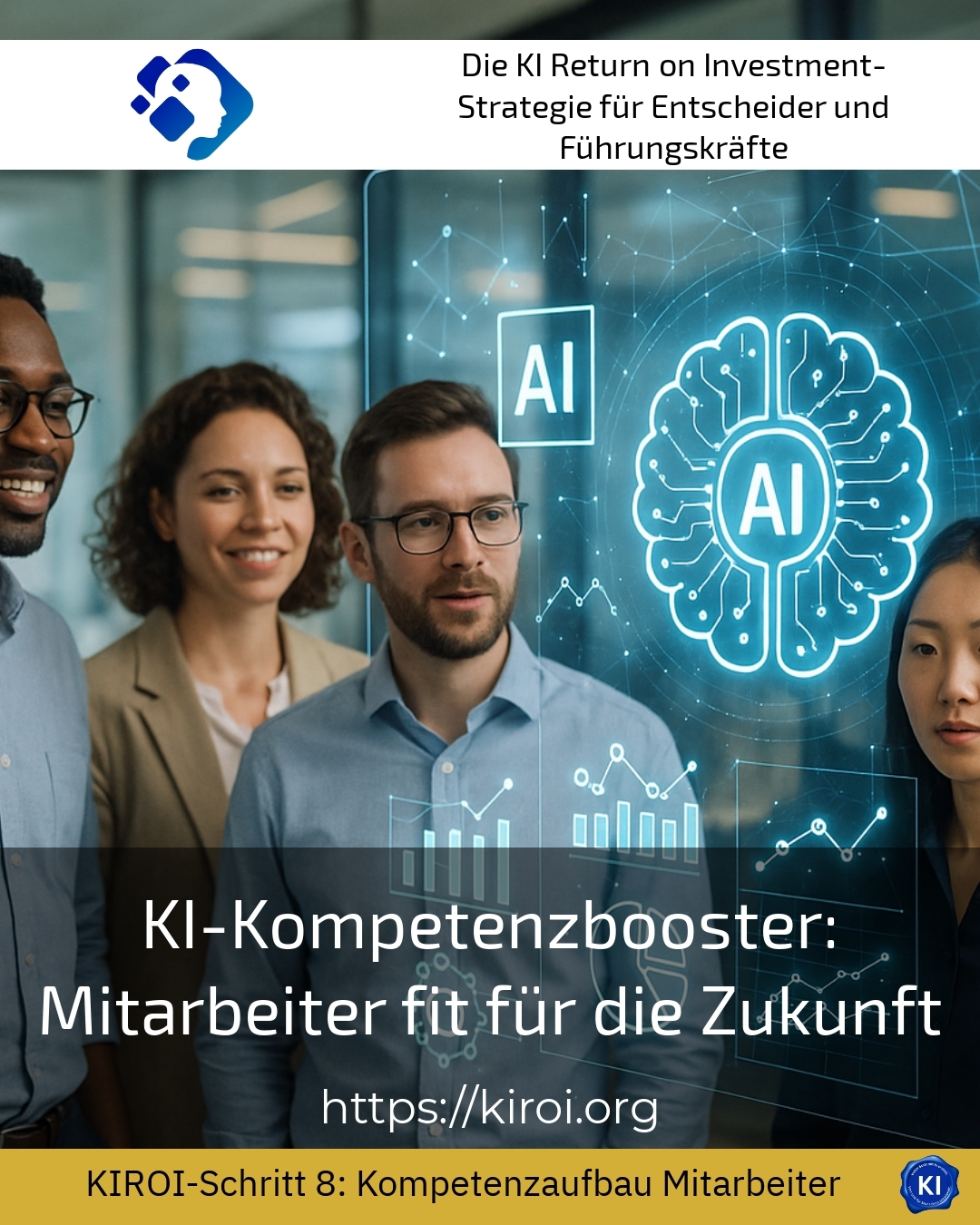
Imagine your workforce mastering complex digital challenges with playful ease. This thought electrifies leaders worldwide. The transformation of the world of work is progressing unstoppably. Those who today invest in AI Skills Booster investing, positioning their company at the forefront of change. Making employees fit for the future requires more than superficial training. It's about a profound realignment of the entire competence portfolio. Clients often report initial scepticism that quickly turns into enthusiasm. We observe this trend in almost all industries. The following explanations will show you tried-and-tested approaches.
Why the AI Skills Booster Has Become Indispensable
The digital revolution is transforming jobs at a breathtaking pace. Routine tasks are increasingly being automated and restructured. At the same time, entirely new fields of activity are emerging with unimagined possibilities. Companies face the challenge of developing their teams accordingly. In retail, for example, employees are using intelligent systems for inventory forecasting. Banks are relying on automated analysis tools for risk assessment of their portfolios. Manufacturing companies are implementing predictive maintenance systems in their facilities. These examples illustrate the breadth of application possibilities.
The need for further development affects all hierarchical levels equally. Case workers require different skills than managers in strategic positions. However, both groups must systematically expand their competencies. A structured approach helps organisations ensure no one is left behind. Logistics companies train their dispatchers in how to use algorithmic planning tools. Insurance companies enable their case workers to collaborate with intelligent assistance systems. Human resource service providers train their recruiters in the use of automated pre-selection processes.
The psychological dimension of competence development
Changes initially cause many people discomfort or even anxiety. This emotional component must not be underestimated. Successful transformation projects therefore always take into account the human side of change. Employees need security and guidance in turbulent times. In the healthcare sector, for example, nursing staff often greet new documentation systems with scepticism. Master craftsmen wonder if their decades of experience will still be valued. Administrative employees worry about the future of their traditional workplaces.
Transruptions-Coaching supports organisations precisely with these complex challenges. The focus is on appreciative support rather than pressure. Impulses for self-reflection help employees redefine their own roles. This gradually builds trust in their own abilities. Automotive suppliers experience initial resistance transform into constructive engagement. Energy providers observe increasing acceptance following careful introductory support. Media companies record growing eagerness for experimentation within their creative teams.
Best practice with a KIROI customer
A medium-sized engineering company with around four hundred employees approached us with a specific concern. The management had set ambitious digitalisation goals and introduced new systems. However, the workforce reacted with considerable reluctance to the innovations. Productivity figures declined, and staff turnover increased alarmingly. In close collaboration, we developed a bespoke support programme for all departments. First, we conducted in-depth discussions with employees at all levels. In doing so, we carefully identified both specific fears and hidden potential. Subsequently, we designed modular learning units that took different starting levels into account. The establishment of cross-departmental learning partnerships between experienced and younger colleagues proved particularly effective. Within eight months, the mood within the company had demonstrably and measurably improved. Usage rates of the new systems rose by an impressive sixty percent. Employees reported increased confidence in handling digital tools. The management particularly praised the sustainable embedding of the new skills.
Practical implementation of the AI competence booster in day-to-day business
Theoretical knowledge alone is not enough for genuine competence development. Employees must be able to apply what they have learned immediately. Practice-oriented training scenarios therefore form the heart of successful programmes [1]. In customer service, teams practise handling intelligent chatbot interfaces. Marketing departments experiment with automated text generation tools for their campaigns. Controlling teams learn to critically interpret and contextualise algorithmic forecasts.
Integration into existing workflows requires particular attention and tact. Nobody has time for additional training alongside daily business. This is why we recommend the concept of embedded learning [2]. New skills are taught and practised directly at the workplace. Sales representatives use intelligent analysis tools for their next customer conversations. Buyers apply forecasting algorithms to their current order planning. Project managers use automated planning aids in ongoing projects.
Individual learning paths for different target groups
Not all employees start with the same prerequisites. Some have already gained technical prior knowledge. Others are entering completely new territory when it comes to digital topics. A differentiated approach takes these differences into account from the outset. Younger employees in advertising agencies often have an intuitive affinity for technology. Experienced accountants have deep process knowledge that absolutely must be retained. Middle managers need strategic orientation rather than technical details.
Designing suitable learning paths begins with a careful assessment. What competencies already exist within the team? Where are the greatest development needs hidden? What are the company's medium-term goals? Tailored development plans emerge from these answers. Logistics employees focus on route planning algorithms and warehouse management systems. HR administrators concentrate on automated applicant management solutions. Quality managers delve into predictive analytics for production processes.
Sustainable anchoring of new competencies within the company
One-off training events often fizzle out without long-term impact. What is learned is quickly forgotten. That is why we emphasise the importance of continuous learning support. Regular refreshers and deeper dives ensure lasting learning success. In the banking sector, monthly learning sessions on new analysis methods are becoming established. Industrial companies are setting up internal expert groups for knowledge exchange. Service companies maintain digital knowledge databases with practical application examples.
Leadership culture plays a crucial role in lasting success. Managers must lead by example and demonstrate a willingness to learn [3]. Those who show curiosity themselves will also inspire their teams. An atmosphere that tolerates mistakes encourages experimentation. Pharmaceutical companies report increased innovation after corresponding cultural changes. Retail companies are seeing teams independently discover new applications. Telecommunications providers are experiencing increased employee satisfaction through encouraging leadership behaviour.
Best practice with a KIROI customer
A financial services provider with multiple branches sought support for a comprehensive transformation initiative. The company aimed to introduce intelligent systems in client advisory services, enabling consultants to integrate algorithm-based recommendations into their conversations. Initially, there was considerable uncertainty among experienced consultants, with many fearing replacement or devaluation by machines. We developed a support programme that took these concerns seriously and addressed them. In workshops, participants devised application scenarios for their daily work, recognising that the new tools would complement, rather than replace, their expertise. The introduction of an internal mentor programme with volunteers proved particularly effective, with technically adept colleagues directly supporting others on-site with specific application queries. The consultants gradually developed trust in the new possibilities. After one year, over eighty percent reported improved quality of advice thanks to the support systems. Customer satisfaction increased measurably, and consultants gained time for in-depth discussions.
The AI Competence Booster as a Strategic Investment
Skills development costs time, money, and organisational attention. However, the investment pays off multiple times over. Well-qualified employees work more efficiently and are more satisfied. They remain loyal to the company for longer and recommend it to others. Chemical companies reduce error rates through better-trained operating personnel on complex plants. Municipal utilities optimise their network control with competent analysts on site. Travel companies increase their revenue through data-driven offer optimisation in sales.
However, calculating the concrete benefit requires realistic expectations. Not all improvements can be immediately measured in euros. Some advantages only become apparent in the medium term through soft factors. Nevertheless, many companies report significant efficiency gains within a few months. Freight forwarders significantly accelerate their order processing with trained dispatchers. Hospitals improve their documentation quality with digitally competent nursing staff. Law firms increase their research performance with further trained specialist staff.
Typical topics that organisations bring to us
The range of concerns is broad and varied. Often, it's about uncertainty in prioritising training measures. Managers wonder which skills are truly relevant for the future. HR departments are looking for effective methods to identify needs within the company. IT managers seek support in teaching technical fundamentals.
Change management topics also play an important role in many queries. How do you take sceptical employees along on the journey? Which communication strategy also convinces critics? How do you prevent overburdening teams that are already stretched thin? These questions occupy decision-makers in mechanical engineering companies just as much as in insurance companies. Municipal utilities face similar challenges to international corporations. Transruption coaching provides impulses for individual solutions in a wide variety of contexts.
My KIROI Analysis
Engaging with future-oriented competence development reveals multifaceted connections. Technical training alone falls short because it neglects the human dimension. Successful transformations combine professional qualification with empathetic change management. This insight is repeatedly confirmed in numerous projects across a wide range of industries.
The role of leaders in the entire process seems particularly significant to me. They decisively shape the learning culture through their own behaviour. Those who exemplify curiosity and openness create fertile ground for development. Conversely, those who demand perfection from the outset stifle the willingness to learn in its infancy. We observe this dynamic across sectors with remarkable regularity.
The investment in the AI Skills Booster proves to be a strategic necessity for competitive organisations. Acting today secures advantages for the coming years. This is not about perfect solutions, but about continuous improvement. Every step towards building competence strengthens the resilience of the entire company in the long term.
My recommendation is therefore: Begin with an honest assessment promptly. Identify key competencies for your specific situation. Then, develop a realistic roadmap with manageable stages. Seek external support if needed for this important journey.
Further links from the text above:
[1] McKinsey: Effective Learning Strategies
[2] Harvard Business Review: Learning and Development
[3] Gartner: Learning and Development Insights
For more information and if you have any questions, please contact Contact us or read more blog posts on the topic Artificial intelligence here.






 Deutsch
  English (UK)