
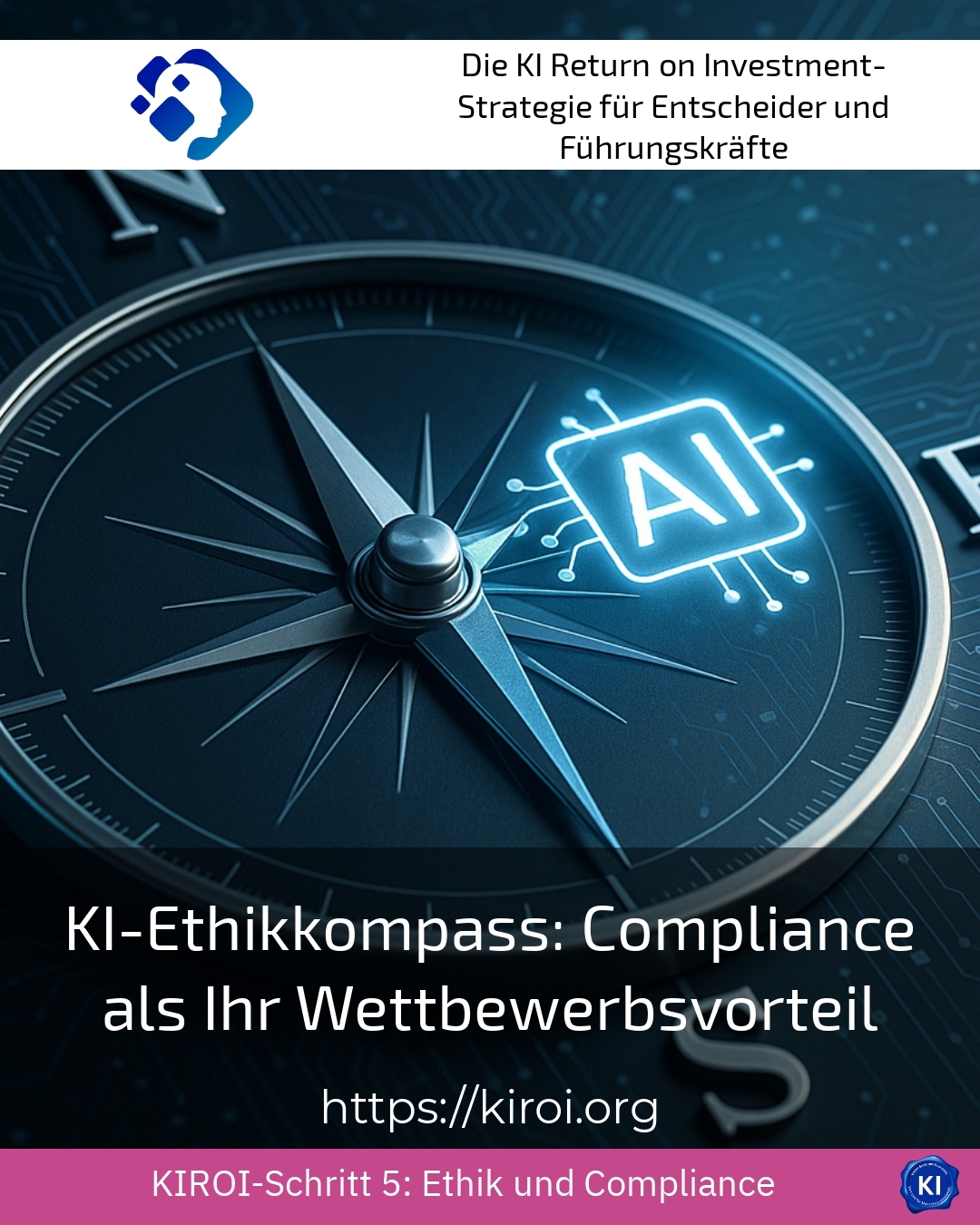
Imagine your company is suddenly at the centre of a public debate because an algorithmic system has made questionable decisions that have angered customers and attracted the attention of regulators. This is a scenario currently being experienced by numerous organisations who are using the AI Ethics Compass: Compliance as your Competitive Advantage We have underestimated. The good news, however, is that forward-thinking companies can turn this challenge into a real opportunity. Those who establish ethical guardrails early on not only gain the trust of their stakeholders but also secure a measurable advantage over the competition.
Why ethical principles become a strategic success factor
The days when technological innovation alone determined market success are a thing of the past. Today, customers, business partners, and regulatory authorities expect transparent and comprehensible decision-making processes. For example, a financial service provider that makes automated lending decisions must be able to explain why certain applications are rejected. Likewise, an insurance company is obliged to disclose its risk assessment models and rule out discrimination. In the healthcare sector, patients in turn expect diagnostic systems to comply with medical ethics standards and protect privacy [1].
This development means businesses must fundamentally realign their way of thinking. Investing in robust ethical frameworks pays off in the long run. Organisations that act proactively avoid costly rectifications and reputational damage. Instead, they build a foundation of trust that strengthens customer loyalty and opens up new business opportunities. The AI Ethics Compass: Compliance as your Competitive Advantage becomes an integral part of the company strategy.
Understanding and utilising regulatory requirements
European legislation sets global benchmarks for the responsible use of intelligent systems [2]. While this regulation is often perceived as a burden, it also presents enormous opportunities. Companies that establish compliant structures early on position themselves as reliable partners. For example, a medium-sized mechanical engineering firm that ethically aligns its production control gains international contracts. In turn, automotive suppliers who implement transparent quality control systems meet the requirements of large manufacturers. Finally, logistics companies that ensure fair route optimisation avoid labour law conflicts.
Compliance with regulatory requirements initially requires a thorough stocktake. Which systems make automated decisions? How are these decisions documented? Who is responsible for errors? These questions must be answered systematically. transruptions-Coaching supports organisations in creating clarity and developing practical solutions.
The AI Ethics Compass: Compliance as your competitive advantage in practice
Theoretical concepts only realise their full potential when they are anchored in daily business practice. Concrete recommendations for action play a central role in this. For example, a retail company implements ethical guidelines for its recommendation system, thereby measurably increasing customer satisfaction. A bank develops transparent algorithms for wealth management and gains the trust of affluent private investors. A telecommunications provider designs its customer service fairly and reduces complaints by a third.
Best practice with a AIROI customer
An internationally operating company in the professional services sector approached us with a complex challenge. Over the years, the company had implemented various automated systems influencing personnel decisions, project allocations, and performance reviews. However, an overarching ethical strategy was lacking, leading to an increasing number of complaints from employees who felt they were being treated unfairly. As part of our collaboration, we first analysed all relevant processes and identified critical decision points. It emerged that certain historical data led to biases that systematically disadvantaged specific employee groups. Together, we developed a comprehensive action plan that included transparent evaluation criteria, regular audits, and clear complaint mechanisms. The implementation was carried out step-by-step over several months, during which we provided intensive support and training to management. The results significantly exceeded expectations, as employee satisfaction rose considerably and the company won several employer awards. Furthermore, those responsible reported that the new structures also improved the overall quality of decisions. This example impressively demonstrates how ethical principles can not only minimise risks but also promote operational excellence.
Implementation strategies for sustainable compliance
The successful implementation of ethical guidelines requires a structured approach that involves all levels of an organisation. Firstly, it is advisable to form an interdisciplinary team that combines technical, legal, and ethical expertise. For example, a pharmaceutical company establishes an ethics committee to evaluate and approve new research projects. An energy provider, in turn, implements control mechanisms for its smart grid systems to ensure fair pricing. Finally, a media group develops guidelines for its recommendation algorithms that promote diversity of opinion rather than restricting it [3].
Particular attention should be paid to the training of all parties involved. Technical staff must understand the ethical implications of their work. Managers need tools to incorporate ethical aspects into business decisions. And customer advisors should be able to competently answer questions about automated processes. This holistic approach guarantees sustainable results and prevents compliance from becoming a mere formality.
Risk mitigation through proactive action
Many companies underestimate the risks associated with inadequately regulated systems. The spectrum ranges from reputational damage and legal consequences to massive financial losses. For example, a transport company that tolerates discriminatory route planning risks class-action lawsuits and public criticism. In turn, a personnel consultancy that uses biased selection processes loses valuable clients and talent. Finally, a property developer who uses non-transparent pricing models attracts the attention of competition authorities.
The costs of preventive measures are not proportional to the potential damage. Companies that invest early often report positive side effects. They discover inefficient processes, improve their data quality, and strengthen their corporate culture. AI Ethics Compass: Compliance as your Competitive Advantage unfolds an effect that goes far beyond mere risk minimisation.
Best practice with a AIROI customer
A retail company with several hundred branches approached us with an urgent request after internal audits revealed irregularities in their automated workforce planning. For a considerable period, the system had systematically disadvantaged certain groups of employees when allocating desirable shifts, something that had initially gone unnoticed. Management feared not only legal repercussions but also a significant loss of trust among the workforce. As part of our support, we initially conducted a comprehensive analysis, examining and documenting all relevant decision parameters. In doing so, we identified several problematic variables based on historical data that reproduced unconscious biases. Together with the IT department and HR, we developed alternative algorithms explicitly focused on fairness. Additionally, we established continuous monitoring to detect and report deviations early on. Transparent communication with employees proved crucial for the acceptance of the new solution. Following the project's completion, the company reported a significantly improved working atmosphere and reduced staff turnover. This case highlights the importance of regular reviews and an open culture of error for long-term success.
Competitive advantages through trust-building
In an age of increasing scepticism towards technological systems, trust becomes the most valuable resource. Companies that credibly uphold ethical principles successfully differentiate themselves from competitors. For example, an insurance company that guarantees fair claims assessment wins loyal customers even in difficult times. In turn, an education provider that offers transparent learning success analyses convinces parents and institutions. Finally, a food manufacturer that implements traceable quality controls builds a strong brand [4].
This dividend of trust manifests itself in concrete business results. Clients frequently report increased conversion rates, reduced customer churn, and improved price enforcement. The investment in ethical infrastructure therefore often pays for itself faster than expected. Transruptions coaching supports companies in quantifying these effects and continuously optimising their strategies.
Future prospects and strategic direction
The regulatory landscape is evolving dynamically, making continuous adaptation essential. Companies should therefore create flexible structures that can respond to new requirements. A technology company, for example, establishes regular reviews of its ethical guidelines and proactively adapts them. A financial services provider, in turn, invests in the training of internal experts who monitor and evaluate current developments. Finally, an industrial company actively participates in standardisation bodies to help shape future regulation.
The AI Ethics Compass: Compliance as your Competitive Advantage thus proving itself as a long-term investment in future viability. Companies that set the right course today will benefit from their foresight tomorrow. Integrating ethical principles into corporate strategy is no longer an optional extra, but a business necessity.
My AIROI Analysis
After intensive examination of numerous companies from a wide range of industries, clear success patterns are emerging. Organisations that understand ethical compliance as a strategic advantage sustainably outperform their competitors in several dimensions. They build more resilient business models, attract more qualified employees, and establish more robust customer relationships. Particularly noteworthy is that the initial investments are typically recouped within two to three years through avoided risks and increased returns.
Experience shows that the greatest challenges lie not in technical implementation, but in cultural transformation. Leaders must embody ethical principles and consistently demand them. Employees need clear guidance and practical tools for their daily work. And the entire organisation must learn to deal with uncertainty constructively. These change processes require time, patience, and professional support.
At the same time, I'm observing that companies that consistently pursue this path develop remarkable momentum. Ethical reflection becomes an intrinsic part of the innovation culture. Employees proactively contribute suggestions for improvement. And customers become true brand ambassadors. These positive feedback loops continuously reinforce the original competitive advantage.
Further links from the text above:
[1] European Commission – Artificial Intelligence
[2] EU Regulatory Framework for AI
[3] AlgorithmWatch – Monitoring Automated Decision-Making Systems
[4] Federal Ministry for Economic Affairs – AI Strategy
For more information and if you have any questions, please contact Contact us or read more blog posts on the topic Artificial intelligence here.










 Deutsch
  English (UK)