
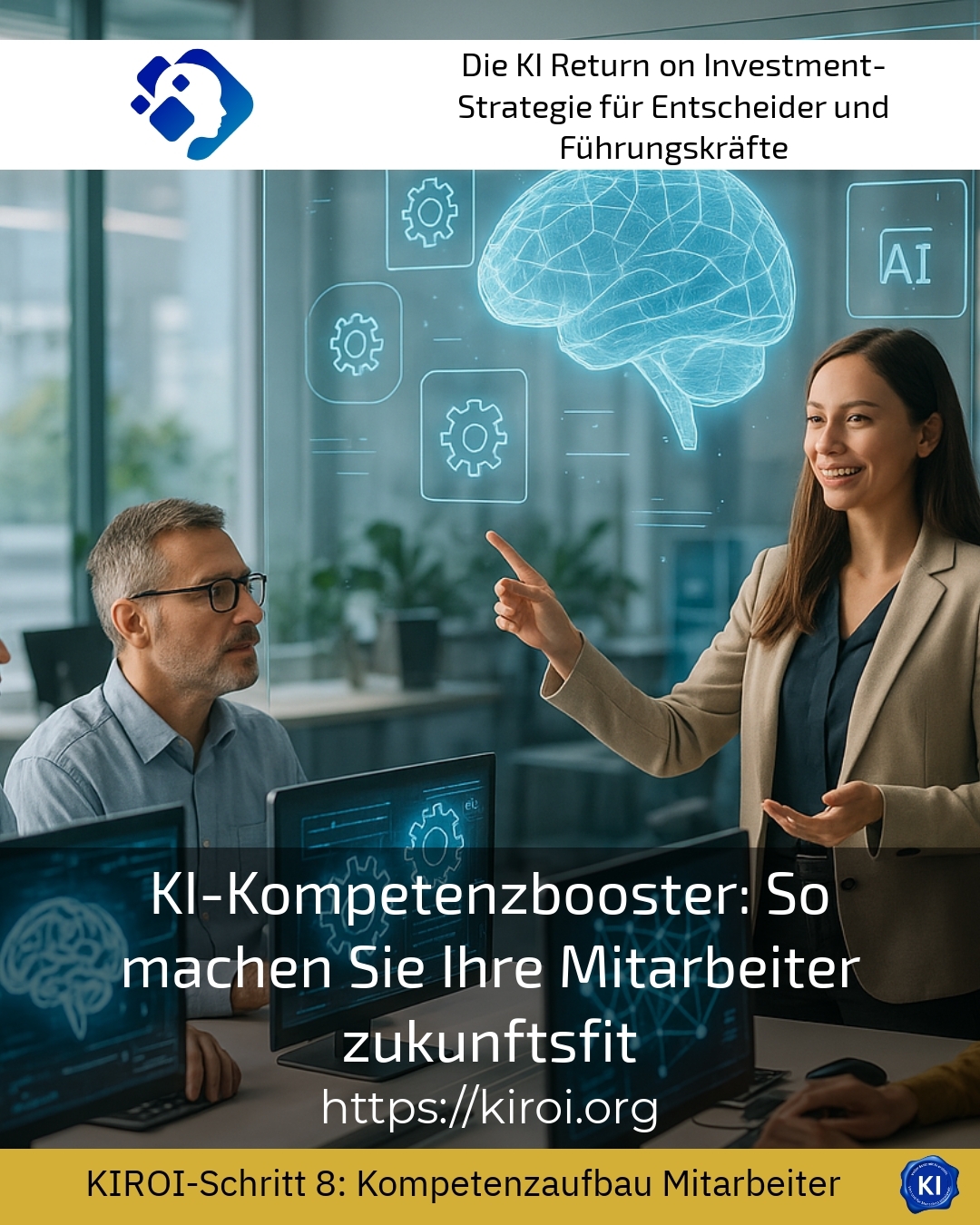
Digital transformation is fundamentally and sustainably changing our working world. Companies face a central challenge. They must empower their teams to work productively with intelligent systems. AI Skills Booster can help prepare employees systematically for the demands of tomorrow. But how can this change be achieved in practice? What skills will be indispensable in the future? And why do many qualification initiatives fail already in the planning phase? These questions occupy executives, HR managers, and senior management alike. In this article, you will learn how to develop your workforce in a targeted manner. You will learn proven strategies that work in practice. I will guide you through the most important aspects of this transformation.
Why the AI skills booster is essential today
The pace of technological change is overwhelming many organisations. Traditional further training concepts are no longer sufficient. Employees need new skills to work effectively with intelligent tools. A study by the World Economic Forum highlights interesting developments [1]. By the end of the decade, more than half of all jobs will fundamentally change. This transformation affects all industries and hierarchy levels equally.
We are seeing dramatic changes, particularly in the financial sector. Algorithms are taking over routine analyses and risk assessments in a matter of seconds. Customer advisors therefore need to redefine and understand their roles. They are becoming strategic consultants who can explain complex interrelationships. In the healthcare sector, intelligent systems are already significantly supporting diagnostics. Doctors and nurses are learning to use these tools effectively. The manufacturing industry is also transforming rapidly through predictive maintenance. Technicians require completely new analytical skills for their daily work.
The challenge lies not just in the technology itself. Rather, it's about people's willingness to change. Clients often report resistance within their teams. This resistance often arises from uncertainty and a lack of understanding. A structured approach can offer valuable support here. transruptions-Coaching assists companies specifically with these transformation projects. We provide impulses and develop tailored qualification concepts together.
The five pillars of sustainable competence development
A sustainable qualification strategy is built on several cornerstones. These pillars form the foundation for successful transformation projects. They enable employees to be developed systematically and holistically.
Technical understanding as the basis for the AI skills booster
Employees do not need to become programmers. A basic understanding of how intelligent systems work is sufficient. They should understand how algorithms can make decisions. This knowledge builds trust and significantly reduces unfounded fears. In retail, for example, buyers use demand forecasts for their orders. They need to understand which data can influence these forecasts. Only then can they critically assess the results.
A logistics company introduced intelligent route planning for its drivers. Initially, many drivers consistently ignored the system's suggestions. They trusted their own experience more than the technology. After training on the technical background, this behaviour changed. The drivers now understood which factors the system takes into account. They also realised when human judgement was still required.
Strengthening critical thinking and outcome evaluation
Intelligent systems provide a large volume of suggestions and analyses. People must be able to evaluate and categorise these results. Critical thinking is therefore becoming the core competency of the future. In legal departments, systems already significantly support contract analysis. However, legal professionals must still be able to independently assess legal risks. They must not blindly rely on automated recommendations.
An insurance company deployed automated claims processing for standard cases. Claims handlers were only supposed to review and process exceptions. However, problems arose due to a lack of training in critically evaluating outcomes. Employees uncritically accepted questionable decisions made by the system. Following targeted training, quality control improved significantly. The workforce learned when scepticism was appropriate and important.
Best practice with a AIROI customer
A medium-sized mechanical engineering company faced a significant challenge. The service department needed to utilise intelligent diagnostic tools for remote maintenance. Initially, the experienced technicians were extremely sceptical of the technology. They had decades of experience and relied heavily on their own judgment. As part of a transruption coaching project, we developed a multi-stage training programme together. First, we systematically analysed existing competencies and identified specific gaps. Then, we designed workshops where technicians could explore the system's limitations themselves. These hands-on experiences reduced reservations and created a genuine understanding of the technology. The technicians realised that the system complemented their expertise, rather than replacing it. After six months, the utilisation rate of the diagnostic tools increased to over eighty percent. The first-time fix rate for service calls improved significantly by more than thirty percent. The employees' realisation of this was particularly valuable. They now understood how to combine their experience with technological support. The company was thus able to offer its customers faster and better service. Employee satisfaction also increased, as frustration from unsolvable problems significantly decreased.
Optimise human-machine communication
The quality of the results is heavily dependent on the input. Employees must learn to formulate and make precise requests. This ability is often referred to as prompt engineering. In marketing, creative teams regularly use systems for initial drafts. Those who can formulate good briefs will receive better starting points for their work. This competence saves time and increases the quality of the results.
Customer service representatives work with intelligent assistant systems daily. They need to understand how to retrieve relevant information efficiently. Clear communication with the system significantly speeds up problem-solving. In human resources, tools already support the pre-selection of applications. Recruiters learn how to formulate their search criteria optimally. This way, they receive more suitable candidate suggestions for open positions.
Practical implementation in daily business operations
Theoretical knowledge alone is not enough for sustainable change. Employees must be able to apply new skills in their daily work. Therefore, successful programmes integrate learning phases directly into the work process. A pharmaceutical company introduced weekly experimentation times for teams. During these phases, employees consciously tested new tools without performance pressure. This psychological safety significantly fostered creativity and willingness to learn.
Banks are increasingly establishing internal communities of practice for knowledge sharing. Employees regularly share their experiences with various applications there. This peer-learning approach significantly accelerates knowledge transfer within the company. An energy provider successfully used gamification elements for its training program. Employees earned points for completed learning modules and practical applications. This playful component increased the participation rate by more than forty percent.
transruptions-Coaching competently supports organisations in the conceptualisation of such programmes. We analyse existing structures and develop tailor-made solutions together. In doing so, we individually consider the specific requirements of each industry. Clients often openly report initial overwhelm with transformation projects. External support can provide orientation and structure here.
The AI Capability Booster for Leaders
Leaders play a crucial role in transformation. They must act as role models and actively support change. Without commitment from leadership, many initiatives fail early on. A retail company experienced exactly this problem very clearly. Middle management blocked changes for fear of losing control. Only after targeted leadership development did the dynamic change.
Leaders require specific competencies for today's new world of work. They must understand how to lead teams in hybrid working environments. Collaboration between people and systems demands new leadership approaches. In the automotive sector, entire departments are rapidly transforming due to new technologies. Production managers need to learn to redefine their role as enablers. They are becoming coaches who support their teams in adapting.
Best practice with a AIROI customer
An international logistics service provider wanted to optimise its dispatching with intelligent systems. The project was at risk of failing because the team leaders were not involved. They felt overlooked and did not openly communicate their concerns upwards. As part of our support, we first held confidential discussions with all parties involved. In doing so, we accurately identified the real causes of resistance within the team. The managers feared a loss of importance for their own roles in the company. Together, we developed a new understanding of roles for the on-site team leaders. They became quality managers who could monitor and optimise system decisions. This new responsibility significantly enhanced their position instead of devaluing it. Additionally, they regularly received training on interpreting system data and key performance indicators. After the realignment, the managers actively and enthusiastically supported the project. The implementation then proceeded much more smoothly than originally planned. The client reported a 25 per cent increase in productivity after one year. Even more important, however, was the increased employee satisfaction in the affected teams.
Typical obstacles and how to overcome them
Many organisations regularly face similar challenges with upskilling projects. A lack of time and resources is often at the top of the list of problems. Employees often find no time for further training alongside their day-to-day business. One possible solution is to integrate learning directly into the workday. Microlearning formats enable short learning units of just a few minutes daily. These bite-sized pieces are easier to fit into the daily routine.
Another hurdle is often the lack of relevance of learning content. Standard programmes do not address the specific work realities of participants. In the construction industry, project managers use different tools than in retail. Tailored content significantly increases motivation and practical application. Employees immediately recognise the direct benefit for their daily work.
Clients also frequently report technical hurdles during implementations. Outdated IT infrastructure sometimes hinders the use of modern learning platforms. Cloud-based solutions can offer a remedy and provide flexibility here. A media company successfully solved this problem with mobile learning formats. Employees could use content on their private devices as desired. Acceptance increased significantly as a result, and learning times were extended.
Long-term strategy for sustainable competence development
One-off training sessions are not enough for sustainable change today. Organisations require a continuous learning culture for long-term success. This culture must always be actively promoted by management. A technology company established quarterly skills reviews for all employees regularly. These assessments identify development needs early and systematically every time. Individual learning paths are then adapted and updated continuously.
Linking skills development with career paths further motivates employees. In the consulting industry, new skills are increasingly being integrated into promotion criteria. Those who develop further are concretely given better opportunities for advancement within the company. This connection creates incentives for employees to engage in self-directed learning. A financial services provider introduced a badge system for acquired competencies. These digital certificates are visible and recognised on the internal network.
transruptions-Coaching competently supports organisations in building such sustainable structures. We provide not only project-specific support, but also long-term strategic development. In doing so, we provide impetus and practical on-site assistance with implementation.
My AIROI Analysis
Equipping employees to work with intelligent systems is no longer an option. It is a strategic necessity for any forward-thinking company today. My analysis shows that successful transformations are based on several clear factors. Firstly, there needs to be a genuine commitment from leadership to change. Without this support, even the best training initiatives quickly falter. Secondly, skills development must always be closely linked to the reality of work.
Employees learn best when they can immediately see the practical benefit. Thirdly, sustainable change always requires a long-term perspective and patience. One-off training sessions do not create lasting, genuine transformation in companies. Instead, a learning culture is needed that enables and promotes continuous development. The AIROI methodology offers a structured framework for organisations in this regard.
From my consulting practice, I know that many companies underestimate the effort involved. The technical implementation is often the easier part of the transformation. The human side, i.e. fears, resistance, and habits, requires more attention. Professional support can make a significant difference for organisations in this regard. transruptions-coaching specialises in this exact interface between technology and people. We understand both sides and can mediate between different perspectives.
The AI Skills Booster is not a panacea for all business challenges. It is an important building block in a comprehensive transformation strategy for organisations. Companies that invest in the development of their employees today create long-term competitive advantages. They become more flexible, innovative, and attractive to talent in the labour market. The question is no longer whether organisations should act or not. The only question remaining is how quickly and consistently they will do so.
Further links from the text above:
[1] World Economic Forum – The Future of Jobs Report
For more information and if you have any questions, please contact Contact us or read more blog posts on the topic Artificial intelligence here.








 Deutsch
  English (UK)