
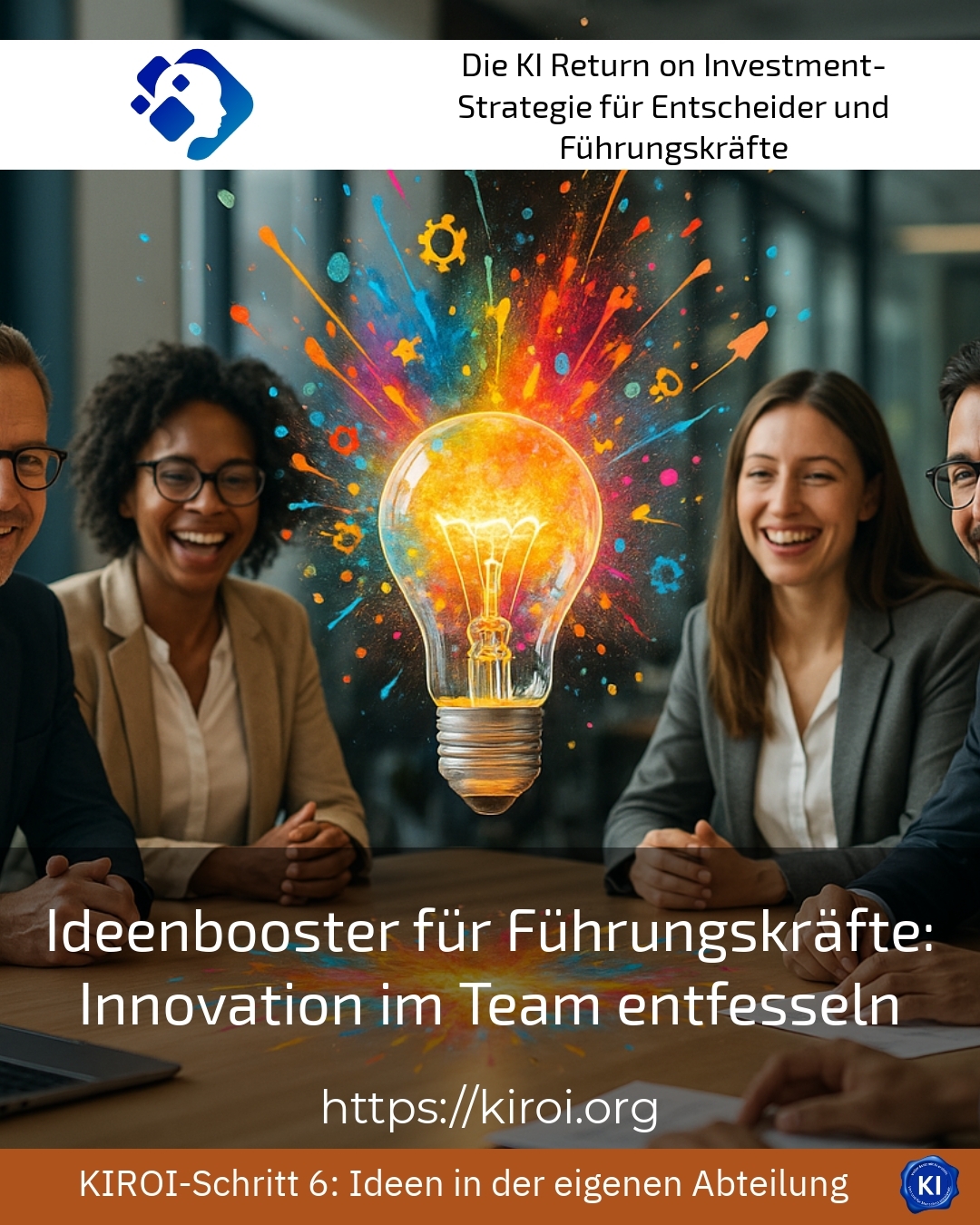
Imagine your team suddenly develops solutions that could revolutionise your entire industry. That's exactly what happens when leaders use the right methods. The right Innovation Booster for Leaders: Unleashing Team Innovation can unleash hidden potential. Many managers report that their best ideas go unused. Others, however, manage to channel creative energy in a targeted way. The difference is not due to chance, but to conscious decisions. This article shows you tried-and-tested methods and concrete impulses for your day-to-day leadership.
Why creative impulses are indispensable in the modern world of work
The world of work is changing rapidly, presenting leaders with new challenges. Those who still rely on proven processes today risk falling behind tomorrow. Creative impulses form the foundation for sustainable business success. In the automotive sector, for instance, manufacturers had to rethink their entire product range. Electric drives required completely different competencies than the classic internal combustion engine. Managers at BMW or Mercedes often reported initial resistance within their teams [1]. It was only when they systematically created space for new ways of thinking that the transformation succeeded. Similar developments are visible in retail, where brick-and-mortar stores are merging with digital concepts. Douglas transformed its business model through consistent employee involvement. The pharmaceutical company Bayer, in turn, established internal innovation labs for research teams. These examples highlight a crucial point. Creativity does not arise on its own, but requires active promotion by management.
The idea booster for leaders as a catalyst for team dynamics
An effective Innovation Booster for Leaders: Unleashing Team Innovation It starts with the right mindset. Leaders must first question and open up their own thought patterns. Transruption coaching guides precisely these transformation processes in companies across a variety of industries. Clients often report stuck structures in their departments. Lufthansa, for example, had to redefine its entire service culture after the pandemic. Leaders relied on intensive workshops with cabin and ground crew. The result was innovative service concepts that came directly from practical experience. In the banking sector, ING underwent a similar change. Traditional hierarchies gave way to agile working methods with greater personal responsibility. Commerzbank, in turn, implemented so-called innovation hubs in various cities. This spatial and cultural change unleashed enormous creative energy.
Best practice with a KIROI customer
A medium-sized mechanical engineering firm from southern Germany came to us with a classic problem. The development department was doing solid work, but genuine breakthroughs were lacking. Management reported a certain fatigue among the engineers. Together, we first analysed the existing meeting structures and communication channels. It emerged that creative suggestions regularly got bogged down in committees. We supported the company in introducing a new idea management system. From then on, employees gained direct access to management for promising concepts. Additionally, we established monthly innovation days free from day-to-day business and time pressure. After six months, the company reported three patent applications from this initiative. Employee satisfaction in development measurably increased by eighteen percent. This example impressively shows how targeted support can activate hidden potential.
Psychological safety as a foundation for creative development
Without psychological safety, every approach to innovation remains a dead letter. Employees must be allowed to make mistakes without fearing consequences. In its Project Aristotle, Google investigated the success factors of high-performing teams [2]. The result was clear and surprising at the same time. It was not the technical brilliance of individual members that determined team success. Rather, the perceived safety to speak up was the decisive factor. The technology giant SAP adopted these findings and fundamentally changed its feedback culture. Henceforth, mistakes were understood as learning opportunities and discussed openly within the team. Siemens implemented similar approaches in its research and development departments. Bosch, in turn, introduced regular retrospectives that involved all hierarchical levels. These cultural changes require time and consistent leadership from above.
Methods and Tools: How to Unleash Innovation in Your Team
Concrete methods support leaders in systematically promoting creative processes. Design Thinking, for example, has established itself as an effective approach in many companies. Deutsche Telekom extensively uses this method for the development of new customer solutions. The user is consistently at the centre of all considerations. BASF, in turn, relies on Open Innovation and actively involves external partners. Startup collaborations bring fresh perspectives into established corporate structures. The insurance group Allianz founded its own venture units for disruptive business models. These deliberately work independently of the core business and its constraints. Another proven approach is the brainwriting session method. Here, team members write down ideas before they are discussed. This prevents dominant personalities from taking over the creative process.
Idea booster for leaders through spatial design
The physical working environment influences creative processes more than many people assume. Adidas deliberately designed its corporate headquarters in Herzogenaurach as a creative space. Open areas alternate with quiet zones for focused work. Furniture manufacturer Vitra is itself experimenting with innovative office concepts. Movable walls and flexible furnishings allow for rapid adaptation to different work modes. Deutsche Bahn has also established an Innovation Hub in Berlin. Here, employees from various departments meet in an inspiring environment. This deliberate mix significantly promotes interdisciplinary exchange. Henkel, in turn, has set up its own Innovation Space in Düsseldorf. Start-ups and corporate employees work together there on forward-looking projects.
Best practice with a KIROI customer
A major energy provider approached us regarding transruption coaching with a specific challenge. The energy transition required entirely new business models and ways of thinking within the company. Managers felt overwhelmed by the speed of the necessary change. We initially supported the senior management through intensive one-on-one discussions. Together, we identified the biggest impediments to creative processes. It became clear that a highly regulated industry presents particular hurdles to innovation. We jointly developed a phased plan for cultural transformation. Managers learned to create scope for manoeuvre without jeopardising necessary compliance. We established so-called "sandbox" areas for experimental projects within the company. These areas operate with relaxed rules while being closely monitored by risk management. After one year, the company had successfully developed several new business areas. Employees reported a noticeable change in the overall company culture.
The role of digital tools in idea generation
Digital platforms can effectively support and accelerate creative processes. Innovation Booster for Leaders: Unleashing Team Innovation benefits from modern collaboration tools [3]. Miro or Conceptboard enable virtual whiteboard sessions across different locations. Continental is using such tools for the global collaboration of its development teams. Engineers in Germany, China, and the USA work synchronously on joint projects. Volkswagen has implemented its own idea platform for all employees worldwide. There, suggestions can be submitted, evaluated, and further developed. The best ideas receive budgets for initial prototypes and tests. Evonik, in turn, relies on artificial intelligence for idea evaluation. Algorithms identify promising concepts and accelerate the selection process. However, this technological support never replaces the human factor.
Overcoming resistance and dissolving forces of inertia
Every change provokes resistance, and that is entirely normal. Leaders must understand these forces of inertia and deal with them constructively. ThyssenKrupp experienced massive resistance from its workforce during its transformation. Long-serving employees feared for their positions and status. Management responded with intensive communication and the involvement of those affected. The retail group Metro had similar experiences during its realignment. External coaches helped here in supporting particularly affected leaders. RWE also relied on professional change support for its corporate restructuring. This investment in people paid off through reduced friction. Resistance can even provide valuable clues to overlooked risks. Therefore, wise leaders listen carefully instead of stifling criticism.
Ensuring the sustainability of creative processes
A one-off workshop is not enough for lasting innovative strength. Managers must integrate creative processes firmly into their daily work. Daimler established regular innovation rituals in its production facilities. Weekly short formats complement larger quarterly events. The chemical company Covestro has firmly anchored creative time in its researchers' employment contracts. Twenty percent of working time can be used for their own projects. Infineon, in turn, introduced a reward system for implemented suggestions for improvement. This recognition motivates employees to participate actively in the long term. Innovation Booster for Leaders: Unleashing Team Innovation requires structural anchoring. Only then can a culture be created that understands creativity as an integral part of work.
My KIROI Analysis
Looking at numerous companies and leadership situations reveals recurring patterns and success factors. Creative potential lies dormant in almost every team but is often not activated. The reasons for this are varied and range from structural obstacles to cultural blockages. Leaders play a crucial, but often underestimated, role in this. Their behaviour significantly influences whether employees dare to voice unconventional ideas. The examples presented from the automotive, chemical, financial, and energy sectors clearly show one thing. Successful transformation is only possible with a holistic approach and consistent implementation. Individual measures fizzle out if they are not embedded in a coherent overall concept. The KIROI methodology supports precisely this systematic approach. It combines an analytical assessment with practice-proven interventions. Leaders do not receive ready-made recipes but individual support. This approach respects the specific characteristics of each company and its people. Experience shows that sustainable change requires time and patience. Quick successes are possible, but cultural transformation usually takes several years. Those who consistently pursue this path will be rewarded with committed teams and innovative solutions. The investment in creative processes pays off in the long term through competitive advantages. Leaders should therefore start laying the foundations for tomorrow today.
Further links from the text above:
[1] Harvard Business Review – Innovation Management
[2] Google Re:Work – Project Aristotle Insights on Team Effectiveness
[3] McKinsey – Psychological safety and leadership development
For more information and if you have any questions, please contact Contact us or read more blog posts on the topic Artificial intelligence here.











 Deutsch
  English (UK)