
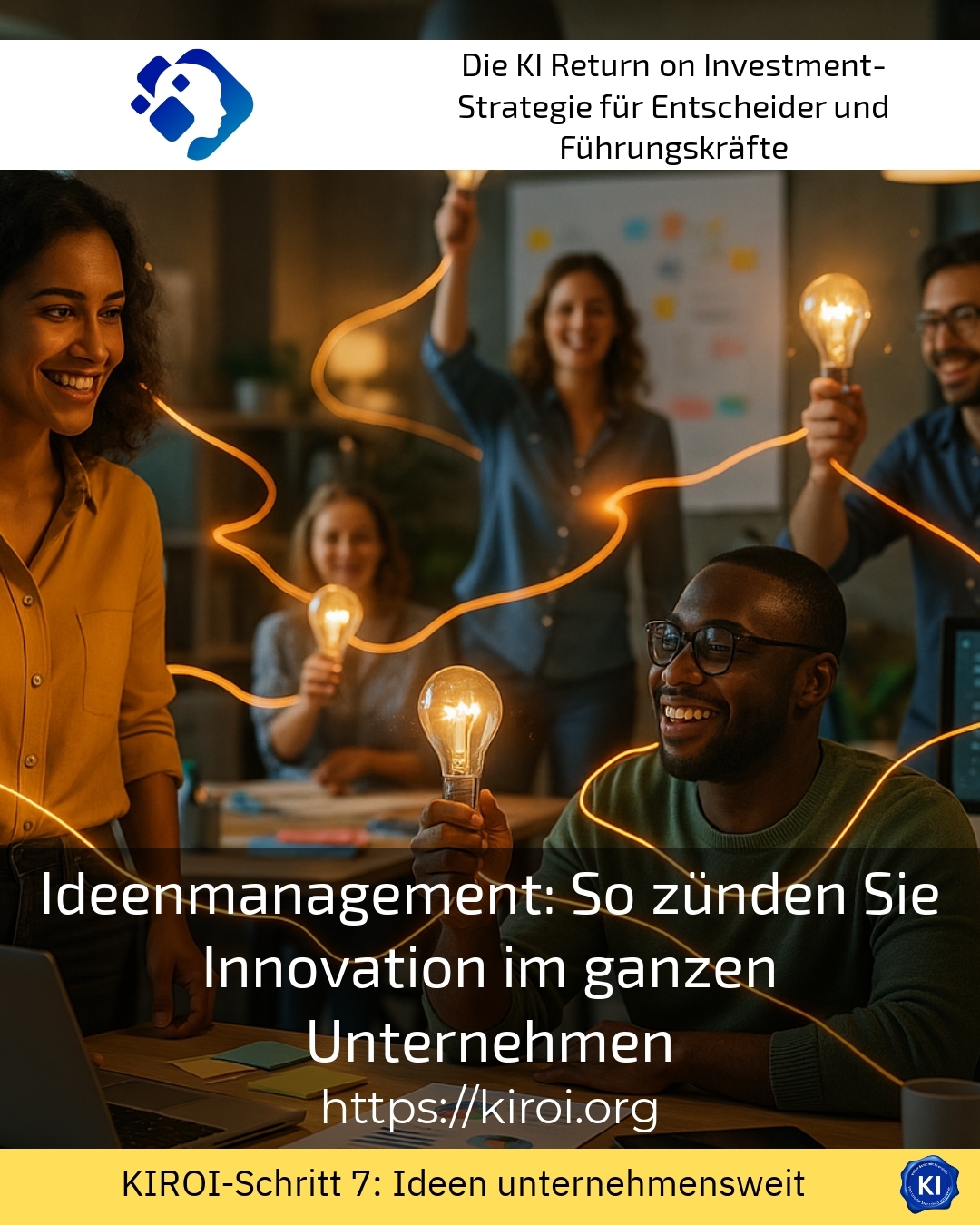
Imagine the next groundbreaking idea is already slumbering within your company. Just waiting to be discovered. Perhaps it's in the head of an employee in accounting. Maybe a technician in the workshop is currently developing the solution to a problem that no one has officially stated. Ideas management It forms the key to systematically unearthing these hidden treasures and leveraging them for sustainable growth. Because in an era of rapidly changing markets and digital transformation permeating all areas, the ability for continuous renewal determines the long-term success of any company. This article shows you how to unleash creative energy throughout your entire operation.
Why Structured Creativity Makes the Difference
Many organisations rely on sporadic flashes of inspiration from individual leaders. This approach squanders enormous potential. Structured approaches to idea generation, on the other hand, activate the collective knowledge of all employees. This creates a continuous stream of suggestions for improvement and innovations.
The power of systematic approaches is particularly evident in the automotive industry. A large supplier collects over ten thousand employee suggestions annually. Approximately thirty percent of these are actually implemented. The savings regularly amount to several million euros. Furthermore, employee motivation increases measurably because people feel taken seriously.
This approach is also gaining importance in healthcare. Hospitals are using digital platforms to capture ideas for improvement from nurses and doctors. Clients often report that small adjustments to workflows can have a big impact. For example, one university hospital reduced waiting times by forty percent thanks to a simple suggestion from the admissions department.
The retail sector also benefits from this methodology. Branch managers know their customers' needs best. A supermarket chain established regular workshops at the market level. This led to new service offerings and optimised shelving systems. Customer satisfaction increased by eighteen per cent within a year.
Establish idea management as a fundamental cultural attitude
Technical solutions alone are not enough. The full impact is only unleashed when creative thinking becomes a cultural given. Leaders play a crucial role in this. They must embody curiosity and encourage experimentation. Mistakes should not be punished, but understood as learning opportunities.
The technology sector demonstrates what such a culture can look like. Software companies often reserve a portion of working hours for pet projects. Employees are allowed to pursue their own questions and develop prototypes. Market-ready products and services regularly emerge from such experiments.
In mechanical engineering, traditional companies are increasingly embracing open innovation formats. A manufacturer of packaging machines invites customers to creative workshops. Together, new functionalities and business models are developed there. Furthermore, the close collaboration sustainably strengthens customer loyalty.
Financial service providers are also discovering the power of participatory approaches. One regional bank introduced a digital suggestion scheme, linking it with gamification elements. After six months, the participation rate stood at seventy per cent of all employees. Suggestions for simplifying internal processes were particularly valuable.
Best practice with a KIROI customer
A medium-sized logistics company was faced with the challenge of systematically increasing its innovative strength and at the same time reducing the high fluctuation rate among younger specialists. With the support of transruptions coaching, we jointly developed a multi-stage strategy to activate the entire company. First, we analysed the existing communication channels and identified barriers to the exchange of ideas for improvement. We then established a low-threshold digital system that enabled all employees to submit and comment on suggestions. Transparent feedback on every idea submitted within a week was particularly important. Managers received special training on how to deal with suggestions in an appreciative manner and provide constructive feedback. After nine months, the company had recorded over four hundred suggestions submitted by two hundred and fifty employees. Staff turnover fell by twenty-two per cent because younger employees in particular felt more involved. Three suggestions led to significant process optimisation in the warehouse area with measurable cost savings.
Using digital tools for systematic idea management
Modern software solutions support the entire process from capture to implementation. They enable transparent assessment procedures and automated notifications. Furthermore, they create visibility for successful projects and their creators. This motivates further participation and creates positive role models.
In manufacturing, specialised platforms are increasingly being used [1]. These combine classic suggestion schemes with agile methods for rapid implementation. A manufacturer of household appliances is successfully using such a system. Ideas are evaluated and prioritised there according to defined criteria. The best suggestions receive budget and resources for realisation.
Insurance companies rely on Artificial intelligence, in order to categorise incoming suggestions. Algorithms automatically recognise thematic clusters and identify duplicates. This saves time during review and significantly improves the quality of evaluation [2]. Furthermore, trends can be identified early and exploited strategically.
The pharmaceutical industry uses collaboration platforms for cross-site development projects. Researchers from various countries work together on new active ingredients and dosage forms. The structured exchange accelerates development cycles and reduces redundancies in research.
Embedding the successful implementation of idea management into everyday life
The introduction of new systems alone does not guarantee success. Sustainable integration into operational business is crucial. Regular communication about progress and successes keeps the topic present. Managers should explicitly ask for new ideas in team meetings. This signals genuine interest.
The energy industry faces enormous transformation challenges. A municipal utility company actively used this period of change to engage its workforce. All employees were invited to submit ideas for new business areas. This resulted in concepts for electromobility services and smart home offerings. The company successfully positioned itself as an innovation leader in its region.
In the education sector, higher education institutions are experimenting with participatory formats. Students and lecturers are jointly developing new teaching concepts and digital tools. A technical university established a campus-wide ideas competition with attractive prizes. Participation exceeded all expectations and generated valuable impetus for teaching development.
Tradespeople are also discovering the power of systematic approaches. An electrical firm with fifty employees introduced short weekly meetings for brainstorming. Within a year, this led to a new service offering and several process improvements. The firm increased its turnover by fifteen percent.
Overcoming resistance and winning over sceptics
Not all employees are open to change. Some fear additional work without any discernible benefit. Others have had negative experiences with previous initiatives. These concerns deserve to be taken seriously. Open communication and visible successes are often more convincing than appeals.
In the public sector, leaders often encounter structural resistance. A city administration overcame this through a pilot project in a particularly open-minded department. The positive results gradually convinced even sceptical colleagues [3]. Today, all departments actively participate in the suggestion scheme.
The construction industry is considered a rather conservative sector. One general contractor broke these patterns through consistent appreciation of employee ideas. Every implemented suggestion was publicly recognised and financially rewarded. The company culture noticeably shifted towards greater openness and a willingness to experiment.
In the hospitality industry, creative formats open up new avenues. One hotel chain regularly organises playful competitions between different establishments. Teams submit their best service ideas and mutually evaluate the suggestions. The best concepts are rolled out across the entire group and contribute to differentiation.
Best practice with a KIROI customer
A traditional family business in the food industry was looking for ways to strengthen its innovative capacity without jeopardising its established corporate culture. transruptions coaching supported the process over a period of eighteen months with regular workshops and individual coaching sessions for key personnel. Together, we developed a hybrid model that combined digital and analogue elements. Older employees preferred face-to-face dialogue in moderated sessions and felt safe there. Younger colleagues preferred to use the mobile app to submit spontaneous thoughts. Both channels were treated equally and systematically analysed. One particular success was the development of a new product line based on an employee suggestion. This line now generates twelve per cent of total sales and opens up new customer groups. The company also received a regional employer award for its participative corporate culture.
My KIROI Analysis
The systematic promotion of creativity and innovation is no longer an option, but a strategic necessity for any forward-looking company. My experience from numerous support projects clearly shows that success depends crucially on the combination of technical solutions and cultural transformation. Digital tools alone do not create an innovation-friendly organisation, but they can amplify and make visible existing dynamics.
Clients particularly often report initial doubts as to whether their workforce is even interested in active participation. This concern almost always proves to be unfounded once the right framework is created. People want to shape things and make a visible contribution. They simply need a safe space and the certainty that their thoughts are valued.
The Ideas management The future will focus even more on networking. Companies are opening themselves up to input from customers, suppliers, and even competitors. The lines between internal and external innovation sources are increasingly blurring. Those who proactively shape this development will gain decisive competitive advantages.
I recommend that companies start with manageable pilot projects and learn from their experiences. Phased expansion works better than a big bang approach. Professional support assists the process and helps to avoid common pitfalls. The investment in structured creativity promotion pays off in the long term through increased competitiveness and more engaged employees.
Further links from the text above:
[1] HYPE Innovation – Idea Management Software
[2] Fraunhofer – Artificial Intelligence in Research
[3] Innovative Administration – Best Practices in the Public Sector
For more information and if you have any questions, please contact Contact us or read more blog posts on the topic Artificial intelligence here.











 Deutsch
  English (UK)