
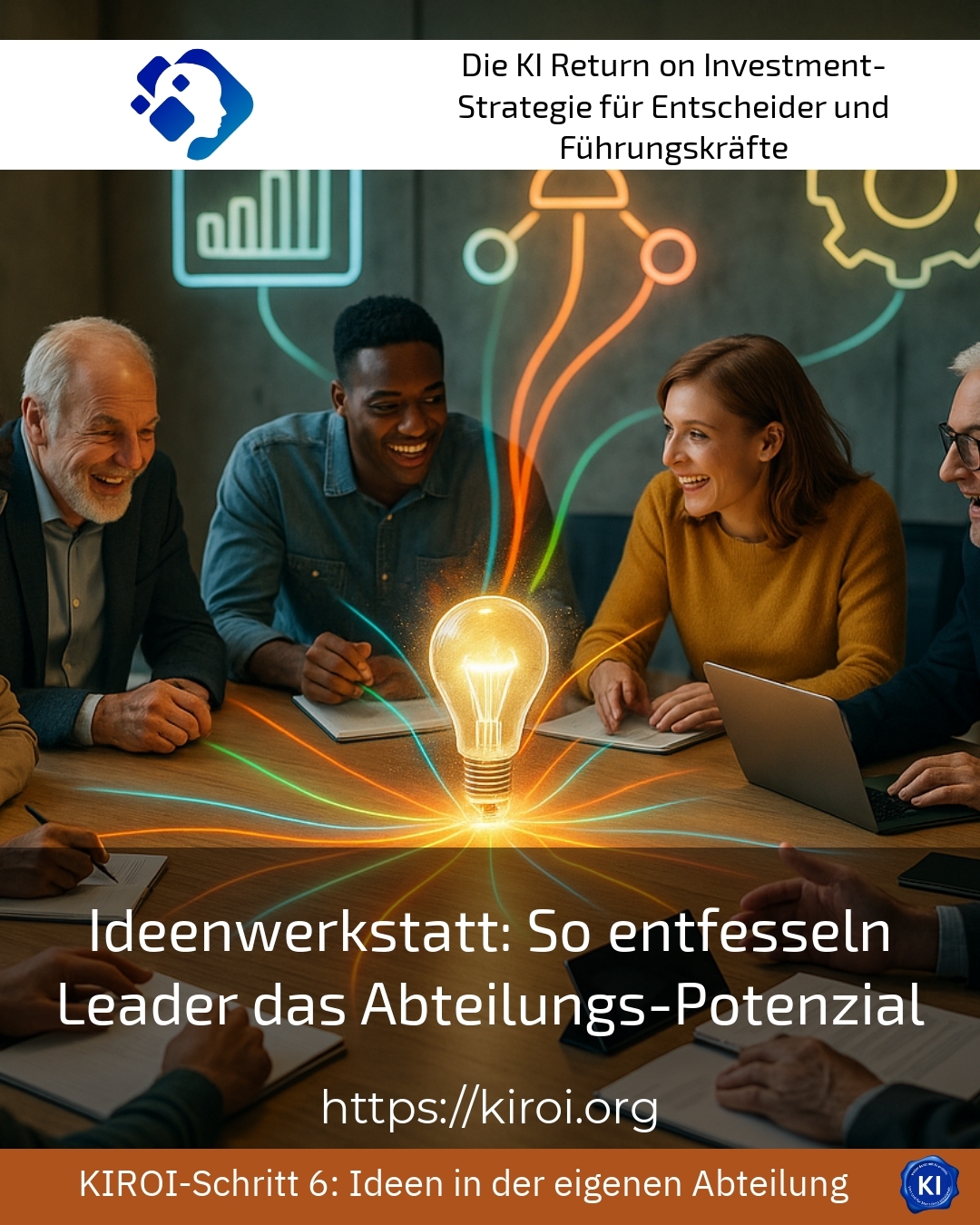
Have you ever wondered why some departments exude a sense of innovation while others, despite having the same resources, remain mediocre? The answer often lies not in budget differences or in the professional competence of the employees, but rather in the way in which leaders initiate and support creative processes. ideas workshop It can become the crucial catalyst that brings hidden talents to the surface and unleashes collective intelligence. At a time when companies are increasingly under pressure to innovate and transform, many executives report similar challenges. They turn to transruptive coaching because they feel their teams could do more. But how can this dormant potential be unleashed systematically and sustainably?
Recognize the hidden power of collective creativity
Many leaders significantly underestimate the creative energy of their teams. They focus on operational metrics and overlook essential innovation potential. Yet a treasure trove of ideas and improvement suggestions lie dormant in every department. However, these insights often remain unspoken because appropriate structures are lacking. A structured ideas workshop It creates just the right framework for creative thinking. It allows employees to look beyond the ordinary. At the same time, it signals appreciation for unconventional ideas.
This is particularly evident in the area of digital transformation. For example, an IT team developed completely new approaches for automating internal processes through moderated creative sessions. A sales team discovered untapped customer segments through systematic brainstorming. And a human resources department revolutionized its recruiting process through innovative employer branding ideas from within the organization. These examples illustrate how different the results can be. However, it is always the leadership’s methodological approach that is crucial.
Best practice with a AIROI customer
A medium-sized manufacturing company faced the challenge of making its product development more agile. The management noticed that innovative ideas almost exclusively came from the top management, while the specialists in the development departments worked more reactively. During the transruptions coaching, an initial assessment of the existing communication structures was carried out. It turned out that there were no established formats for the cross-departmental exchange of ideas. Together we developed a concept for monthly innovation meetings where employees from different departments came together. The first meeting already yielded surprising results, as a production employee proposed a material modification that enabled significant cost savings. This idea had been known to him for some time, but he had never found a suitable framework to implement it. After six months, the company had accumulated a portfolio of over fifty actionable improvement proposals, twelve of which had already been implemented.
Psychological security as the foundation of the Ideas Workshop
Without psychological security, creative formats remain ineffective. Employees need to feel that their contributions are welcome. They need the certainty that unconventional ideas will not be mocked. This atmosphere does not arise by itself; it requires conscious leadership. Leaders must take the lead and show their own vulnerability. They must admit their own mistakes and acknowledge uncertainties. Only in this way can a climate of genuine openness be created.
In practice, we often see that executives underestimate this dimension. For example, a marketing team initially introduced only cautious, consensus-based ideas. Only when the team leadership itself presented an incomplete, sketchy campaign idea did the other team members open up. A finance team only dared to propose innovative suggestions for process optimization after several meetings. And a customer service team developed revolutionary self-service concepts after the leader explicitly encouraged wild ideas. These examples show how crucial the attitude of the leaders is to the success of creative formats.
Choosing methods for a successful idea workshop
The choice of methodology significantly influences the quality of the results. Not every format fits every team culture or question. Experienced leaders therefore experiment with different approaches. Design Thinking is ideally suited for complex challenges with a customer focus. Brainwriting techniques help introverted team members to express their thoughts. And the Walt-Disney method structures the creative process into clearly defined phases. This methodological diversity allows for consideration of different thinking and communication styles.
For example, a logistics company used the reverse method with great success. The team wondered how to make the supply chain as inefficient as possible. From the humorous responses, they then derived concrete improvement measures. A software development team relied on rapid prototyping within the creative sessions. And an purchasing department combined classic brainstorming with systematic supplier evaluation. These diverse approaches illustrate how adaptable the concept of ideas workshop It is possible.
Best practice with a AIROI customer
An insurance company wanted to make its claims processing more customer-friendly without compromising process efficiency. The responsible department head had already made several attempts to gather ideas from her team, but the results were always superficial and lacking in innovation. As part of our support, we first analyzed the previous formats and identified structural weaknesses in the moderation and question-posing processes. Together, we developed a multi-stage creative format that systematically included different perspectives, including the views of customers, claims handlers, and the IT department. The integration of real customer feedback was particularly effective as a catalyst for idea development. The team then developed a concept for proactive status communication that measurably improved customer satisfaction. In addition, ideas were developed for simplified document submission via mobile devices. The department manager later reported that the team dynamic had changed significantly due to the new formats, and that employees were now regularly bringing forward improvement proposals on their own initiative.
The role of the leader as an innovation enabler
Modern leadership does not mean knowing all the answers, but asking the right questions. Leaders who want to unleash innovation potential see themselves as facilitators rather than decision-makers. They create spaces for creative thinking and protect it from the operational pressures of everyday life. This attitude often requires a change in leadership role. Many leaders are drawn to transruptive coaching sessions in response to this challenge. They feel that their usual leadership style is reaching its limits.
A healthcare field manager recognized through coaching that his direct leadership style suppressed creative impulses. He learned to ask more questions and offer fewer solutions. A e-commerce team leader developed new moderation techniques for her team meetings. And a department manager in the energy industry established regular innovation periods in which no operational issues were discussed. These individual development processes show how diverse the paths to innovative leadership can be.
Establishing structures for sustainable idea workshop processes
Unique creative workshops often fail to have an impact because implementation stalls. Sustainable innovation culture, on the other hand, requires lasting structures and processes. These must be integrated into the workday without dominating it. Regular brainstorming sessions with clear rules of engagement have proven effective. Transparent evaluation criteria for submitted proposals create trust. And visible quick wins motivate continued participation.
An advertising agency introduced weekly thirty-minute inspiration sessions. A mechanical engineering company established a digital brainstorming board with a voting function for all employees. And a retail company created the role of the innovation scout, which was rotated between employees. These structural measures embed creativity in the organizational daily routine and also signal that contributions to innovation are valued and taken seriously.
Understanding and constructively using resistance
Not all team members welcome new creative formats with enthusiasm. Some perceive them as an additional burden in an already full calendar. Others doubt the seriousness of the leadership level. And others fear negatively reflecting poorly through unconventional ideas. These objections are understandable and should not be ignored. Experienced leaders take them as valuable clues to underlying organizational issues.
A pharmaceutical company initially faced considerable skepticism when introducing innovation formats. In the past, employees had experienced that their ideas were collected but never implemented. Only when the leadership spoke transparently about past failures and made concrete commitments to implementation did the mood change. A telecommunications provider deliberately included skeptical employees in the format development. And a consulting firm launched with a voluntary pilot team before the format was expanded to all departments. These examples illustrate the importance of a sensitive approach to resistance for sustainable success.
Best practice with a AIROI customer
A technology company with multiple locations struggled to harness innovation impulses from its decentralized organization. The local teams often felt left out of central innovation initiatives and therefore developed a certain passivity. In the context of the transruptive coaching, we worked with the management to develop a hybrid innovation concept that combined local autonomy with centralized coordination. Each location was given the opportunity to design its own workshop formats, while a digital network enabled cross-location exchange. Particularly innovative was the introduction of virtual cross-location sessions, where teams from different locations worked together on challenges. These encounters not only led to new ideas but also to a stronger sense of belonging. A concrete result was a new service concept that combined elements from three different practices in the field and has now been rolled out across the company. The executives reported that their teams showed a noticeably increased willingness to innovate.
My AIROI Analysis
The systematic development of department potential through structured creative formats represents one of the most effective leadership interventions I have encountered in my coaching practice. What at first glance appears to be a simple methodological issue turns out to be a profound question of leadership style and organizational culture. Leaders who ideas workshop-Successfully establishing formats often involves a self-directed development process. They learn to relinquish control and develop confidence in the collective intelligence of their teams. This transformation rarely happens overnight; it requires patient guidance and continuous reflection.
What I find particularly remarkable is how strongly the impact of successful innovation formats extends beyond the immediate output of ideas. Teams that regularly collaborate creatively develop a different level of communication and a stronger sense of “we.” They become more resilient to change and more open to new perspectives. These secondary effects are often underestimated but contribute significantly to long-term organizational development. In my experience, many innovation initiatives fail not because of a lack of methods, but because of insufficient leadership support during the implementation phase. This is where transruptive coaching comes in, helping leaders not only introduce formats but also create the necessary cultural conditions and embed them sustainably.
Further links from the text above:
[1] Harvard Business Review – Innovation Management
[2] McKinsey – The Eight Essentials of Innovation
[3] Design Council – Framework for Innovation
For more information and if you have any questions, please contact Contact us or read more blog posts on the topic Artificial intelligence here.








 Deutsch
 English (UK)