
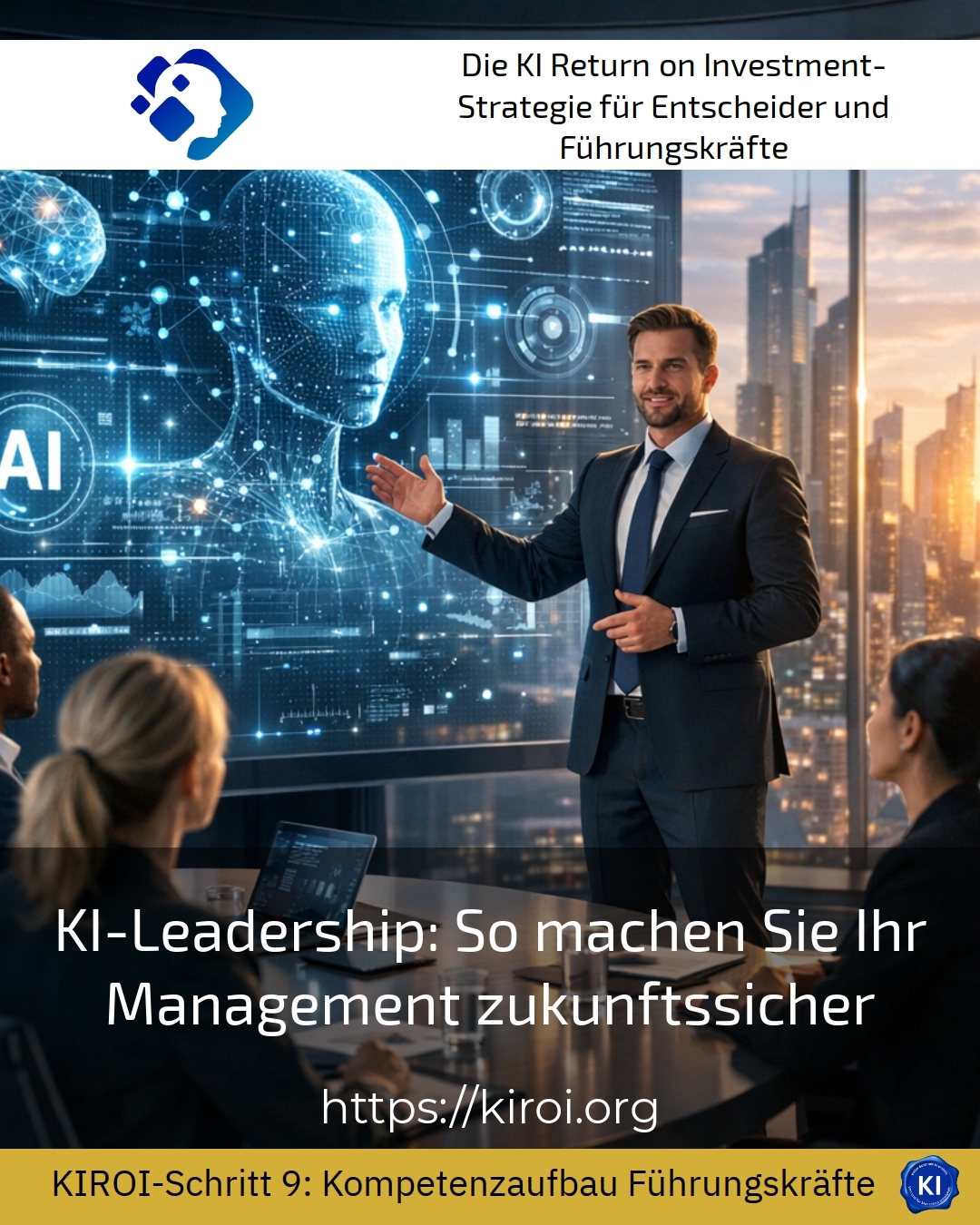
Will your senior leadership remain relevant in five years, or will intelligent systems have already taken over strategic decisions? This question currently concerns decision-makers in almost all sectors of the economy, because the rapid development of learning algorithms and automated processes is triggering fundamental changes at the top levels of management. AI Leadership In this context, a transformative approach is being described that combines traditional leadership competencies with an understanding of data-driven technologies, enabling managers to navigate their organizations with confidence through digital change. Clients often report that they feel overwhelmed by technological disruption and are seeking guidance.
The fundamental transformation of leadership through AI leadership
The role of leaders is currently changing in ways that have not been seen since the Industrial Revolution. While managers used to primarily make operational decisions, their scope of responsibilities is increasingly shifting towards the strategic orchestration of human-machine interactions. In the logistics industry, for example, intelligent systems are now taking on the complete route planning, allowing leaders to focus on overarching network strategies. Similarly, in retail, algorithms automatically optimize order quantities and inventory levels, while management instead develops customer-oriented concepts. In healthcare, diagnostic assistance systems also support decision-making and relieve clinical managers from time-intensive routine tasks.
This shift requires a completely new skill set that combines technical knowledge with strong social skills. Leaders must understand how algorithms work and where their limits lie. At the same time, the human component remains indispensable, because complex ethical considerations and creative problem solving continue to require human intuition. Transruptive coaching provides guidance in these multifaceted development processes and supports leaders in assuming their new role.
Why AI leadership is no longer an option
The integration of intelligent technologies into leadership processes has evolved from a competitive advantage to a necessity for survival. Companies that ignore this development risk losing their market position completely within a few years. In the banking sector, progressive institutions are already automating complete credit decision processes, thereby gaining significant efficiency advantages over traditional competitors. The insurance industry uses predictive analytics for risk assessments, enabling it to offer more precise rates. Even in the restaurant industry, innovative operators rely on intelligent personnel planning systems that match occupancy forecasts with available staff.
Best practice with a AIROI customer
A medium-sized company in the manufacturing industry faced the challenge of fundamentally modernizing its leadership structures. The management team realized that traditional decision-making processes had become too slow and that the company was missing market opportunities. As part of an AIROI accompanied transformation project, we first developed a comprehensive understanding of the company’s specific challenges. The management team underwent an intensive development program that combined technological knowledge with strategic competencies. Particularly important was the realization that intelligent systems should be understood not as a threat, but as a support. After six months, the management team had developed a completely new sense of self and was able to make decisions much faster. Employee satisfaction increased measurably because management had more time for personal conversations. The company was able to triple its speed of response to market changes and won important contracts as a result. This success shows that the combination of technological expertise and human leadership creates crucial competitive advantages.
Strategic competencies for the management of the future
The requirements for executives have dramatically expanded in recent years. In addition to classic management skills such as delegation and communication, modern leaders need a deep understanding of data-driven decision-making processes. In the automotive industry, plant managers must now understand how predictive maintenance systems work and when human intervention is required. Retail managers work daily with personalized recommendation systems and must be able to critically evaluate their recommendations. Executives in the energy industry use complex load forecasts and coordinate decentralized generation facilities with intelligent support.
The ability to balance human intuition with algorithmic recommendations is becoming a core competency of successful leadership. Managers must recognize when they can trust the system and when critical questioning is warranted. This judgment cannot be replaced by technology and therefore remains a crucial human contribution [1]. At the same time, leaders must accompany their teams through change processes and take fears of technological displacement seriously.
Emotional intelligence as an indispensable complement to AI leadership
The more routine tasks are taken over by algorithms, the more important the emotional component of leadership becomes. In uncertain times, employees seek guidance and appreciation from their supervisors. In the call center sector, for example, chatbots are taking on an increasing share of customer inquiries, while human agents focus on complex emotional situations. The leaders of these teams must understand how frustrating it can be to deal with frustrated customers. In healthcare, digital assistants support documentation, but the emotional care of patients remains entirely in the hands of the staff. In creative industries such as advertising, algorithms generate initial designs, while human teams evaluate the emotional impact.
Leaders need to understand these changed working conditions and support their teams accordingly. Transruptive coaching can provide valuable insights on how managers can strengthen their emotional presence and build authentic relationships. Clients often report that after intensive reflection on their leadership role, they appear significantly more confident.
Practical implementation: This is how change is achieved
The theoretical insight that AI Leadership While it is no longer indispensable, it is not enough in itself. What is crucial is the concrete implementation in day-to-day business operations. A step-by-step approach is recommended, starting with the analysis of existing leadership structures. In the construction industry, for example, companies have begun to systematically train their project managers in using Building Information Modeling. Logistics companies are establishing regular exchange formats in which executives report on their experiences with automated systems. In the education sector, school principals are also developing new skills in using adaptive learning systems.
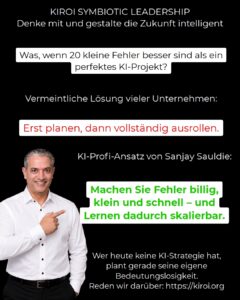
A critical success factor is the involvement of the entire senior management in the transformation process. Individual pioneers can certainly provide important impulses, but lasting change requires collective commitment. The corporate culture must become more experimental and provide room for controlled failure [2]. Only then can executives gain the necessary experience in dealing with new technologies.
Best practice with a AIROI customer
A regional bank with several branches faced the challenge that younger management was significantly more tech-savvy than the experienced senior management. This discrepancy led to tensions and significantly hampered the digital transformation of the institution. As part of a AIROI mentoring program, we developed a mentoring program that promoted cross-generational learning. The experienced management shared their knowledge about customer relationships and strategic decision-making processes, while the younger colleagues brought technological expertise. Particularly valuable was the insight that both perspectives are indispensable for successful leadership. The program included monthly tandem sessions, joint project work, and structured reflection discussions with the coaching team. After a year, the leadership team had evolved into a learning community that no longer viewed change as a threat but as an opportunity. The bank was able to successfully introduce several innovative services and thereby gained new customer groups. Employee turnover at the leadership level significantly decreased because all involved parties recognized their development opportunities and felt valued.
Overcoming obstacles with strategic AI leadership
The path to future-proof leadership is rarely linear and often fraught with resistance. Many leaders perceive technological changes as a threat to their position and react defensively. In the media industry, for example, editors fear that automated text generation will undermine their expertise. Hotel managers worry that intelligent booking systems will restrict their freedom of decision. Even in technology-driven industries such as the IT industry, team leaders report uncertainty in the face of rapid developments.
Taking these fears seriously and working constructively with them is one of the most important tasks in the transformation process. Transruptions coaching supports leaders in reflecting on their concerns and developing action strategies. Experience shows that open exchange and practical experimentation significantly reduce fears more effectively than theoretical persuasion efforts. Leaders who first gain positive experiences with intelligent systems often develop a passion for the new possibilities.
The ethical dimension of modern leadership
Responsible management today also means taking societal impacts into account when making technological decisions. Leaders must understand the ethical questions that the deployment of intelligent systems raises. In human resources, for example, algorithm-based selection processes can unintentionally perpetuate discrimination when training data contain historical biases [3]. Credit decisions by banks affect the lives of many people and therefore require special care. In healthcare as well, leaders must weigh which decisions they leave to algorithms and which require human judgment.
The ability to make these complex tradeoffs distinguishes responsible leadership from purely efficiency-driven management. AI Leadership Therefore, it necessarily also includes an ethical component that often falls short in day-to-day management. Leaders who take on this responsibility gain the trust of their employees and customers.
My AIROI Analysis
The transformation of leadership landscape through intelligent technologies is not a temporary phenomenon, but a fundamental reordering of what constitutes successful leadership. According to my analysis of current developments and the numerous mentoring projects of recent years, several key insights crystallize that are relevant to leaders across all industries. First, the combination of technological understanding and emotional intelligence becomes the crucial differentiating characteristic of successful managers. Neither purely technically oriented nor exclusively relationship-oriented leadership will be able to meet the complex demands of the future. Second, it is evident that companies that systematically prepare their leaders for the changed requirements can achieve significant competitive advantages. The investment in leadership development pays off measurably, as the practical examples impressively demonstrate. Thirdly, I observe a growing willingness among executives to face the new challenges and actively develop their competencies. This positive development gives me optimism for the future of corporate leadership. Coaching transformation projects by experienced coaches and consultants can accelerate change and minimize risks. However, the personal commitment of each individual leader to open up to change and explore new paths remains crucial. The future belongs to those who understand technology as a tool while cultivating the human dimension of leadership.
Further links from the text above:
[1] Harvard Business Review: Insights on Leadership
[2] McKinsey: People and Organisational Performance
[3] World Economic Forum: Artificial Intelligence and Robotics
For more information and if you have any questions, please contact Contact us or read more blog posts on the topic Artificial intelligence here.







 Deutsch
 English (UK)