
Have you ever wondered who actually has the final say in your company – the algorithm or the person behind it? This question currently concerns executives worldwide. The dynamics between Man the AI or AI the man It is certainly increasingly determining the success or failure of entire business models. At the same time, a fascinating development is taking place. While many organizations still cling to rigid control patterns, completely new forms of collaboration between biological and artificial intelligence are already emerging. The answer to this fundamental power question determines whether technological systems will liberate or restrict us.
The traditional control paradigm and its limitations
Most companies take a simple approach. They rely on complete human control of every algorithmic output. This path seems logical and secure at first glance. Every recommendation, analysis, and forecast undergoes manual review. Support staff checks automated calculations. Executives review machine-generated reports. Quality managers validate system-generated process proposals.
However, this model quickly reaches its practical limits. The sheer volume of data overwhelms human capacity. A single analyst cannot possibly review thousands of transactions daily. The review is superficial or selective. Moreover, significant time delays arise. Decisions that should be made in seconds suddenly take hours or days. This costs competitive advantages and customer confidence.
In addition, there is a psychological problem. People tend to become blind to technical systems after a while. They sign off on reports without actually reading them. They confirm recommendations because the effort of a real audit seems too great. The formal control exists on paper, but in reality it no longer functions as a real safety net.
Man the AI or AI the Man – A new perspective
The question of the relationship between control Man the AI or AI the man It requires a fundamental change of mindset. Instead of a one-sided hierarchy, we need collaborative structures. Both sides possess unique strengths. Algorithms process gigantic amounts of data in fractions of a second. People understand contexts, recognize ethical implications, and make value judgments.
For example, an insurance company uses automated damage assessments. The system analyzes photos of accident damage and estimates repair costs. An experienced expert would need hours to perform the same task. At the same time, humans immediately recognize when a photo is obviously manipulated. This combination creates an added value that neither side could achieve alone.
An investment bank uses algorithmic trading systems. These react to market movements in milliseconds. No human trader could trade that fast. Yet experienced portfolio managers keep a strategic focus. They understand geopolitical connections and societal trends. The machine optimizes execution. The human defines the direction.
A hospital uses diagnostic assistance systems. These detect abnormalities in X-ray images with impressive accuracy. Doctors use these findings as valuable second opinions. However, they make the final diagnosis themselves. In doing so, they take into account the entire medical history and the personal conversation with the patient.
AIROI The philosophy: Mutual control loops
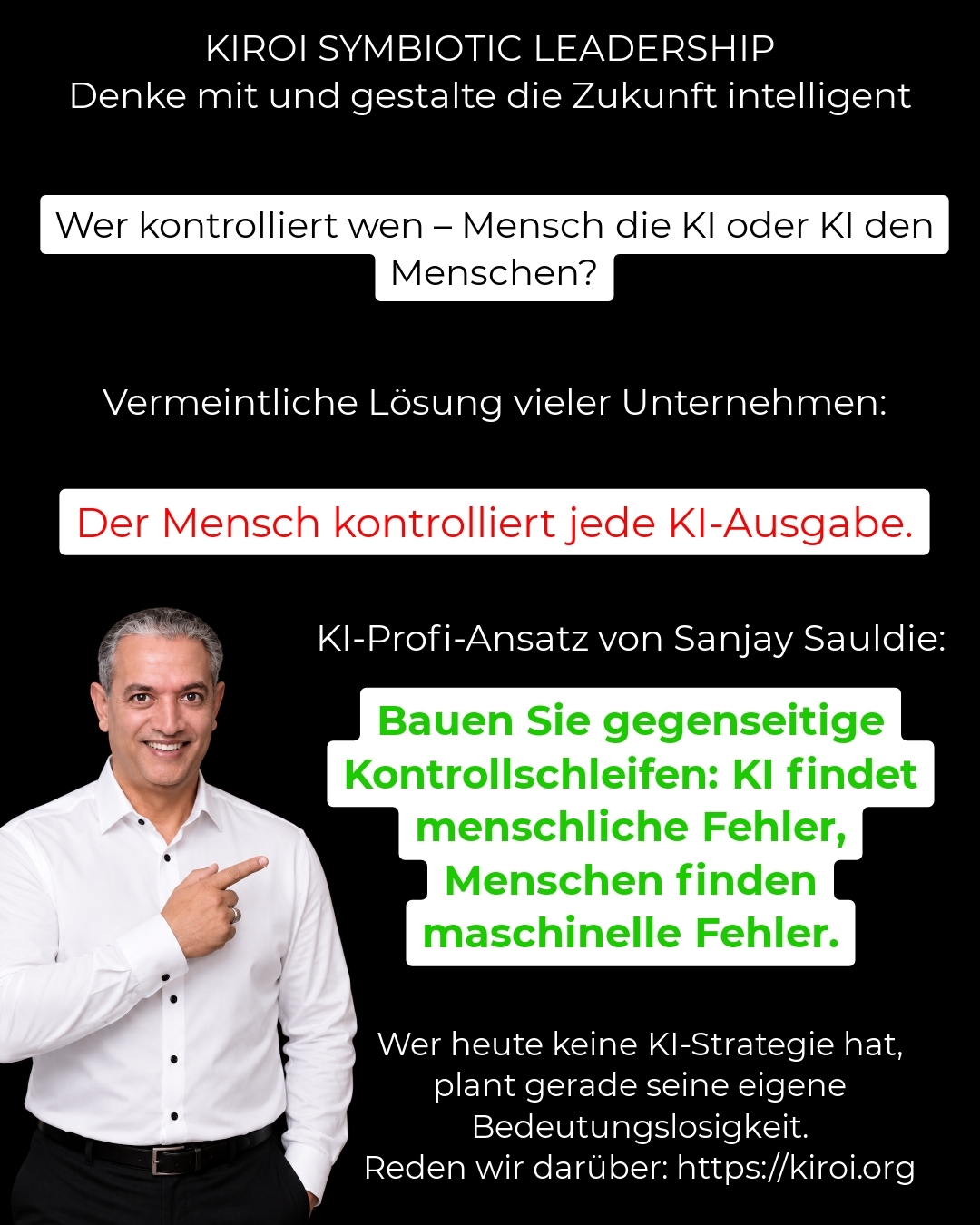
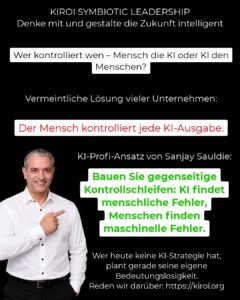
The AIROI-concept offers an elegant solution to the dilemma. It establishes mutual control mechanisms. Algorithms identify human errors. Humans detect machine weaknesses. This symmetry creates a robust system of mutual monitoring.
Specifically, this involves the following steps. Automated systems continuously check human decisions for inconsistencies. They detect patterns that indicate fatigue, biases, or errors of commission. At the same time, trained employees regularly review the outputs of the algorithms. They specifically look for systematic distortions or logical errors.
An accounting firm implemented this approach in its balance sheet analysis. The system automatically flags unusual entries. It detects deviations from industry standards or historical patterns. The auditors examine these indications more closely. At the same time, they critically evaluate the plausibility of the algorithmic assessments. They question the underlying assumptions and data sources.
A human resources department applies this principle when selecting candidates. Algorithms screen application documents for relevant qualifications. Recruiters check whether the system has missed important soft skills. The technical system, in turn, points to unconscious bias among human decision-makers. It analyzes whether certain candidate groups are systematically disadvantaged.
A logistics company optimizes delivery routes with algorithmic support. The system theoretically calculates optimal paths. Experienced dispatchers correct unrealistic suggestions. They are familiar with construction sites, difficult parking situations, or unreliable time windows. The system learns from these corrections and continuously improves itself.
Best practice with a AIROI customer
A medium-sized financial services company faced a significant challenge in credit underwriting. The manual processes were time-consuming and prone to errors. At the same time, the management did not blindly trust automated decisions. As part of a transruptive coaching project, we jointly developed a dual control system. The algorithmic system first fully automatically analyzes all incoming credit applications. It evaluates creditworthiness, collateral, and repayment probability based on extensive data sources. In parallel, the system flags applications where human agents have made errors in the past. These warnings alert the employees to their individual weaknesses. On the other hand, experienced credit analysts regularly review samples of the machine-based decisions. They systematically document when the algorithm missed important contextual information. This knowledge is directly incorporated into the system’s further development. The result exceeded all expectations. The error rate decreased by more than forty percent within nine months. At the same time, the average processing time significantly accelerated. The employees reported a higher level of job satisfaction. They no longer felt like mere bystanders over a black box. Instead, they saw themselves as equal partners in an intelligent system. This project impressively demonstrates how mutual feedback loops can benefit both parties.
Practical implementation of mutual control
Implementing mutual control loops requires careful planning. First, clear responsibilities must be defined. Which decisions does the system make autonomously? When is human intervention required? At what threshold does escalation automatically trigger? These boundary lines should be worked out in collaboration with the employees involved.
For example, a wealth manager defined clear thresholds. Transactions below a certain volume are executed automatically by the system. Larger positions require human confirmation. At the same time, the system automatically reports when human traders repeatedly violate the agreed investment strategy.
A law firm uses intelligent contract review. The system identifies problematic clauses in contract documents. Lawyers assess the relevance of these indications for the specific client. The system learns from these assessments. It understands better which risks are actually critical for which types of clients.
A tax advisory firm implemented plausibility checks in both directions. Algorithms detect unusual tax arrangements and point out possible errors. At the same time, tax advisors document cases where the system incorrectly labeled legitimate design options as problematic. These feedback reports continuously refine the algorithmic assessment.
Humanity versus AI or AI versus humanity – Cultural prerequisites
Technical implementation alone is not enough. The control ratio between Man the AI or AI the man It also requires cultural change. Employees need to understand why mutual oversight is beneficial. They should not perceive algorithmic guidance as criticism. Instead, they should view it as collegial support.
An insurance company conducted extensive training sessions. Employees learned how the systems used worked. They understood the strengths and weaknesses of the algorithms. This knowledge enabled them to adopt a constructive and critical attitude. They were able to better categorize machine suggestions and question them more purposefully.
A private bank promoted an open approach to errors. Both human and algorithmic errors were systematically analyzed. No one was punished. Instead, the findings were fed into improvement processes. This culture of error created the prerequisite for honest feedback in both directions.
A consulting firm established regular retrospectives. Teams openly discussed the interplay with technical systems. They identified situations where control had failed. Together they developed improvement proposals. This participatory approach strengthened confidence in the new processes.
My AIROI Analysis
The question of the relationship between control Man the AI or AI the man Ultimately, it is misaligned. It suggests a conflict when cooperation would be possible. The real challenge lies not in the dominance of one side. It lies in the intelligent combination of complementary skills. The traditional model of unilateral human control is outdated. It overwhelms employees and wastes machine potential. At the same time, complete algorithmic autonomy would be irresponsible. Machines do not understand ethical nuances or societal contexts.
The philosophy of AIROI-philosophy offers a third way. Mutual control loops leverage the strengths of both sides. Algorithms detect human errors with impeccable consistency. Humans discover machine blind spots with their intuition and experience. This symmetry creates systems that are more robust than any individual component. Practical implementation requires technical skill and cultural sensitivity. Clear process definitions must be linked to open communication. Employees need both competence and trust. Leaders must actively accompany and lead the change. Organizations that successfully tread this path gain a sustainable competitive advantage. They combine efficiency with prudence. They harness speed without losing control. They create work environments where people and machines spur each other to peak performance.
Further links from the text above:
[1] AIROI-Blog on Artificial Intelligence
Are you a leader and would you like to learn how you can genuinely introduce AI into your company in a valuable and sustainable way, away from the hype? Take part Contact us or read more blog posts on the topic Artificial intelligence here.







 Deutsch
 English (UK)