
Have you ever wondered why some companies, despite perfectly planned strategies, still fail in the area of AI project How can you fail while others achieve astonishing success with seemingly chaotic approaches? This question currently preoccupies countless executives across all industries, and the answer could fundamentally change your entire perspective on digital transformation. The truth is as counterintuitive as it is liberating: perfection can be your greatest enemy, while controlled failure turns out to be your most powerful ally.
The paradox of perfection in the AI project
In a world obsessed with efficiency and optimization, the idea of intentional errors seems downright heretical. Yet this is precisely where the key to sustainable success in the implementation of intelligent systems lies hidden. Many organizations invest months, sometimes even years, in the meticulous planning of their technological initiatives only to find that the circumstances have already fundamentally changed during this planning phase. For example, a manufacturing company spent eighteen months developing a comprehensive concept for automated quality control, while competitors had already deployed functional prototypes and were gathering valuable experience.
The traditional approach follows an apparently logical pattern that is deeply rooted in the corporate culture of many organizations. First, extensive analyses are conducted and requirements catalogs are created. Then lengthy coordination processes between different departments follow. Finally, a complete system is developed and rolled out. This methodology may have worked for classic software projects. However, in the implementation of learning systems, it often proves counterproductive because the technology itself only fully realizes its potential through practical application.
First plan, then fully roll out – the conventional route
Average companies typically approach the problem by first developing a detailed master plan that should account for all eventualities before even a single line of code is written. This approach is based on the assumption that errors are costly and must therefore be avoided at all costs. For example, a financial services provider invested significant sums in consulting services to develop a flawless strategy for intelligent customer communication, and was ultimately so exhausted from the planning phase that the actual implementation was carried out only halfheartedly.
A trading company wanted to optimize its warehouse management and commissioned a project team to complete the design. After a year of intensive work, an impressive document was produced. However, technological capabilities had evolved in the meantime. The original concept was already outdated before it could even be implemented.
A similar situation occurred with a healthcare provider who wanted to develop a perfect scheduling system. The requirements analysis alone took six months. When the system finally went live, the patient needs had changed. The expected acceptance did not occur because no one had involved the users during the long planning phase.
The hidden costs of perfection
What at first glance appears to be a risk-minimizing strategy turns out to be a resource-sucking behemoth when examined more closely. The time spent in endless planning meetings, coordination rounds, and documentation is no longer available for practical learning and real innovation. An energy provider invested considerable resources in planning an intelligent grid management system. The employees spent months in workshops. In the end, they lacked the practical experience to operate the system meaningfully.
A logistics company experienced a similar effect when introducing automated route planning. The theoretical preparation was meticulous. But when the system was launched, unexpected difficulties emerged. No one had gained practical experience on how to deal with system errors. The frustration within the team grew, and the project came to a standstill.
AIROI The solution for your AI project
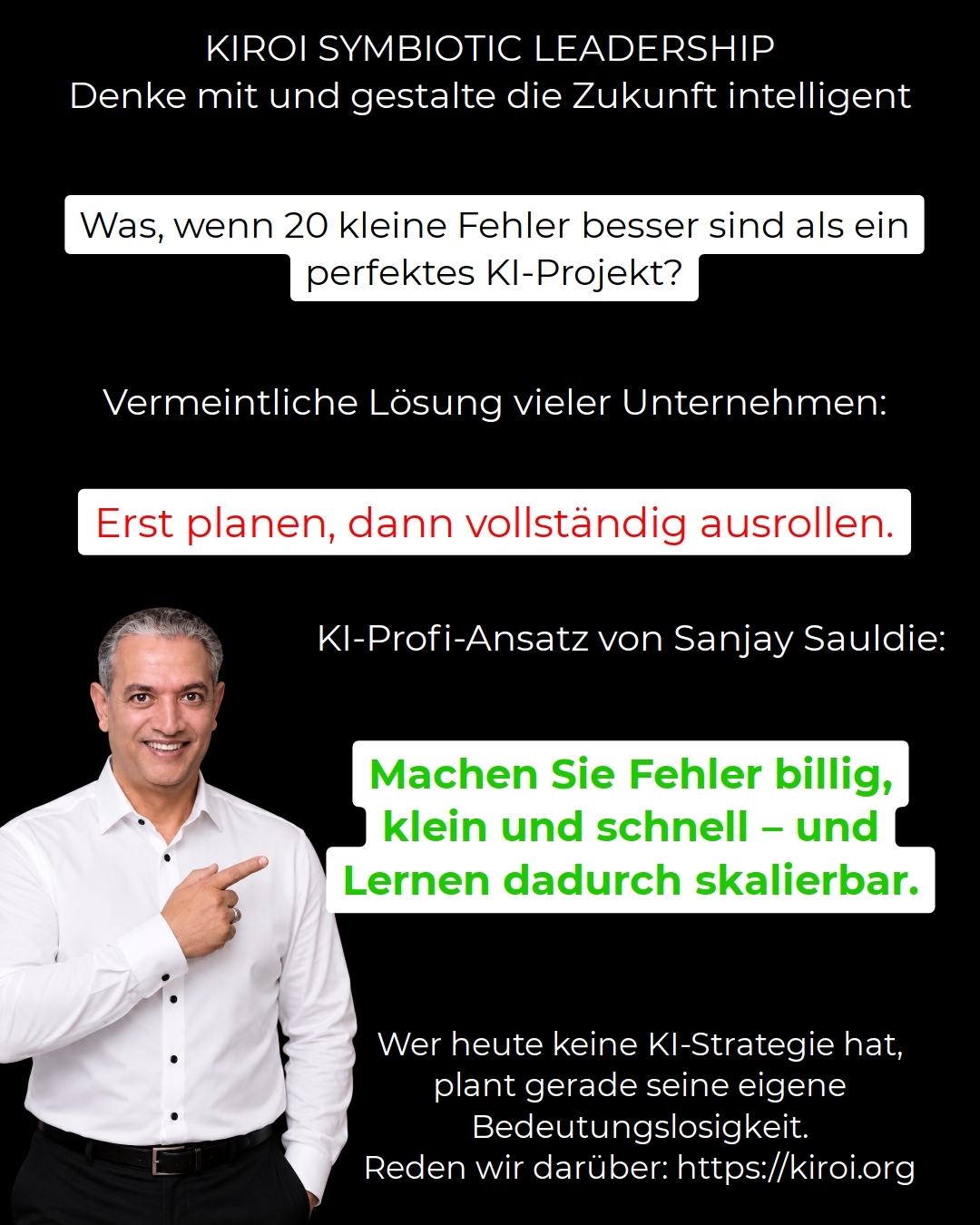
The AIROI-approach radically breaks with perfectionism and instead relies on a philosophy that does not view errors as a threat but as valuable learning resources: Make mistakes cheap, small, and fast – and by doing so, make learning scalable. This methodology recognizes that when working with intelligent systems, no one can know all the answers in advance because the technology itself is dynamic and only unfolds through interaction with real data and people.
Instead of months-long planning phases, transruptive coaching recommends short experimental cycles. Teams learn to formulate small hypotheses and test them quickly. For example, a retailer did not start with a complete recommendation system. They first tested simple product suggestions in a single store. The insights were invaluable and cost only a fraction of a large rollout.
An insurance company used this approach in claims processing. Instead of a complete system, they started with a simple prototype. Employees could provide feedback before making major investments. The final solution was thus much better adapted to the actual needs.
Best practice with a AIROI customer
A medium-sized manufacturing company faced the challenge of optimizing its production planning through intelligent systems, having already experienced negative results from a failed large-scale project that had to be shut down after two years of development. As part of the transruptive support, the management team developed a completely new approach based on rapid and cost-effective experiments that delivered tangible results within a few weeks. Instead of developing a comprehensive system for all production lines, the team focused on a single machine and tested various approaches to predict maintenance needs. The errors that occurred were small enough to cause no serious operational disruptions, but instructive enough to gain fundamental insights into the company’s specific requirements. After six such micro-experiments, the team gained a deep understanding of what worked and what didn’t, and was able to build a system based on this that is now successfully deployed throughout production and has measurably reduced downtime. The total cost of this iterative approach was significantly lower than that of the originally failed large project, while the results exceeded all expectations.
Small mistakes as a catalyst for great knowledge
The crucial difference between a costly failure and a valuable learning process lies in the scale and speed with which mistakes can be made and corrected. A large, monolithic project that fails after two years not only leaves financial losses behind, but also demoralized teams and an organization that henceforth views every innovation with suspicion. Twenty small experiments, of which fifteen fail, yield five working approaches and a team that has learned through practical experience what works in their specific context.
A telecommunications provider used this principle in customer service. Instead of a complete chatbot, they tested different dialogue variants. Some did not work, others were surprisingly effective. The insights from these small tests formed the final system.
One pharmaceutical company applied the approach to document processing. Various methods for automatic text analysis were tested in parallel. The teams quickly learned which approaches were suitable for their specific document types. The end result was more precise than any theoretically planned solution.
Scalability through controlled failure in the AI project
The true power of this approach lies in its scalability; as traditional methods become increasingly complex, the philosophy of small errors enables the organic expansion of successful practices. A mechanical engineering company began with a single pilot project for predictive maintenance and has now deployed over thirty different applications. Each solution is based on the insights from previous experiments. The organization has developed collective intelligence that no external consulting firm could have provided.
A media company used iterative tests for personalized content recommendations. Initial attempts showed unexpected user reactions. Instead of treating them as failures, they were treated as valuable insights. The final solution surprised even skeptical executives with its accuracy.
An automotive supplier experimented with image recognition systems for quality control. Various camera angles and lighting variants were tested. Systematic evaluation of the failed attempts led to a solution that outperforms human inspectors for certain types of defects.
The role of the leader in the experimental cycle
For leaders, this paradigm shift means a fundamental change in their role; instead of acting as guardians of the perfect plan, they become facilitators of a learning culture where mistakes are not punished but valued as valuable sources of information [1]. This requires not only a new mindset but also concrete structural adjustments. Budgets must provide flexible spaces for experimentation. Reporting channels must enable quick feedback. The corporate culture must provide psychological safety.
A food manufacturer created dedicated innovation teams with their own budget. These teams were explicitly allowed to fail as long as they documented their findings. The result was an innovation speed that left competitors in awe.
A construction company established weekly learning rounds in which teams presented their mistakes. This practice evolved into one of the organization’s most valuable sources of knowledge. Employees began to be proud of their instructive failures.
Best practice with a AIROI customer
A finance executive came to the transruptive support team with the request that her organization had developed a veritable fear of technological innovation after several failed large-scale projects and was now threatening to lose its edge in the competition. Together we developed a framework for safe experimentation that allowed teams to test new ideas without having to fear negative consequences in the event of failures, while ensuring that successful approaches could be quickly scaled up. The transformation began with a symbolic act in which the management publicly shared a personal failure and acknowledged the lessons learned, triggering a cultural change that continues to this day. Within a year, the organization had conducted more than forty small experiments, of which about a quarter led to scalable solutions, while the remaining provided valuable insights that prevented future misjudgments. Employee satisfaction increased measurably as people felt encouraged to be creative and explore new paths, rather than freeze in fear of failure.
Practical implementation of the experimental culture
Implementing this philosophy requires concrete measures that go beyond mere lip service and intervene deep within the organizational structures. First, clear boundaries for experiments must be defined – not to restrict innovation, but to create a safe framework within which errors remain truly minor and inexpensive [2]. For example, a chemical company established that experiments may only take up a certain percentage of the department budget and last no longer than one month before a decision is made on whether to continue or discontinue them.
A textile company implemented so-called innovation sprints. Teams had two weeks to develop a prototype. In the end, it was decided whether the idea had potential. This discipline prevented unsuccessful approaches from consuming too much resources.
A tourism company established a simple traffic light system for experiments. Green meant to continue, yellow required adjustments, and red led to an immediate stop. This clear structure gave teams confidence in their decisions.
The AI project as a continuous learning process
Ultimately, the point is to understand the implementation of intelligent systems not as a one-time project, but as an ongoing learning process that permeates the entire organization and produces ever-improving results over time. One retail company reports that its systems are now working three times more effectively than at the time of initial implementation – not because it was planned perfectly from the beginning, but because it has continuously learned from practical experience and optimized it.
A transportation company has applied this approach to fleet optimization. Every week, small adjustments are tested. The cumulative effect of these micro-improvements exceeds any single optimization attempt.
An real estate company uses continuous experimentation in valuation automation. The accuracy of the system is constantly improving. Employees do not see the technology as a threat, but as a learning partner.
My AIROI Analysis
The realization that twenty small mistakes can be more valuable than a perfectly planned large project presents a real challenge for many leaders because it contradicts deeply rooted beliefs about professional behavior. Nevertheless, practical experience from numerous follow-up sessions in the context of transruptive coaching shows that organizations that undergo this paradigm shift become more successful, agile, and innovative in the long term than their perfectionist competitors.
The AIROI-methodology offers a structured framework to achieve this change without falling into chaos. It enables controlled experimentation with clear boundaries. It fosters a culture where learning is more important than perfectionism. It transforms the fear of failure into curiosity about new insights.
For leaders, this means a fundamental redefinition of their role. They are becoming facilitators rather than planners. They create spaces for safe experimentation. They celebrate both instructive failures and resounding successes. In a world that is changing ever faster, this ability to learn quickly and effectively is perhaps the most important competitive advantage of all.
The future does not belong to the perfect planners, but to the brave experimenters. Not those who avoid every mistake, but those who learn from every mistake. Not those who spend years in the planning phase, but those who start today and are better tomorrow than yesterday.
Further links from the text above:
[1] Harvard Business Review – Innovation Management
[2] McKinsey Digital Insights – Agile Innovation
Are you a leader and would you like to learn how you can genuinely introduce AI into your company in a valuable and sustainable way, away from the hype? Take part Contact us or read more blog posts on the topic Artificial intelligence here.








 Deutsch
 English (UK)