
Who actually determines what really matters when algorithms can calculate more precisely than any expert?
This question currently concerns numerous decision-makers in a world where automated systems are becoming increasingly autonomous. While machines are now optimizing processes, recognizing patterns, and making predictions, a fundamental question remains unanswered: Artificial intelligence It can perfect the „how,“ but who actually defines the „why“? This article explores how companies can overcome this challenge. It shows why the AIROI masterplan coaching can provide valuable insights as a transruptive accompaniment. The boundary between technical brilliance and human responsibility is increasingly blurred. Leaders need to understand where control begins and delegation ends.
The fundamental shift: When competence becomes a commodity
In almost every industry, we are currently experiencing an unprecedented transformation. Systems analyze production data in real time and automatically adjust parameters. Logistics platforms calculate optimal routes before human dispatchers even have a chance to look at the map. Customer service bots answer inquiries faster and often more precisely than trained employees. This development raises fundamental questions that go far beyond technical aspects.
Consider, for example, the field of manufacturing, where automated quality controls detect errors that remain hidden from the human eye. Or think of financial departments, where algorithms predict payment flows and predict liquidity shortages. Even in human resources, intelligent systems scan applications and create candidate rankings. The technical superiority of these tools is beyond question. But this is precisely where the paradox lies, which many organizations underestimate.
The better machines master the operational business, the more urgent the question of strategic direction becomes. A manufacturing robot optimizes lead times, but it doesn’t ask whether the product still fits the market. A marketing algorithm maximizes click rates, but it doesn’t question whether the message fits the corporate ethics. An e-commerce system reduces procurement costs, but it doesn’t take into account long-term supplier relationships or sustainability goals. These blind spots are not a technical failure, but a structural characteristic of automated systems. Artificial intelligence optimized within predefined framework conditions. However, it does not independently expand these framework conditions.
How average companies solve the problem: People define tasks, AI performs them
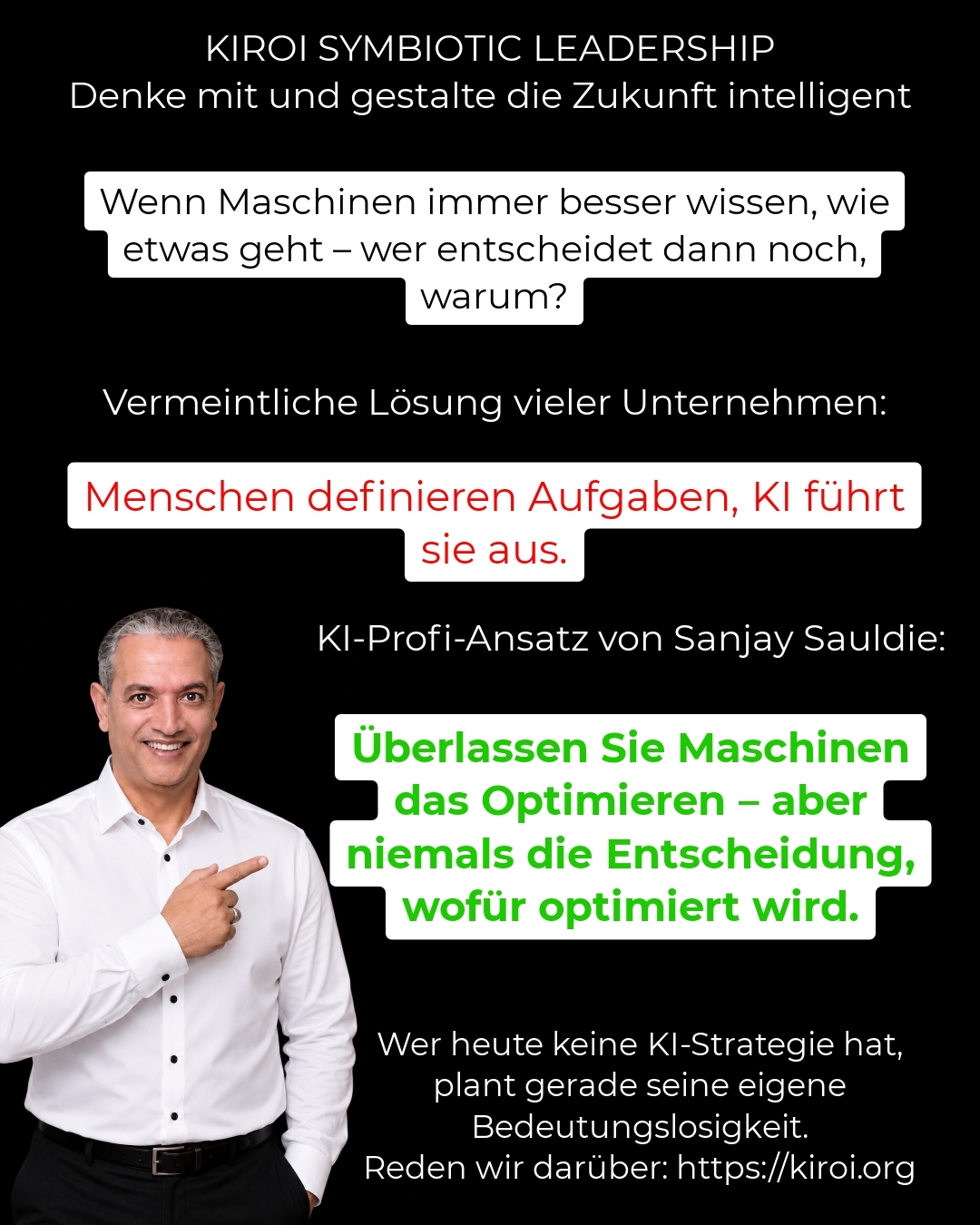
Most organizations follow an established pattern when integrating intelligent systems. Executives formulate objectives, functional departments translate these into measurable metrics, and technical teams configure the corresponding tools. This approach seems logical and works satisfactorily in many cases. The division of labor is clear: people define tasks, AI performs them.
In practice, it looks like this: A sales manager claims that the conversion rate is to be increased by ten percent. The system automatically tests various targeting strategies and identifies the most successful variants. A production manager defines maximum rejection rates. The machine control adjusts production parameters accordingly. A human resources manager sets diversity targets. The personnel management system recalculates criteria. These examples illustrate the basic principle that is applied in numerous companies.
However, this approach has limitations that often become apparent only belatedly. The problem lies not in the execution itself, but in the definition of the goal. Companies often optimize on metrics that were set years ago. They do not adjust their metrics to changing market conditions. They overlook the fact that different optimization goals can conflict with each other. A system that maximizes customer satisfaction can simultaneously reduce employee satisfaction. An algorithm that boosts short-term profits can endanger long-term customer relationships.
Best practice with a AIROI customer
A medium-sized machine-building company implemented intelligent systems to optimize sales processes. The system automatically identified the most promising leads and prioritized customer inquiries based on their likelihood of completion. The results were initially impressive, as the conversion rate increased by fifteen percent within a few months. However, after about a year, management noticed a worrying development: The share of regular customers steadily declined because the system systematically prioritized existing customers lower than potential new ones. As part of a AIROI masterplan coaching session, the company fundamentally reanalyzed its target definitions and realized that the original metrics did not reflect essential aspects of the business model. The management team developed a multidimensional target system that took customer acquisition, customer retention, service quality, and employee satisfaction into account in addition to new customer acquisition. This realignment required intensive discussions at the board level because different departments held different priorities. The transruptions coaching accompanied this process and supported the organization in finding viable compromises. Today, the company operates with a balanced scorecard system that is regularly reviewed and adjusted.
The hidden costs of superficial optimization
Many organizations underestimate the consequences of one-dimensional goals. A logistics company optimized delivery times and significantly reduced travel costs. At the same time, driver turnover increased dramatically because the system generated unrealistic time requirements. A trading company maximized warehouse turnover through algorithmic inventory control. The result was frequent delivery bottlenecks during seasonal peak times. A service company increased the workload of its consultants through intelligent project planning. However, the quality of customer advice suffered significantly because reflection times were systematically eliminated.
These examples illustrate a fundamental pattern: Automated systems optimize exactly according to the goals that are given to them. However, they do not take into account implicit values or cultural norms. They do not recognize any inconsistencies between different organizational goals. They do not question the adequacy of their optimization criteria. Artificial intelligence In this sense, it is neutral. However, it reinforces existing tendencies and accelerates developments that would be slower without it.
AIROI The solution: Let machines optimize, but never decide over what they should do
The AIROI-Masterplan takes a differentiated approach that combines technical efficiency with human judgment. The basic principle can be summarized as follows: Leave the optimization to machines – but never the decision on what to optimize. This distinction may seem obvious at first glance. In practice, however, many companies unknowingly cross this boundary.
The AIROI-approach consistently distinguishes between the operational and strategic levels. At the operational level, automated systems take on all tasks that can be formulated in clear rules. Routine decisions, process control, data analysis, and pattern recognition belong to this area. Machines here fully utilize their strengths. They work faster, more precisely, and more persistently than humans. They are free from fatigue, distraction, and personal preferences.
At the strategic level, however, responsibility remains solely with humans. Goal definition, value assessment, ethical evaluation, and long-term orientation require skills that automated systems do not possess. They require context understanding that goes beyond data. They require empathy that algorithms cannot simulate. They require a sense of responsibility that machines structurally lack.
Practical application of the AIROI-principle in everyday life
In purchasing, the AIROI-approach, for example, means: Automated systems analyze supplier prices, compare conditions, and identify savings potential. However, the decision whether to replace a proven supplier with a cheaper one is made by humans. They weigh factors that are not included in any database: trustworthiness, innovation capability, regional connections, or strategic partnership.
In human resources, intelligent systems take on the preliminary screening of applications and create competency profiles. However, the final hiring decision is based on human assessment. Executives consider aspects such as cultural fit, development potential, or team dynamics that are difficult to quantify. In customer service, chatbots answer standard inquiries and resolve routine problems. However, people continue to handle complaints with emotional weight, complex claims, or strategically important customers.
Best practice with a AIROI customer
An international trading company implemented the AIROI-approach after several costly misjudgments that were due to excessive reliance on automated forecasts. The transruptions coaching accompanied a multi-month transformation process in which all essential decision-making processes were analyzed and categorized. The organization developed a classification system that assigned each decision to one of three categories: fully automated, partially automated with human approval, or entirely human-driven. This categorization was not based on technical criteria but on an assessment of the consequences and reversibility of each decision. Automated reorders for standard items fell into the first category because erroneous decisions can be quickly corrected. Price changes for strategic products, however, required human approval because they affect customer relationships in the long term. Product assortment decisions remained entirely in human hands because they touch the brand promise and corporate identity. The result was a differentiated governance system that combined technical efficiency with strategic control. Employees often report that they feel relieved by this clear division of responsibilities and that they can more purposefully use their expertise.
The role of master AIROI-plan coaching in transformation
Implementing these principles requires more than technical knowledge. It requires a cultural change that affects all levels of an organization. The AIROI Masterplan Coaching supports companies in systematically shaping this change. It provides guidance for leaders who need to redefine their role in an increasingly automated work environment.
An essential aspect of this coaching involves developing decision-making skills. When operational tasks are eliminated, strategic skills become more important. Leaders must learn to ask the right questions instead of simply giving answers. They must understand which optimization goals actually fit the company’s purpose. They must recognize and resolve inconsistencies between various metrics.
Transruptions coaching accompanies projects in which these skills are developed practically. It supports teams in reflecting on and improving decision-making processes. It helps organizations explicitly formulate their values and translate them into action guidelines. It offers methods to continuously evaluate the quality of strategic decisions.
Artificial intelligence as a tool, not as an autopilot
A key insight of the AIROI-approach is that automated systems are tools, not autopilots. A tool enhances human capabilities. It does not replace them. A autopilot, on the other hand, takes full control. It independently decides on direction and speed. Most organizations oscillate between these two models without consciously choosing one.
In the financial sector, advanced companies use algorithmic analysis as decision support. However, they do not rely blindly on forecasts. In marketing, automated systems test campaign variants and identify successful patterns. However, creative direction and brand messaging are determined by marketing managers. In production, intelligent systems control manufacturing processes in real time. However, product development and quality standards are defined by engineers and designers.
This division of labor requires new competencies at all levels. Employees must understand how automated systems work in order to critically evaluate their results. Leaders must know the limits of these systems in order to formulate realistic expectations. Executives must be able to assess the strategic implications of technological decisions.
My AIROI Analysis
The central insight from my work with numerous organizations can be summarized as follows: The technical capabilities of automated systems are evolving exponentially, while the human ability to define goals remains constant or even declines. This asymmetry leads to a dangerous dynamic in which companies are increasingly working towards increasingly questionable goals. They optimize metrics that were relevant years ago. They maximize metrics that are no longer relevant to the market environment. They perfect processes whose meaningfulness no one questions anymore.
The AIROI-Masterplan addresses precisely this challenge by consistently separating means from ends. Machines are excellent means for achieving goals. People are irreplaceable when defining goals. This distinction is not only philosophically interesting but has concrete organizational consequences. It requires new governance structures. It demands different skill profiles. It entails changed decision-making processes.
My experience shows that companies that consistently implement this distinction are more resilient and adaptable. They can react faster to changing market conditions because their goals are not frozen in automated systems. They retain their ability to innovate because human creativity is not replaced by algorithmic optimization. They maintain their ethical integrity because value decisions continue to be made by humans.
Transruptional coaching supports organizations in taking this challenging path. It does not offer ready-made solutions; rather, it accompanies individual transformation processes. It does not replace internal competencies; it strengthens them. It does not promote technological promises of salvation; rather, it promotes critical reflection. Because in the end, it is not the technical brilliance that determines the success of an organization; rather, it is the clarity of its goals and the integrity of its values [1].
Further links from the text above:
[1] AIROI-Master plan: Strategically use artificial intelligence
Are you a leader and would you like to learn how you can genuinely introduce AI into your company in a valuable and sustainable way, away from the hype? Take part Contact us or read more blog posts on the topic Artificial intelligence here.









 Deutsch
 English (UK)