
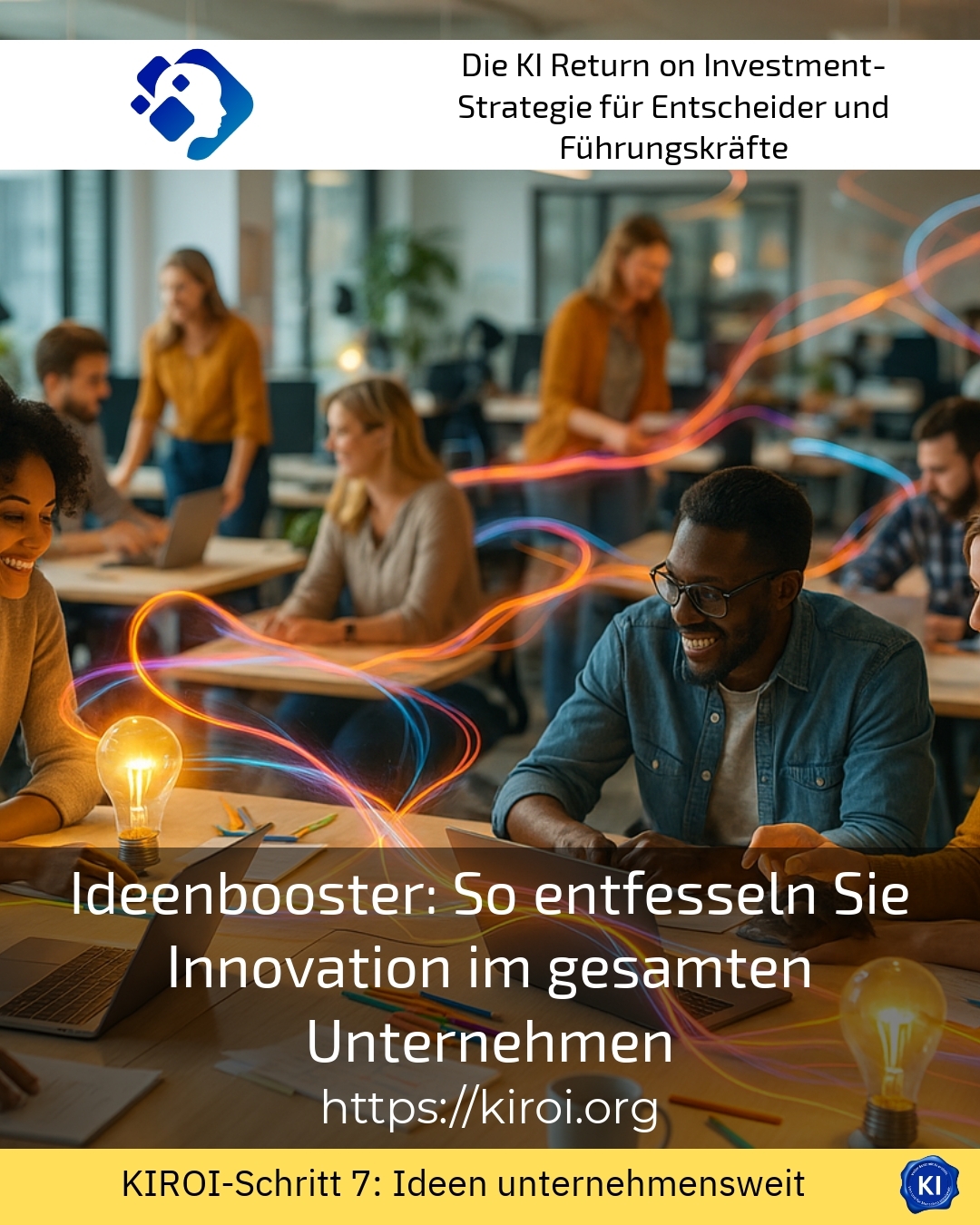
Imagine your employees practically brimming with creative ideas, and every department actively contributing to the advancement of your company. Does that sound like a utopia? Not at all, because with the right Idea-booster transform dormant potential into genuine competitive advantages. The challenge lies in creating structures that don't stifle creativity, but systematically foster it. This is precisely where a well-thought-out innovation culture comes into play, going far beyond occasional brainstorming sessions. In this post, you'll learn how organisations of all kinds unleash their innovative power.
Why the right idea generator makes all the difference
Innovation rarely emerges in a vacuum. It needs fertile ground, incentives, and above all, people who dare to think outside the box. Many companies underestimate how important psychological safety is for creative processes. Employees must know that their suggestions are welcome. Only then will they dare to forge unconventional paths. At the same time, they need clear channels to submit their ideas.
For example, a medium-sized manufacturing company introduced digital suggestion boxes. The response exceeded all expectations. Within a few months, hundreds of suggestions for improvement were received. A logistics service provider established weekly innovation meetings for all teams. Solutions to problems that management had never recognised emerged there. A retail company used gamified platforms for idea collection. The playful elements increased participation many times over.
These examples show that the Idea-booster can take on diverse forms. The fundamental attitude of the leadership remains crucial. Those who want innovation must grant freedom. At the same time, binding structures are needed for implementation.
How an idea booster unleashes innovation throughout the company
The key lies in the systematic integration of creative processes. Individual workshops are not enough to initiate lasting changes. Rather, it is about establishing innovation as an integral part of the company culture. This first requires a clear commitment from management. Furthermore, employees need specific time slots for creative work. Without dedicated resources, even the best approaches will fizzle out.
For example, a financial services provider set aside ten percent of working hours for innovation projects. This investment quickly paid off. New product ideas emerged, putting them one step ahead of the competition. A software company established cross-departmental innovation teams. These brought together different perspectives and achieved astonishing results. A car parts supplier launched an internal start-up program. Employees were able to develop and pitch their own business ideas.
Best practice with a KIROI customer
An internationally operating mechanical engineering company faced the challenge of fundamentally transforming its innovation culture, as previous approaches had yielded little fruit and competitors were increasingly catching up. As part of a transruption coaching process, we first analysed the existing structures and identified numerous blockades that hindered creative processes. Together, we developed a multi-stage concept that linked different hierarchical levels and gave all employees a voice. The introduction of so-called innovation sponsorships, in which managers specifically supported promising ideas and their implementation, proved particularly effective. Within a year, the number of submitted suggestions for improvement increased by more than three hundred percent, and several concepts led to marketable products. Employee satisfaction also improved significantly because people finally felt heard and valued. The company today reports a completely changed atmosphere in which lateral thinking is explicitly encouraged. This project impressively demonstrates how professional support enables sustainable change.
Establishing methods and tools as idea boosters
Besides cultural aspects, concrete methods play an important role. Design Thinking has proven effective on many occasions for placing user needs at the centre. The method promotes empathetic understanding and iterative development. Lean Startup approaches enable rapid testing of hypotheses, allowing failures to be identified early and resources to be conserved. Open Innovation breaks down boundaries and involves external partners.
A pharmaceutical company used Design Thinking to develop more patient-friendly packaging. The result positively surprised all involved. An energy provider relied on Lean Startup to test new business models. Rapid prototypes provided valuable insights into customer needs. A consumer goods manufacturer collaborated with startups as part of Open Innovation [1]. Fresh external impulses significantly revitalised internal development processes.
The choice of the right method depends on various factors. Company culture, industry, and objectives play a role in this. It is important that the chosen approaches are applied consistently. Half-hearted attempts rarely lead to the desired success.
The idea booster needs the right framework.
Even the best innovation method will fail without the right conditions. Managers bear a particular responsibility in this regard. They must lead by example and demonstrate an openness to new ideas themselves. At the same time, it is important to actively embody tolerance for mistakes. Punishing employees for failed experiments stifles all creativity from the outset. Innovation requires courage, and courage requires security.
A telecommunications company introduced 'Failure Fridays'. Teams would share their failed projects and the lessons learned from them. An insurance company established an innovation prize for the boldest ideas. Success wasn't the only criterion; the learning effect was also taken into account. A technology group set up protected experimentation spaces [2]. Here, teams could test new concepts without pressure.
These examples illustrate how important the design of the environment is. Innovation cannot be ordered, but it can be enabled. The task of leaders is to remove obstacles. At the same time, they should provide resources and make successes visible.
Using digital tools as an idea booster
Digitalisation offers numerous opportunities for fostering innovation. Collaboration platforms facilitate the cross-site exchange of ideas. Artificial intelligence can support the analysis and evaluation of proposals. Crowdsourcing tools enable the involvement of large groups of employees. Virtual whiteboards promote creative collaboration, even across distances.
A construction company implemented a digital innovation platform for all construction sites. Craftsmen on-site could submit suggestions for improvement directly. A hotel chain used AI-powered analysis to evaluate guest feedback, which led to the creation of innovative service offerings that increased satisfaction. A media company used Virtual Reality for creative workshops. The immersive environment fostered unusual approaches to thinking.
However, digital tools are not an end in themselves. They only unfold their effect in combination with the right culture. Technology alone does not create innovation. It can merely support and accelerate processes.
Best practice with a KIROI customer
A family-run business with a long tradition in the food industry approached us because their innovation pipeline had stagnated for years and the pressure from competitors was becoming increasingly noticeable. Management recognised that the existing structures were hindering rather than fostering creative impulses, as hierarchies were pronounced and decision-making processes were lengthy. As part of our support, we jointly developed a hybrid concept that combined analogue methods with digital tools and appealed to all generations within the company. Older employees, in particular, contributed valuable experience, while younger colleagues contributed technical expertise. This intergenerational collaboration proved to be extremely fruitful and led to several marketable product innovations. The company reports a significantly improved communication culture and an increased sense of belonging. Employees at all levels now feel encouraged to contribute their ideas and actively participate in the company's development. This example shows how transruption coaching can initiate sustainable changes, even in traditional structures.
Activate your ideas booster with professional support
The path to an innovative organisation is rarely straightforward. Resistance, setbacks and uncertainties are all part of it. This is precisely where professional guidance can provide valuable impetus. External perspectives help to identify blind spots. Experienced coaches support the design of suitable structures. They accompany change processes and strengthen leaders in their new role.
Clients frequently report similar challenges. Innovative ideas get lost in the hierarchy. Employees feel unheard. Leaders don't know how to foster creativity. Existing processes leave no room for experimentation. Departments work in isolation rather than interconnectedly.
Companies come to us with these topics. We position transruption coaching as support for projects involving innovation culture and creativity promotion. This isn't about ready-made solutions. Rather, we support them in finding their own approaches and anchoring them sustainably.
My KIROI Analysis
The examination of innovation promotion reveals a multi-layered picture that extends far beyond individual methods or tools. Successful companies are characterised by their understanding of creativity as a strategic success factor and their corresponding investment. Cultural aspects play at least as important a role as structural frameworks. The examples from various industries illustrate that there is no one-size-fits-all solution, but rather that individual solutions are required. Approaches that involve different hierarchical levels and ensure psychological safety prove to be particularly effective. Managers play a key role in this, as their behaviour significantly shapes the innovation culture. Digital tools can provide support but can never replace the human factor. The greatest successes are achieved where technological possibilities meet an open corporate culture. Professional guidance can accelerate this process and help to avoid typical pitfalls. Ultimately, it is about unlocking the existing potential that lies dormant in every company. Employees have ideas; they just need the opportunity to contribute them. Those who recognise this and consistently implement it gain sustainable competitive advantages in a constantly changing business world.
Further links from the text above:
[1] Harvard Business Review: Innovation
[2] McKinsey: The Eight Essentials of Innovation
[3] Forbes: Innovation
For more information and if you have any questions, please contact Contact us or read more blog posts on the topic Artificial intelligence here.











 Deutsch
  English (UK)