
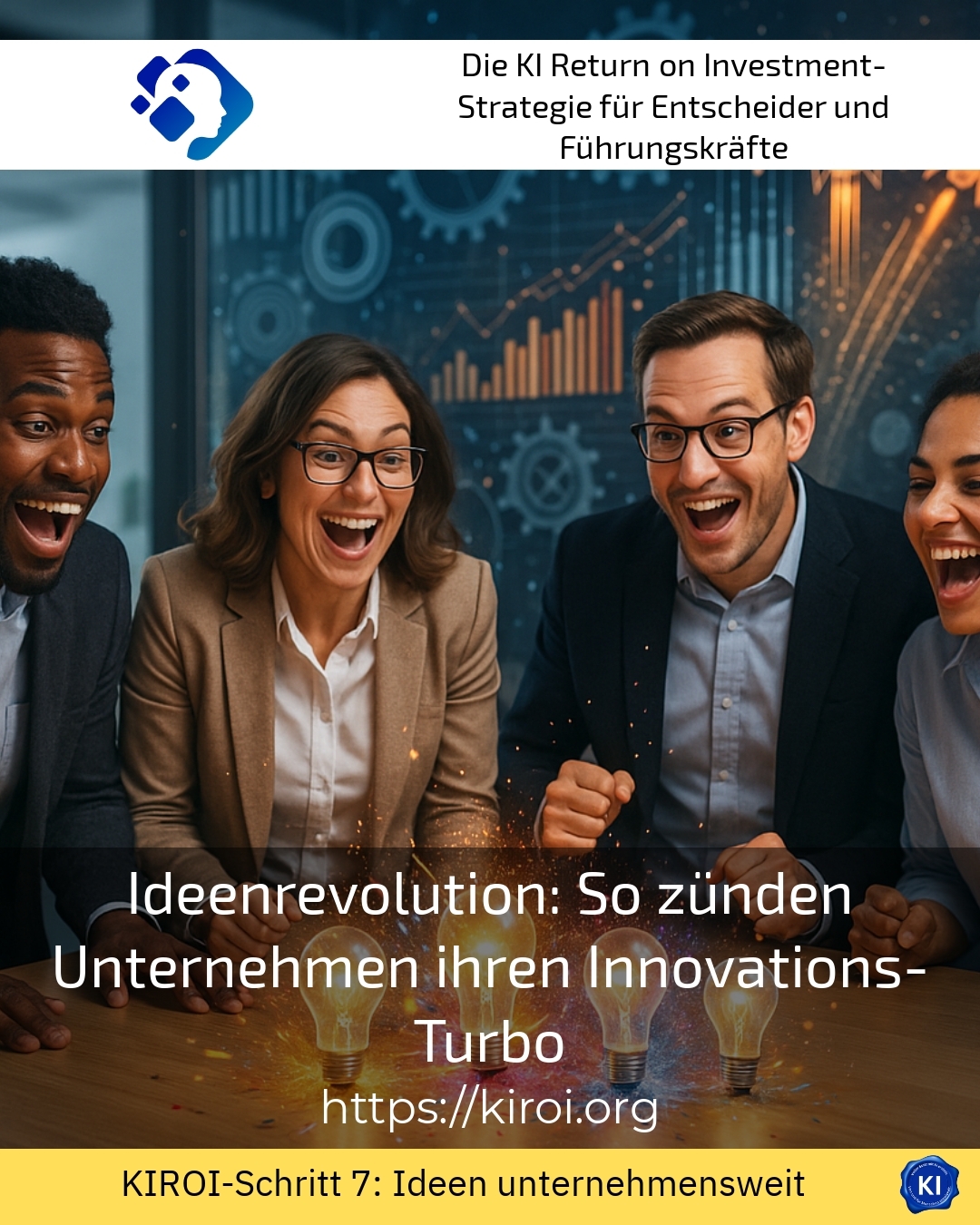
Imagine your company could develop entirely new business models within a few months, leaving your competitors in the dust. The Idea revolution is no longer an abstract vision, but a lived reality in progressive organisations. But how can the creative spark be systematically ignited and transformed into measurable results? In this post, you will learn which strategies successful companies use to ignite their innovation turbo.
Understanding the Fundamentals of the Ideas Revolution
Creative breakthroughs rarely happen by chance. Instead, they require a well-thought-out system and a supportive company culture. Many leaders underestimate the importance of psychological safety for their teams. Employees must feel confident enough to contribute even unconventional suggestions. This atmosphere of trust forms the foundation of any sustainable change.
For example, a leading automotive supplier from southern Germany has set up internal innovation labs where employees are allowed to experiment completely freely. The results surprised even sceptical managers across the board. A logistics company from Hamburg, in turn, introduced weekly creative sessions where hierarchies are deliberately abolished. Furthermore, a medium-sized mechanical engineering company from Baden-Württemberg implemented a digital idea management system, which now generates over three thousand suggestions per year.
Scientific research impressively confirms these observations [1]. Companies with established creative processes often achieve significantly higher growth rates than their conventional competitors. It is particularly noteworthy that not only large corporations can benefit from these approaches. Small and medium-sized enterprises also report positive effects on their competitiveness.
Strategic approaches for the innovation turbo
The successful implementation of creative impulses requires more than just goodwill from company management. It demands concrete structures and clear processes that channel and simultaneously foster creativity. Various methods that have proven effective in practice play a crucial role in this.
Design Thinking has established itself as a particularly effective approach because it consistently puts people at the centre. A pharmaceutical company from the Rhineland is now successfully using this method in almost all of its development processes. A financial service provider from Frankfurt, in turn, combines Design Thinking with agile working methods and is achieving remarkable results. Furthermore, an energy provider from North Rhine-Westphalia has been able to reduce its product development times by a third through this approach.
Best practice with a AIROI customer
An internationally operating trading company faced the challenge of fundamentally modernising its internal processes. Management recognised that traditional consulting approaches would not deliver the desired results. Therefore, they decided to engage transruption coaching to tackle the transformation holistically. In several workshops, participants initially identified the biggest innovation blockages within the company. It became apparent that the middle management level, in particular, was unconsciously slowing down change. Through targeted coaching impulses, it was possible to constructively resolve these resistances and transform them into positive energy. Within six months, employees developed over two hundred concrete improvement suggestions. More than seventy of these ideas have already been successfully implemented and are now contributing to value creation. The company reports a significantly increased willingness to innovate at all hierarchical levels. Particularly noteworthy is the fact that former critics are now among the most active supporters of the change.
The Role of Digital Tools in the Idea Revolution
Modern technologies can significantly accelerate creative processes and support them in diverse ways. For example, artificial intelligence analyses large amounts of data and identifies patterns that humans might overlook. Collaboration platforms enable cross-location teamwork in real-time, thereby fostering the exchange of ideas.
A technology company from Munich is already using intelligent algorithms to identify customer trends early on. These insights flow directly into the development process, significantly shortening time-to-market. Meanwhile, a consumer goods manufacturer from Düsseldorf is using virtual brainstorming rooms where teams from different countries can work together. Additionally, an insurance group from Cologne has developed its own innovation app, through which employees can submit ideas at any time.
However, integrating these tools requires sensitive change management and a clear communication strategy [2]. Technology alone does not solve problems; it must be used meaningfully by people. Therefore, many companies accompany the introduction of new tools with comprehensive training programmes and individual coaching.
Cultural change as the foundation of sustainable creativity
The most profound change doesn't occur in processes, but in people's minds. A corporate culture that views mistakes as learning opportunities fosters brave experimentation and unconventional thinking. Leaders play a crucial role model function for their entire organisation in this regard.
A chemical company from Ludwigshafen has completely redesigned its failure culture and now even celebrates failed projects publicly. These so-called "Failure Parties" create transparency and alleviate employees' fear of failure. A media company from Berlin, on the other hand, has radically dismantled hierarchies and consistently relies on self-organising teams. In addition, a retailer from Bremen practices regular reverse mentoring programmes in which young employees coach experienced managers.
Clients often report that cultural changes initially meet with significant resistance and require patience. Transruptions coaching can provide valuable impetus in such situations and guide the transformation. The external perspective helps to identify blind spots and develop approaches to solutions.
Practical methods for promoting creative processes
As well as the broad strategic lines, numerous concrete techniques exist that can boost creative output. These methods can often be implemented with a manageable amount of effort and quickly show initial results.
Edward de Bono's Six Thinking Hats method helps teams look at problems from different perspectives. A construction company from Stuttgart is now successfully using this technique in all project meetings. Morphological analysis, in turn, helps a textile manufacturer from Saxony to systematically develop new product variations. Furthermore, a software company from Hamburg uses the SCAMPER technique to creatively further develop existing products [3].
Best practice with a AIROI customer
A medium-sized manufacturing company from the Black Forest wanted to fundamentally strengthen and sustainably improve its innovation capability. Management realised that traditional improvement processes were no longer sufficient to remain competitive. Together with AIROI, the company developed a comprehensive creativity program for all departments and hierarchical levels. In the first step, those involved analysed the existing innovation barriers and documented them systematically. It became apparent that a lack of communication between departments, in particular, was hindering the flow of ideas. This situation changed fundamentally within a few months through the introduction of cross-functional project teams and regular innovation workshops. Employees were also given the freedom to pursue their own projects and try out new approaches. The result significantly exceeded all expectations of the initially sceptical management level. Within a year, the company filed several patents and developed two completely new product lines. The corporate culture has changed sustainably, and creativity has now become an integral part of everyday work.
Measuring and evaluating the success of creative initiatives
Evaluating creativity programmes presents many companies with significant challenges and requires new ways of thinking. Classic metrics often fall short because they cannot adequately reflect the qualitative aspects. Nevertheless, systematic success monitoring is indispensable in order to justify investments and further develop programmes.
A telecommunications company from Bonn has developed a differentiated key performance indicator system that combines quantitative and qualitative indicators. A healthcare group from Munich regularly measures employee satisfaction and the innovation climate, in addition to hard factors. Furthermore, a car manufacturer from Ingolstadt relies on regular innovation audits by external experts with international experience.
The Idea revolution often shows its effects with a time delay and therefore requires patience. Short-term successes can be deceptive and should not be overestimated. A long-term perspective and continuous adaptation of measures are therefore essential for sustainable success.
Challenges and typical stumbling blocks in the idea revolution
Despite the best of intentions, many innovation initiatives founder on predictable obstacles and avoidable mistakes. Understanding these stumbling blocks helps companies navigate around them and develop more successful strategies.
A common problem is the lack of support from senior management beyond the project's initial phase. For instance, an electronics manufacturer from Dresden experienced their innovation initiative faltering after a change in leadership. A food producer from Lower Saxony, on the other hand, initially struggled with unrealistic deadlines for implementing new ideas. Furthermore, a fashion company from Düsseldorf grappled with resource conflicts between day-to-day operations and innovation projects.
transruptions-Coaching supports companies in recognising and proactively addressing such hurdles early on. External guidance creates space for honest reflection and constructive criticism without internal company taboos. Many organisations value this neutral perspective as a valuable contribution to their development.
My AIROI Analysis
The systematic promotion of creativity and innovation represents one of the most important strategic tasks for companies in the coming years. From my experience in numerous consulting projects, I can confirm that Idea revolution is not a short-term trend, but a fundamental necessity for long-term success. Companies that invest in their innovation capabilities now will create significant competitive advantages for the future.
What seems particularly important to me here is the realisation that technological solutions alone are not enough. People remain at the centre of every successful transformation and must be involved accordingly. Cultural change takes time and patience, but it is essential for sustainable results and genuine behavioural change.
The examples presented impressively show that companies of all sizes and sectors can benefit from systematic promotion of creativity. The AIROI methodology offers a structured framework that can be individually adapted. However, the will to change at all levels of the organisation is crucial.
I recommend that companies start with small, manageable pilot projects to gain experience. These learning experiences form the basis for larger initiatives and reduce the risk of expensive failures. Transruptions coaching can effectively support this process and provide valuable impetus for further development.
Further links from the text above:
[1] Harvard Business Review – Innovation Research
[2] McKinsey – Innovation Insights
[3] Design Council – The Double Diamond Framework
For more information and if you have any questions, please contact Contact us or read more blog posts on the topic Artificial intelligence here.







 Deutsch
  English (UK)