
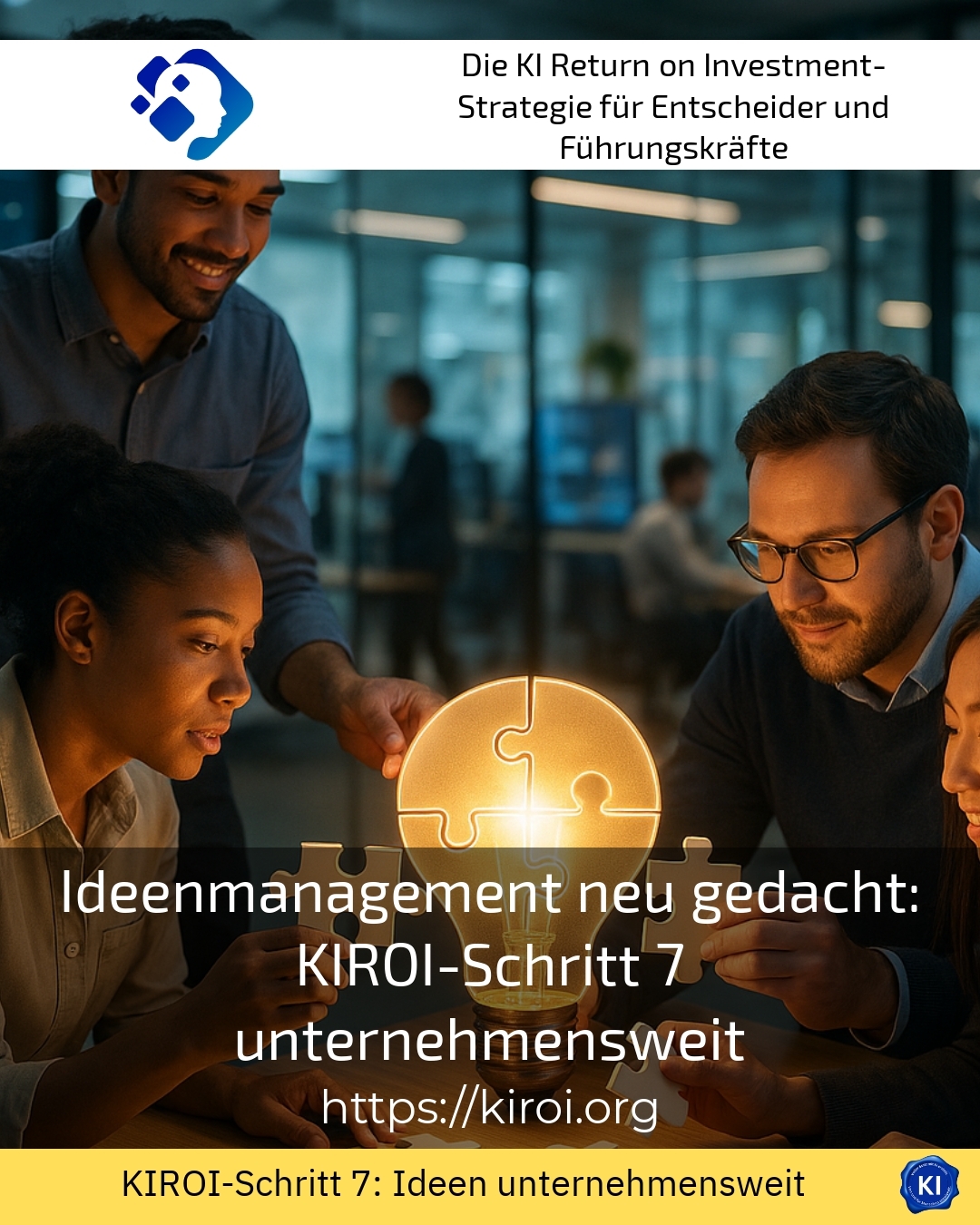
Creativity is a crucial competitive advantage in modern businesses. But how can the full potential of all employees be systematically harnessed? Modern idea management offers an answer here. It goes far beyond the mere collection of suggestions. Rather, it is a holistic accompanying process that structurally captures, evaluates, and implements creative impulses into sustainable change. In particular, the KIROI step 7 is revolutionising how companies think about and implement idea management throughout the organisation. This approach creates the foundation for a vibrant innovation culture that involves all levels and delivers measurable results.
Ideas management today means more than just collecting.
Many organisations report a widespread problem. Ideas are submitted, but then often nothing more happens. Clients frequently report that suggestions are overlooked or receive no feedback. This significantly demotivates teams. A manufacturing plant found that 70 percent of submitted ideas were never processed. The consequence was declining employee motivation and missed opportunities.[6]
Idea management in the modern sense therefore means much more. It is a dynamic process that offers continuous support. The focus shifts from a piecemeal suggestion system to a holistic strategy. All employees are actively involved. Their creativity is systematically fostered and channelled.[1][3]
Transparency is essential in this regard. A logistics company re-introduced an ideas management system. Employees were given complete insight into the status of every idea. The result: participation increased by 45 percent within six months.[4]
KIROI Step 7: Unleashing company-wide idea management
KIROI Step 7 takes idea management to a whole new level. It ensures company-wide scaling and sustainable support for ideas. Instead of being considered in isolation, ideas go through all phases transparently.[1][2]
What makes this step so special? It combines structured processes with targeted coaching. Obstacles in communication or implementation are identified early on. This allows them to be systematically removed. A software company used Step 7 for optimisation. Development cycles were shortened by 30 percent.[1]
BEST PRACTICE with one customer (name hidden due to NDA contract) By implementing KIROI Step 7 in a medium-sized manufacturing company, cross-departmental obstacles were identified and dismantled. This led to faster product development and significantly boosted employee motivation. The company benefited from targeted support that went far beyond simply collecting ideas, promoting consistent implementation. Within eight months, 35 ideas were successfully implemented, resulting in cost savings of approximately €120,000.
How the KIROI Step 7 Idea Management Works in Practice
The process begins with systematic collection. Ideas come from everywhere. Employees, customers, and partners submit their suggestions. Modern digital platforms centralise this collection.[2]
The next step is the objective evaluation. An interdisciplinary team evaluates according to clear criteria. Methods such as scoring models or SWOT analyses help here. A marketing company used a standardised evaluation framework. The consistency of decisions increased significantly.[4]
The best ideas are prioritised and implemented. Clear accountability is essential for this. Each initiative has a designated point of contact. Regular workshops ensure continuous support. A retail company established weekly coordination meetings. This led to a 50 percent reduction in implementation delays.
Cross-functional collaboration as a success factor
A special feature of modern idea management is active networking. Different departments work together. This creates collaborations that would otherwise not be possible.
IT departments cooperate with marketing and customer service. In the area of software development, this allows for rapid adjustments. New features come directly from the teams. One technology company saw innovation cycles decrease by 40 percent.
Logistics companies are reporting significant savings. Transport routes are being jointly analysed and optimised. A large logistics provider is saving around €15,000 per month in fuel costs. In field service, visit intervals are being made more efficient based on employee suggestions. Travel times are being reduced. Customer satisfaction is increasing.[1]
Digital tools as a driver for idea management
Modern idea management software is indispensable today. It allows for the central capture of all suggestions. Transparent tracking becomes possible. Objective evaluation follows clear criteria.
Established tools offer commenting and annotation options. Iterative idea development follows innovation phases. Collaborative workspaces emerge. A financial company implemented such software. The idea rate increased from 8 to 32 suggestions per 100 employees annually.[5]
AI-powered systems also help with scaling. They enable automated processes. Suggestions are prioritised. Structured follow-ups are carried out systematically. This way, ideas do not lose importance but are processed efficiently.
BEST PRACTICE with one customer (name hidden due to NDA contract) In the field of industrial manufacturing, Step 7 was used with digital support to systematically identify implementation barriers for promising ideas. Moderated workshops helped to overcome these barriers. This resulted in accelerated implementation of innovation projects and more intensive exchange between specialist departments, which sustainably strengthened innovation capacity. The digital platform enabled real-time tracking of all initiatives, increasing the implementation rate from 15 to 62 percent.
Practical tips for successful implementation
To effectively integrate idea management in line with KIROI Step 7, specific actions are required. First, digital tools should be introduced. These connect idea management and communication. Transparency is created.[1]
Moderated workshops with neutral facilitation are essential. They open up new perspectives. Blocked issues are resolved. One chemical company conducted quarterly workshops. Employee satisfaction increased by 35 percent.[1]
Regular knowledge sharing between teams is central. Ideas grow across departments. An insurance company established monthly cross-functional meetings. The rate of implemented ideas doubled.[3]
A clear division of roles ensures responsibilities. The evaluation and implementation of ideas require defined areas of responsibility. A media company assigned an "idea patron" to each initiative. The success rate of implementation improved by 45 percent.[4]
An open dialogue is fundamental. Ideas should be shareable without judgement. Psychological safety must arise. A design studio created regular idea exchanges without pressure to evaluate them. Participation rose from 20 to 78 percent of employees. [5]
Typical challenges in idea management
Communication barriers between specialist departments are common. They slow down the flow of innovation. A technology company found that many ideas failed due to a lack of resource planning. The introduction of a clear prioritisation framework helped. The implementation rate increased significantly.[6]
Lack of accountability leads to delays. Nobody feels responsible. An industrial company realised that barriers between departments were slowing down progress. Appointing responsible individuals solved the problem. A pharmaceutical group took seven weeks to implement ideas. After optimisation: two weeks.
Lack of feedback is demotivating for idea generators. They feel ignored. A continuous feedback system needs to be established. An energy company implemented automated status updates. The remobilisation of the teams was measurable.[5]
BEST PRACTICE with one customer (name hidden due to NDA contract) The customer strategically employed step 7 to foster communication between production, logistics, and quality assurance. Through regular workshops, ideas were jointly evaluated and challenges were resolved early on. This led to a noticeable increase in innovative capacity and faster implementation of improvements, which positively impacted competitiveness. The company documented an improvement in implementation time from an average of 8 months to 12 weeks.
The role of corporate culture in successful idea management
Ideas management requires the right corporate culture. Without it, all measures will only be partially effective. An open, appreciative culture is necessary.
Employees must feel that their ideas are heard. Leaders should actively encourage innovation. A mechanical engineering company implemented an idea reward system. Every implemented idea was recognised. Participation rose to 85 percent of the workforce.[3]
Psychological safety is central. Employees can fail without fear of consequences. A software company established an experiment budget. Teams could test ideas. Some failed. That was expressly permitted. The company's innovative strength doubled.[1]
Continuous learning must be encouraged. Knowledge from ideas should be shared. A consulting firm created internal knowledge databases. Best practices were documented. New employees benefited immediately.[4]
Measurable success factors and KPIs
Idea management must be measurable. Concrete key figures help to assess success. The rate of submitted ideas is an initial indicator. A corporation had 5 ideas per 100 employees. After implementing KIROI Step 7: 28 ideas per 100 employees.[2]
The implementation rate shows effectiveness. How many ideas are actually realised? A retail company increased this from 12 to 67 percent.[3]
The time from idea to implementation is critical. A car parts supplier reduced this from an average of 18 months to 5 months.[4]
The financial impact should be documented. An industrial company achieved annual savings of 2.5 million euros through implemented ideas. The ROI of idea management was approximately 8:1.
Employee satisfaction increases when ideas are implemented. Engagement and retention improve. A financial institution saw its staff turnover rate decrease. By 12 percent in the first year.[6]
Ideas management across various industries
Manufacturing companies are benefiting enormously. A mechanical engineering firm used idea management for process optimisation. Manufacturing costs fell by 8 percent. Another manufacturer increased product reliability by 15 percent through employee improvements.[1]
Innovations in the service sector often arise from direct customer contact. A telecommunications company collected ideas from customer service employees, which led to seven new services and a 3 percent increase in revenue.[4]
In retail, idea management improves the customer experience. A wholesaler implemented suggestions from cashiers. This led to faster checkouts and better reviews. Online reviews rose from 3.2 to 4.6 stars.[3]











 Deutsch
  English (UK)